Mixed-metal kitchen accents work best when brass, stainless steel, and black are not asked to do the same job. Brass can supply warmth at pendants, faucets, pulls, and lighting details; stainless steel naturally serves the appliance and work-zone layer; and black hardware can add graphic definition at cabinetry, seating, rails, and task fixtures. The key is to repeat each finish with purpose while giving it a consistent place in the room—by height, cabinet color, function, or zone. These kitchens show how a few well-placed accents can make three metals feel cohesive across layouts ranging from compact nooks to open kitchens.
1. Anchor a Bright Kitchen With Black at Working Height
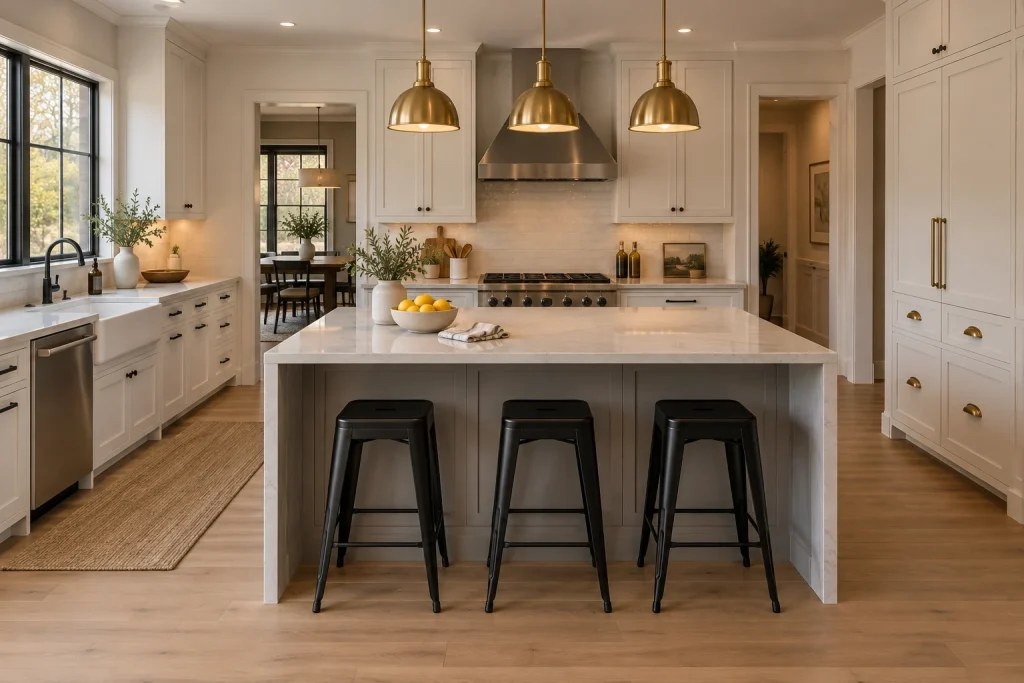
This mixed-metal kitchen accents scheme gives each finish a distinct job. Three brass dome pendants establish the warm, decorative note overhead, while the stainless-steel range hood, range, and dishwasher bring a cooler utility finish across the perimeter. Matte-black pulls repeat on the white cabinets and gray island, then reappear in the three black stools. That repetition matters: it makes the black hardware feel like a deliberate grounding element rather than a competing third finish. On the tall cabinet bank at right, long brass pulls and smaller brass cup pulls create a focused brass moment without spreading the warm metal across every cabinet. The pale countertops, white tile backsplash, and light wood floor leave enough visual quiet for the finishes to read separately.
Why it works: The room assigns brass to focal points, stainless steel to appliances, and black to the most frequently repeated furniture and cabinet details.
- Three brass dome pendants
- Stainless-steel hood, range, and dishwasher
- Matte-black cabinet pulls
- Black counter stools
- Brass pulls and cup pulls on the tall cabinet bank
Design tip: Repeat black in seating or lighting before adding it to every cabinet.
2. Let Stainless Steel Become the Reflective Backdrop
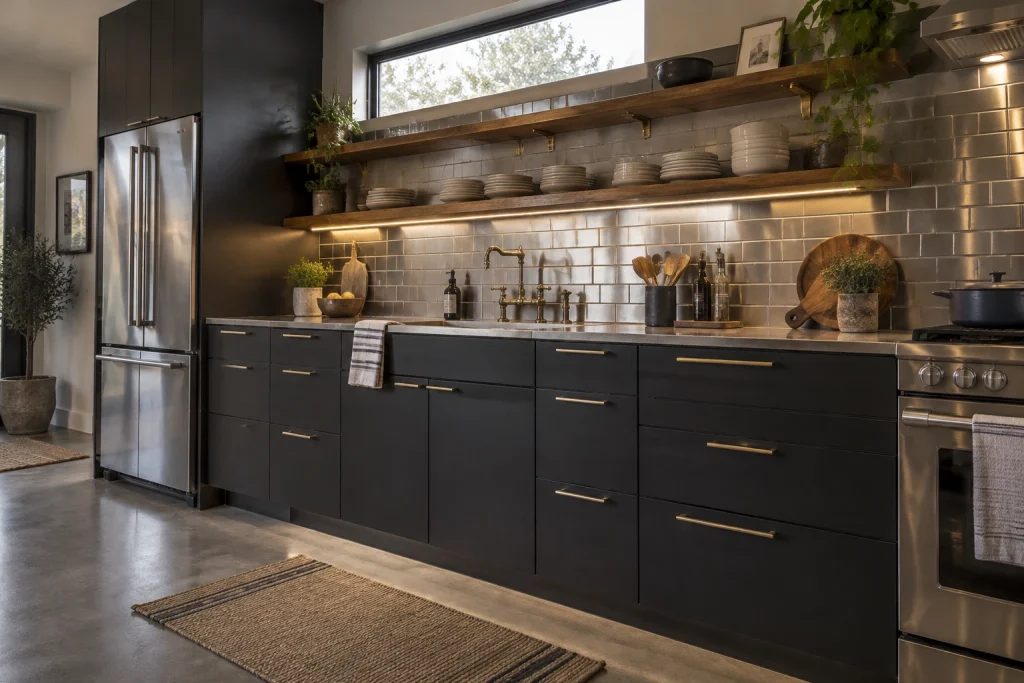
Here, brushed stainless-steel tile runs across the wall behind a long stretch of nearly black cabinetry, turning a functional backsplash into the room’s brightest surface. Its horizontal grout lines echo the long, slim brass-toned pulls below, while a stainless refrigerator and range reinforce the cooler metal at both ends of the composition. Brass appears in smaller, warmer increments: the bridge faucet, shelf brackets, and cabinet pulls. The open wood shelves add a needed matte, organic layer between the steel and black finishes, and their brackets make the brass visible against the tile rather than lost in the cabinetry. A dark pot, black bowl, and charcoal planters further connect the lower cabinets to the upper display without making the wall feel visually flat.
Why it works: Stainless steel supplies scale and light reflection, while the brass is reserved for fine linear details that are easy to spot against black and silver surfaces.
- Stainless-steel tile backsplash
- Dark flat-front lower cabinets
- Slim brass-toned pulls
- Brass bridge faucet and shelf brackets
- Wood open shelves
Design tip: Use the warm metal on narrow details when a large stainless surface already dominates the wall.
3. Use Black Pulls to Bring Order to a Compact Galley
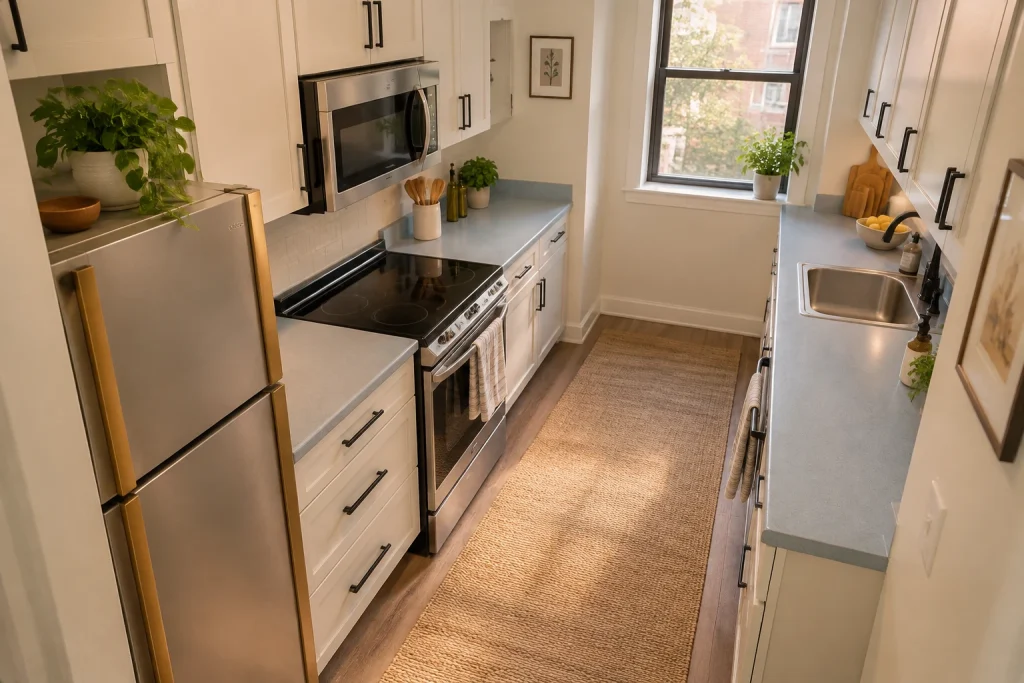
A narrow galley benefits from a controlled approach to mixed metals, and this kitchen keeps the contrast crisp. Black bar pulls run consistently across the warm white cabinet doors and drawers on both sides, creating a strong visual rhythm down the corridor. Stainless-steel appliances—the refrigerator, microwave, and range—form the practical metal layer at the left, while brass-toned trim on the refrigerator introduces warmth in a concentrated vertical band. The pale blue-gray counters soften the meeting of white cabinets, black hardware, and steel appliance fronts. A black faucet and a black range surface repeat the pull color at counter level, so the finish mix reads as connected rather than scattered. The unobstructed center aisle and long runner keep the small space visually direct.
Why it works: Black is repeated most often, stainless is limited to appliances, and brass-toned detail is concentrated on one appliance face instead of competing across the galley.
- Consistent black bar pulls
- Stainless refrigerator, microwave, and range
- Brass-toned refrigerator trim
- Pale blue-gray countertops
- Black faucet and cooktop surface
Design tip: In a small kitchen, confine the warm metal to one clear zone instead of distributing it along both cabinet runs.
4. Balance Farmhouse Warmth With a Dark Counterline
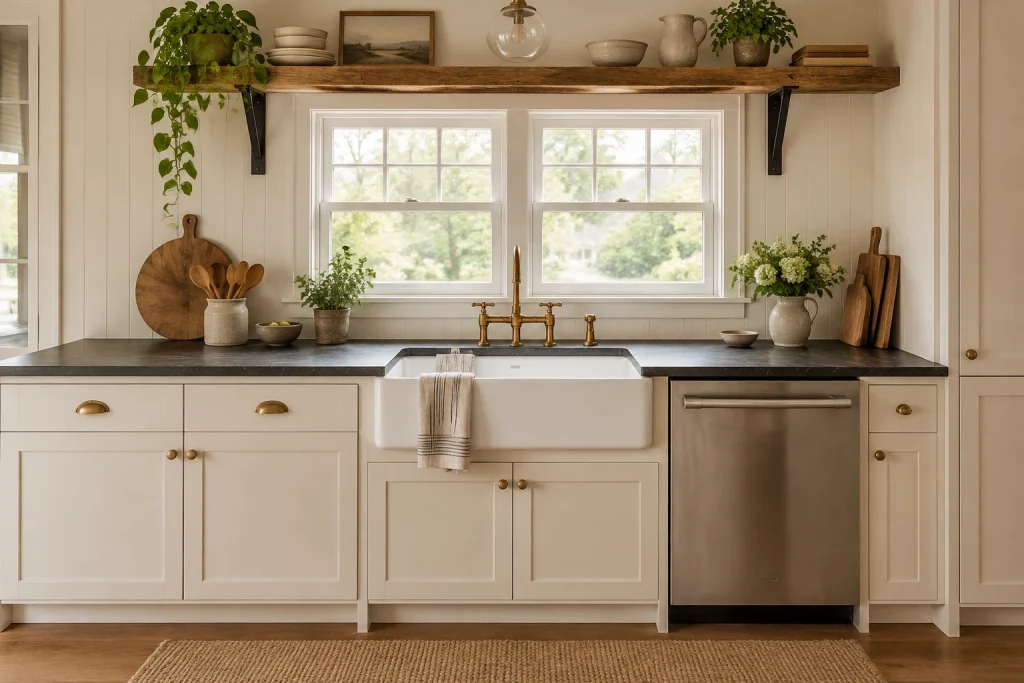
This sink wall layers its metals vertically and with restraint. An aged-brass bridge faucet sits at the center of the white apron-front sink, with matching brass-toned cup pulls and round knobs distributed across the cream cabinetry. Above, a substantial wood shelf rests on black iron brackets, giving the darkest finish a defined upper position. Below the windows, the nearly black countertop creates a strong horizontal band that links the black brackets to the lower half of the room. A stainless-steel dishwasher adds a cooler, reflective surface beside the sink without interrupting the warm palette; its handle is the only long silver line in view. The white window trim and sink provide a clean pause between the dark counter, warm wood, and varied metals.
Why it works: The black elements are concentrated in the shelf support and countertop, brass centers the sink, and stainless steel remains a single practical accent beside it.
- Brass bridge faucet
- White apron-front sink
- Black iron shelf brackets
- Dark countertop
- Stainless-steel dishwasher
Design tip: Center the warmest metal at the sink, then limit stainless steel to nearby appliances.
1. Let Marble Create the Common Ground
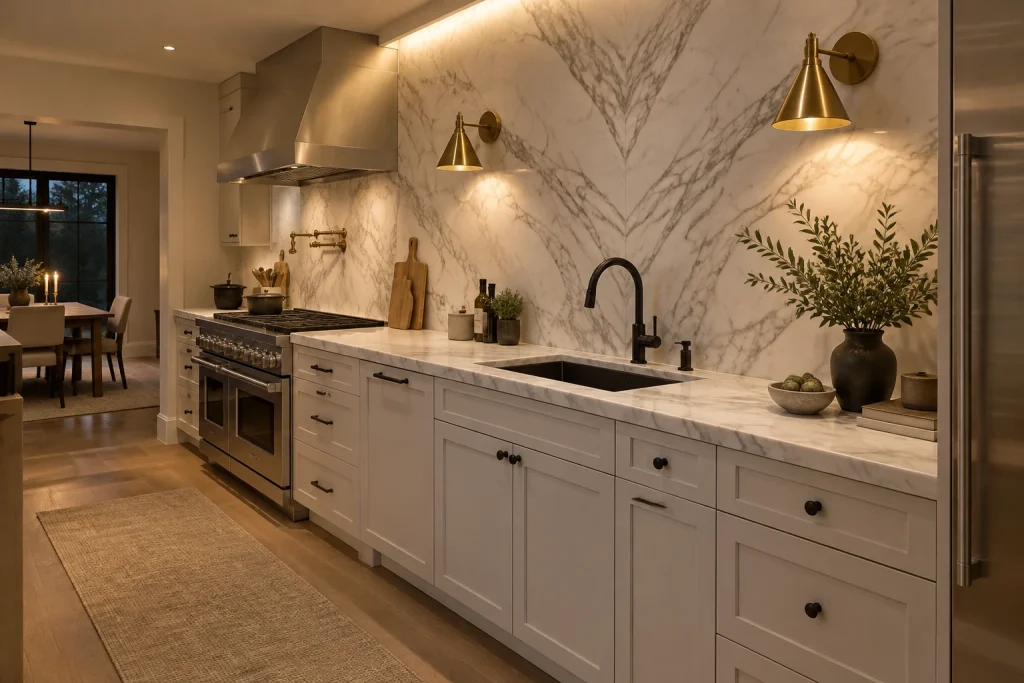
In this mixed-metal kitchen accents scheme, the sweeping white marble counter and backsplash act as the visual bridge between finishes. Brass appears in the articulated pot filler and the pair of conical wall sconces, where its warm glow picks up the marble’s creamier tones. Stainless steel takes the harder-working edge through the large range, hood, and refrigerator. At the sink, a tall matte-black faucet, matching soap dispenser, dark sink basin, and black cabinet hardware introduce a crisp counterpoint. The success is in the hierarchy: marble dominates, steel handles the appliances, brass is reserved for elevated focal points, and black is concentrated at the sink and on the cabinetry.
Why it works: A large neutral stone surface gives three distinct metal finishes a shared backdrop, while each finish has a clearly defined role instead of competing for attention.
- Full-height white marble with gray veining
- Polished brass pot filler
- Brass wall sconces
- Stainless steel range, hood, and refrigerator
- Matte-black faucet, sink, and cabinet hardware
Design tip: Choose one broad neutral surface, such as marble or quartz, before introducing three metal finishes.
2. Use a Small Nook to Make the Mix Legible
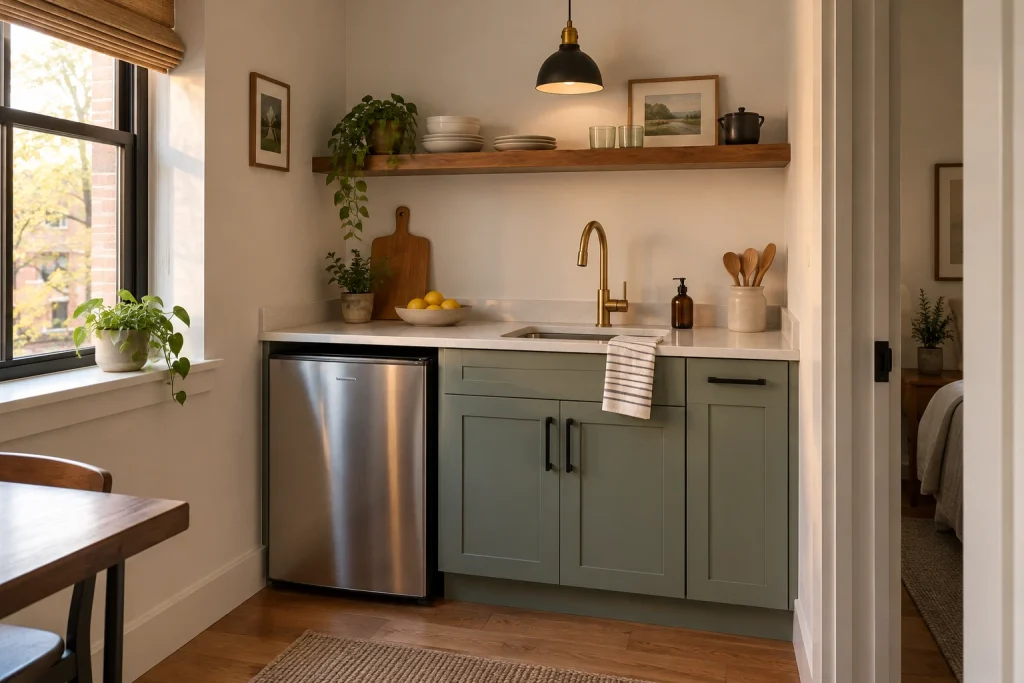
This compact kitchenette shows how few pieces are needed to establish a mixed-metal story. A brass-toned gooseneck faucet is the warm focal point against muted sage cabinet fronts and a pale countertop. Long black pulls give the lower cabinets a clean, graphic outline, echoed by the black shade of the pendant above. The pendant’s brass top repeats the faucet finish without requiring more brass across the room. Stainless steel on the undercounter refrigerator adds a cooler, reflective surface at the left, while the warm wood shelf and wood cutting boards soften the contrast. With one open shelf, the materials remain easy to read rather than getting lost in a crowded display.
Why it works: The metal mix is repeated in small, deliberate pairs: brass at the faucet and pendant, black at the pulls and pendant shade, and steel at the refrigerator.
- Muted sage lower cabinets
- Brass-toned gooseneck faucet
- Black bar pulls
- Black-and-brass pendant
- Stainless steel undercounter refrigerator
Design tip: In a compact kitchen, repeat each metal finish at least once and limit open shelving to one edited display.
3. Keep the Base Warm and the Contrast Precise
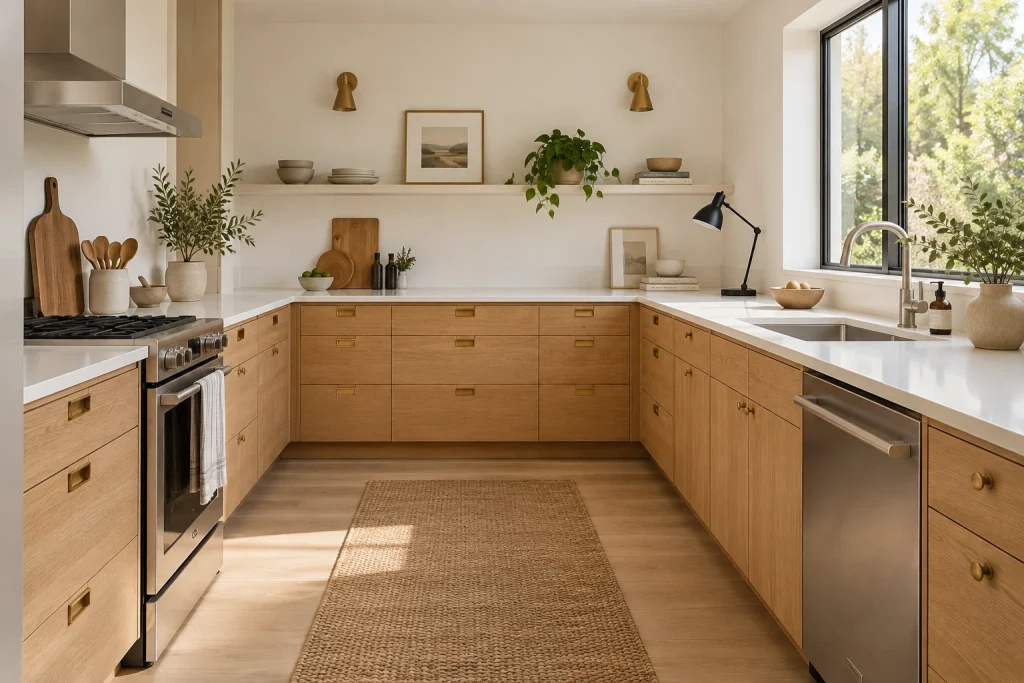
Light oak cabinetry sets a calm, wood-forward foundation for mixed-metal kitchen accents in this U-shaped kitchen. Recessed brass pulls run across the drawer fronts and cabinets, adding a warm line without interrupting the clean planes of the wood. Brushed stainless steel appears where function naturally calls for it: the range, hood, dishwasher, sink, and tall faucet. A slim black task lamp on the counter introduces the darkest note, visually distinct from the warmer brass sconces mounted above the open shelf. The white countertop and pale wall tile keep the materials separated and readable. Rather than scattering black hardware across every cabinet, the design uses black as one compact, sculptural accent.
Why it works: Oak, white surfaces, and restrained hardware create enough visual quiet for brass, steel, and black to register as intentional layers.
- Light oak flat-panel cabinetry
- Recessed brass pulls
- Brushed stainless steel appliances and sink
- Black counter task lamp
- Brass wall sconces
Design tip: Use black in one small lighting or accessory moment when brass is already carrying the cabinet hardware.
4. Direct the Eye Down a Narrow Galley
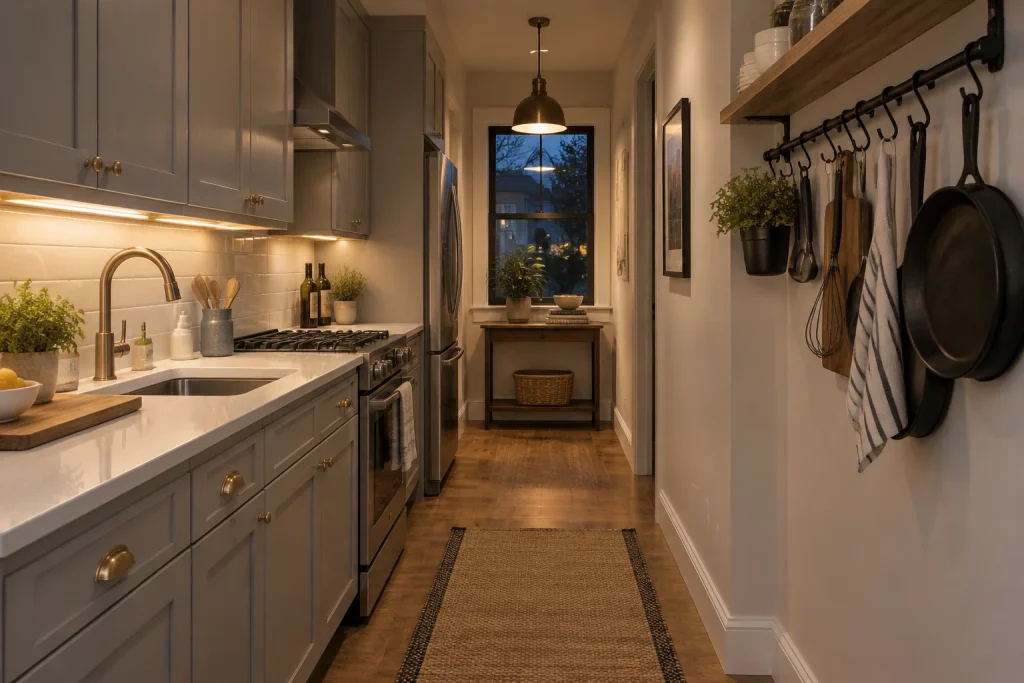
In this narrow galley, mixed metals help organize the long sightline rather than add visual weight. Brass cabinet knobs, cup pulls, and the arched faucet warm the dove-gray cabinetry along the left wall. Stainless steel appliances and a stainless sink form a practical middle layer, while the black rail system on the opposite wall creates a strong linear counterpoint. Its hooks hold dark pans, utensils, cutting boards, and striped towels, turning storage into a vertical feature. A dark pendant with brass detailing hangs at the far end of the corridor, drawing attention toward the window. Undercabinet lighting brightens the white tile backsplash and counter, keeping the darker rail and hanging cookware from making the room feel visually compressed.
Why it works: The finishes are assigned by plane: brass and steel along the work wall, black on the opposing storage wall, and a dark pendant at the end of the view.
- Dove-gray cabinets with brass knobs and cup pulls
- Brass-toned arched faucet
- Stainless steel range and refrigerator
- Matte-black wall rail with hooks
- Dark pendant with brass detail
Design tip: In a narrow galley, keep one wall visually streamlined and reserve open storage for the opposite wall.
1. Use the Island to Set the Metal Hierarchy
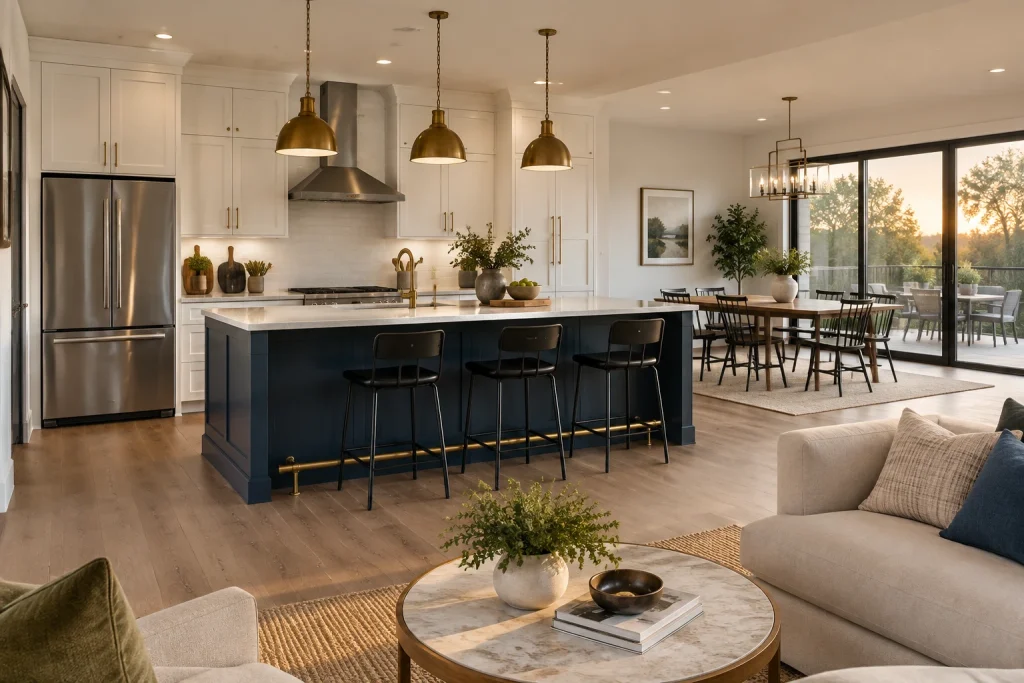
This kitchen makes the navy island the clearest place to introduce mixed-metal kitchen accents. Three black counter stools create a dark, graphic line across the seating side, while a slim brass footrail runs beneath them as a warmer, lower-level detail. Above, three brass dome pendants repeat that warmth at ceiling height. The stainless-steel refrigerator and range hood sit farther back against white cabinetry, reading as a practical, cool-toned layer rather than competing decoration. Brass cabinet pulls and the brass-toned faucet carry the warm finish into the working wall. Because the metals are repeated in separate, purposeful roles—brass for illumination and trim, black for seating, stainless for appliances—the contrast feels organized against the navy-and-white backdrop.
Why it works: Each finish has a visible zone and scale: brass marks focal details, black grounds the island seating, and stainless anchors the appliance wall.
- Brass dome pendant lights
- Brass island footrail
- Matte-black counter stools
- Stainless-steel refrigerator and range hood
- Navy island with white countertop
Design tip: Repeat one warm metal above and below the counter, then keep seating hardware in a contrasting dark finish.
2. Zone Metals by Cabinet Color and Height
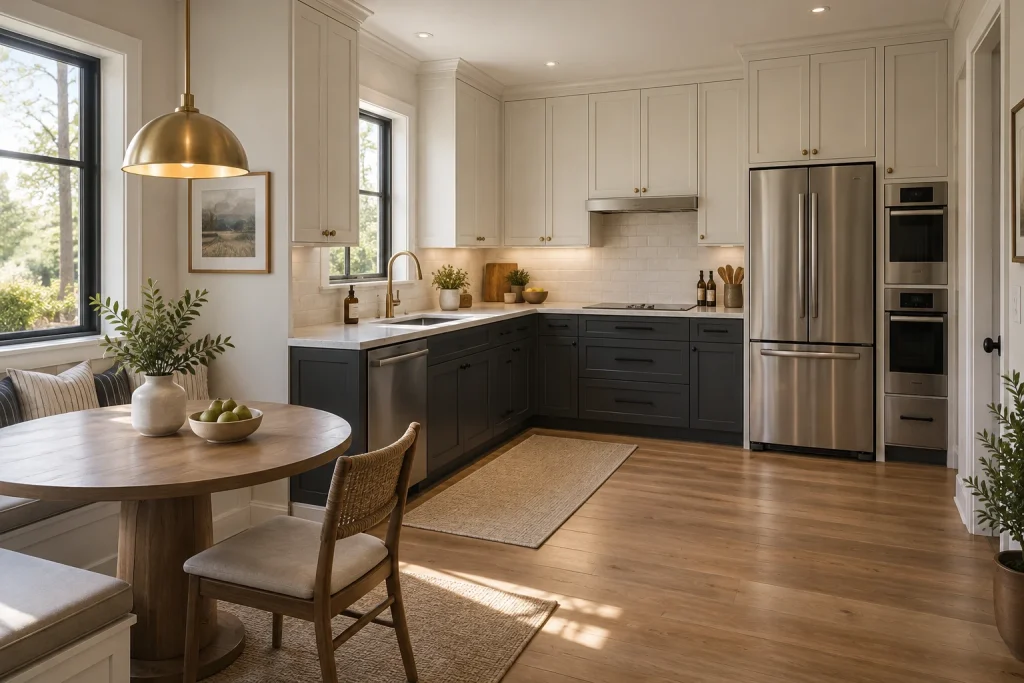
Here, mixed metals are arranged in clean visual bands rather than scattered across every surface. Small brass knobs punctuate the tall off-white upper cabinets, and the large brass pendant over the round breakfast table reinforces that upper-zone finish. Below the white countertop, the deep charcoal base cabinets use long black pulls and smaller dark knobs, giving the lower run a more grounded edge. Brushed stainless steel forms a separate appliance zone: the refrigerator, stacked ovens, and dishwasher group the cool metal along the cabinetry. A brass faucet adds a focused warm accent at the sink without interrupting the stainless appliances nearby. The result is a readable progression from warm brass overhead to dark hardware below, with stainless acting as a neutral center point.
Why it works: Separating finishes by height and function gives brass, black, and stainless distinct jobs, so the kitchen retains a calm, tailored rhythm.
- Off-white upper cabinets with brass knobs
- Deep charcoal lower cabinets with black pulls
- Brass pendant over the breakfast table
- Brushed stainless refrigerator and stacked ovens
- Brass faucet and stainless dishwasher
Design tip: Assign a finish to each cabinet level before choosing hardware: warm metal for uppers, dark pulls for lowers, and stainless for appliances.
Final thoughts
A successful mixed-metal kitchen does not require every finish to appear on every surface. Start with the materials that are hardest to change, such as stainless appliances or a black countertop, then assign brass and black to supporting roles that repeat clearly. Keep the mix readable with a dominant backdrop, a practical appliance finish, and one or two intentional accent metals. Whether the design relies on black pulls, brass lighting, a warm faucet, or a dark rail system, repetition and clear placement make mixed-metal kitchen accents feel considered.