Statement-dining-room-light-fixtures do more than brighten the table: they establish a focal point, emphasize the dining zone, and connect the ceiling to the furniture below. The most successful choice starts with the table’s shape and scale. Linear chandeliers naturally complement rectangular tables, while round tables can support globe clusters, ring fixtures, or radiating starbursts. In open-plan rooms, a bold pendant or beam-style light can also give the dining area a distinct identity without adding a physical divider. Style matters just as much as silhouette. Matte-black shades add graphic contrast to light, minimal spaces; brass and aged-gold finishes bring warmth to dark or traditional rooms; clear glass and open candle-style forms keep a statement fixture from feeling visually heavy. Use these examples to find a dining room light that feels proportionate to the table, suited to the room’s architecture, and intentional within the wider palette.
1. Use One Oversized Pendant to Define a Long Table
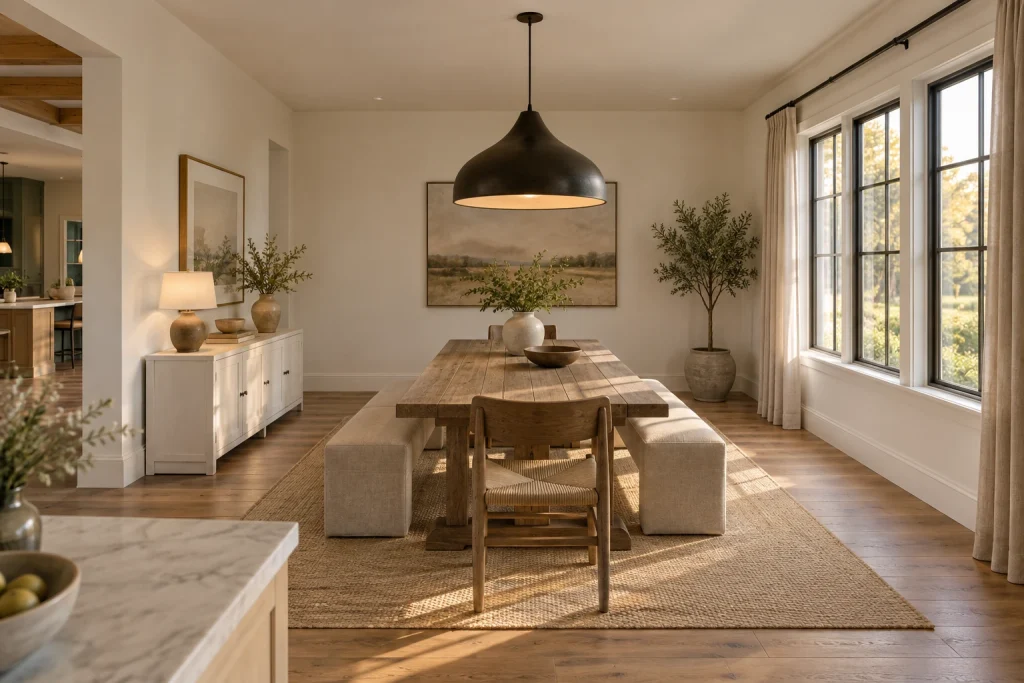
A single, generously scaled pendant can carry an entire dining room when its silhouette is this clear. Here, a wide matte-black shade hangs centrally over a long plank dining table, creating a strong vertical pause against warm white walls and the pale landscape artwork behind it. Its dark exterior gives the otherwise soft, neutral scheme a needed outline, while the warm inner glow directs attention to the tabletop. The fixture’s rounded profile also softens the table’s linear geometry and the black window muntins to the right. Upholstered benches keep the seating visually low and quiet, so the pendant remains the obvious focal point rather than competing with a busier chandelier. A white sideboard and its small lamp add a second, lower layer of light without challenging the overhead fixture.
Why it works: The pendant is large enough to read from across the open room, yet its solid, simple form is restrained beside the rustic wood table, woven rug, and quietly framed art. Centering it on the table—not the room at large—makes the dining surface feel intentionally anchored. The long black stem also gives the broad shade breathing room from the ceiling, while the bare wall and lightly furnished sideboard area preserve a clean backdrop for its profile. Daylight from the row of windows keeps the black finish from feeling too heavy, and the fixture’s warm underside keeps the dining zone inviting after daylight fades. This is a useful approach for statement-dining-room-light-fixtures when one sculptural gesture is preferable to multiple decorative layers.
- Wide matte-black dome pendant
- Long natural-wood plank table
- Low upholstered bench seating
- White sideboard with table lamp
- Large black-framed windows
Design tip: Choose a pendant with a broad shade when the table is long, then keep nearby furnishings visually low.
2. Match a Linear Chandelier to a Rectangular Table
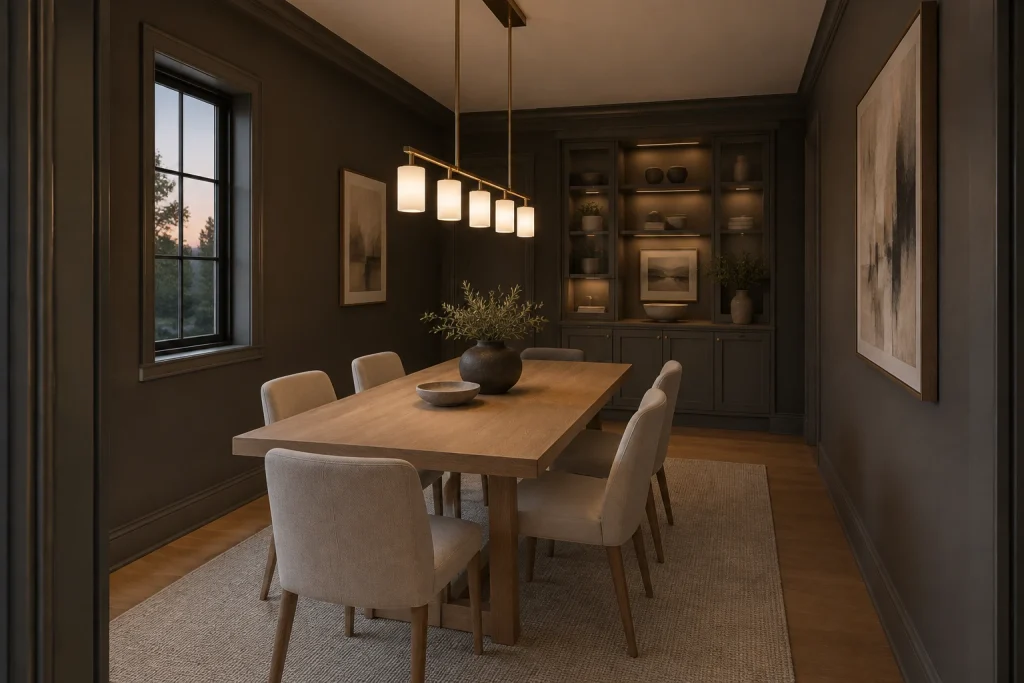
In a narrow dining room, a linear fixture can reinforce order rather than add visual bulk. This chandelier follows the long axis of the light-wood rectangular table with a slim brass bar and a row of softly glowing cylindrical shades. The repeated pendants bring light along the table’s length while the open space between each shade prevents the fixture from becoming a solid visual ceiling. Warm brass subtly stands out against the deep charcoal walls and cabinetry, connecting the lighting to the room without disrupting its restrained palette. Light upholstered chairs temper the dark envelope, and the pale rug creates a clear dining field beneath them. At the far wall, the illuminated built-in is neatly aligned with the table and chandelier, making the room’s strong end-to-end perspective feel deliberate.
Why it works: The fixture echoes the table’s shape, so it makes the room feel composed instead of visually crowded. A round or very wide branching chandelier could interrupt the narrow proportions; this long, thin format preserves the view toward the built-in while still providing a distinct centerline. Its individual shades deliver rhythm and a warmer pool of light against the dark-painted walls, which absorb more light than a pale room would. The window on the left brings in cooler ambient light, while the chandelier and cabinet lighting establish a more intimate evening layer. Notice, too, how the art is kept flat to the walls and tabletop decor is minimal: these choices protect the chandelier’s clean horizontal gesture.
- Brass linear suspension bar
- Five cylindrical white shades
- Rectangular light-wood table
- Deep charcoal walls and built-in
- Textured light neutral rug
Design tip: For a rectangular table, select a fixture whose length follows the tabletop without spanning beyond its ends.
3. Let a Glass Globe Cluster Add Airiness to a Compact Nook
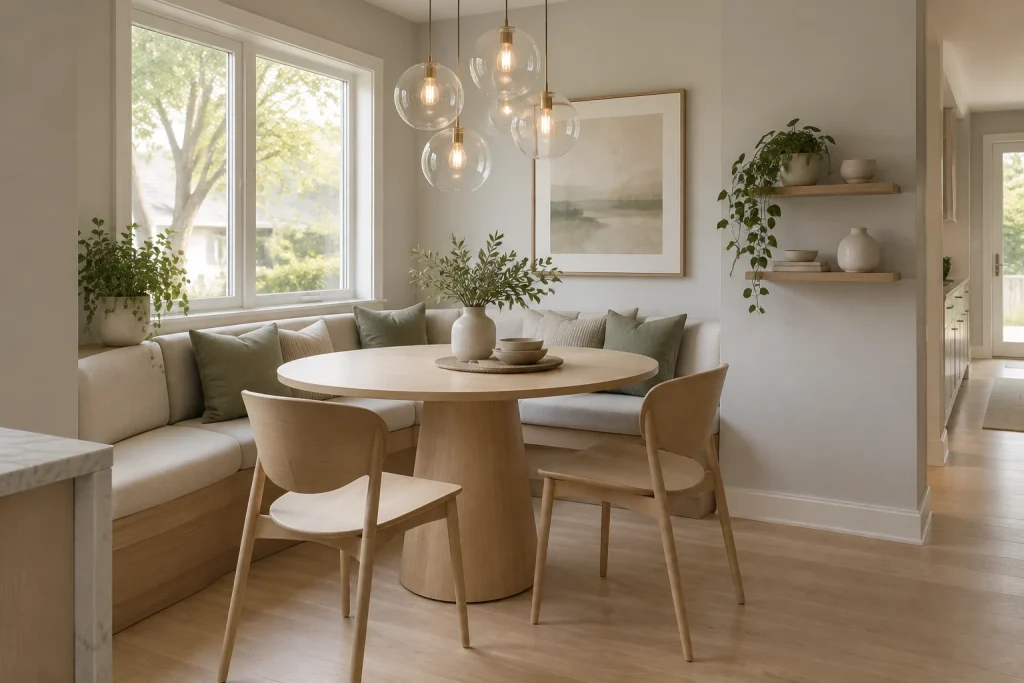
A clustered globe fixture delivers a statement without blocking sightlines in this light-filled dining nook. Five clear glass pendants descend at varied heights over the round pale-wood pedestal table, their brass details adding warmth while the transparent shades keep the window, artwork, and soft gray walls visually present. The changing drop lengths make the grouping feel dimensional above a table that is compact and circular. Below, the curved banquette and two light wood chairs create a gentle, rounded composition that mirrors the globes rather than competing with them. Muted sage pillows and leafy plants add softness around the perimeter, while the tabletop remains edited to a vase, small stack of bowls, and woven mat. Open floating shelves on the right extend the room’s airy, horizontal lines without adding another heavy furnishing.
Why it works: Clear glass is especially effective when a dining area shares visual space with adjacent rooms, as it creates sparkle and illumination with very little apparent mass. Here, the globe cluster is visible from the kitchen edge in the foreground, but it does not obscure the large window or make the banquette wall feel closed in. The multiple pendants give a small round table enough presence; one small pendant might disappear against the window and framed art, while a large opaque shade could feel weighty. Brass fittings repeat the room’s warm wood tones, and exposed bulbs lend a warm contrast to the daylight. The fixture proves that statement-dining-room-light-fixtures need not be oversized if their grouping, transparency, and placement are strong.
- Five clear glass globe pendants
- Brass suspension details
- Round pale-wood pedestal table
- Curved upholstered banquette
- Open wood floating shelves
Design tip: Over a round table, use a globe cluster with varied cord lengths to create interest without adding visual weight.
4. Make a Starburst Chandelier Earn Its Height
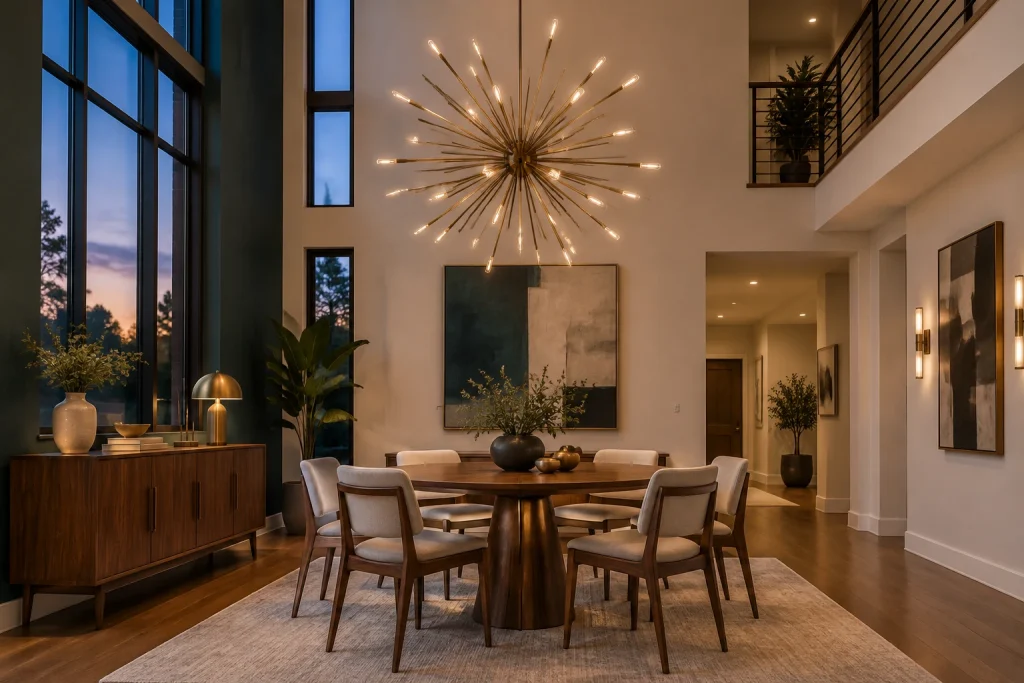
A double-height dining space can support a fixture with real reach, and this aged-brass starburst chandelier makes full use of the vertical volume. Dozens of slender arms radiate from a central hub, each ending in a small exposed light, so the fixture reads as a glowing sculpture against the tall cream wall. Its circular burst repeats the shape of the round walnut table below, establishing a clear axis from ceiling to floor. Deep teal at the window wall provides a saturated backdrop beside the chandelier’s warm metal, while the twilight view through the tall black-framed windows heightens the contrast. Walnut chairs with light upholstered seats keep the table grouping grounded. A low walnut sideboard, brass lamp, large artwork, and a pale area rug complete the setting without competing with the chandelier’s expansive outline.
Why it works: The chandelier succeeds because its scale is matched by both ceiling height and open wall area. Rather than filling the room with a dense, opaque mass, the fine metal arms let the tall windows, artwork, staircase railing, and surrounding architecture remain visible through the fixture. Its warm points of light create an intentional evening focal point against the cool blue view beyond the windows and the dark teal wall. The centered round table is equally important: the chandelier’s radial form would look less resolved above a long rectangular surface. The sideboard stays low along the window wall, leaving a broad clear field around the table and emphasizing the dramatic drop from above. This is a strong model for using a sculptural chandelier as the room’s primary visual event.
- Aged-brass starburst chandelier
- Round walnut pedestal table
- Six walnut-framed upholstered chairs
- Tall black-framed windows
- Deep teal accent wall and walnut sideboard
Design tip: Reserve an open zone around a large radial chandelier so its silhouette can read clearly from multiple angles.
1. Use a Linear Fixture to Define an Open Dining Zone
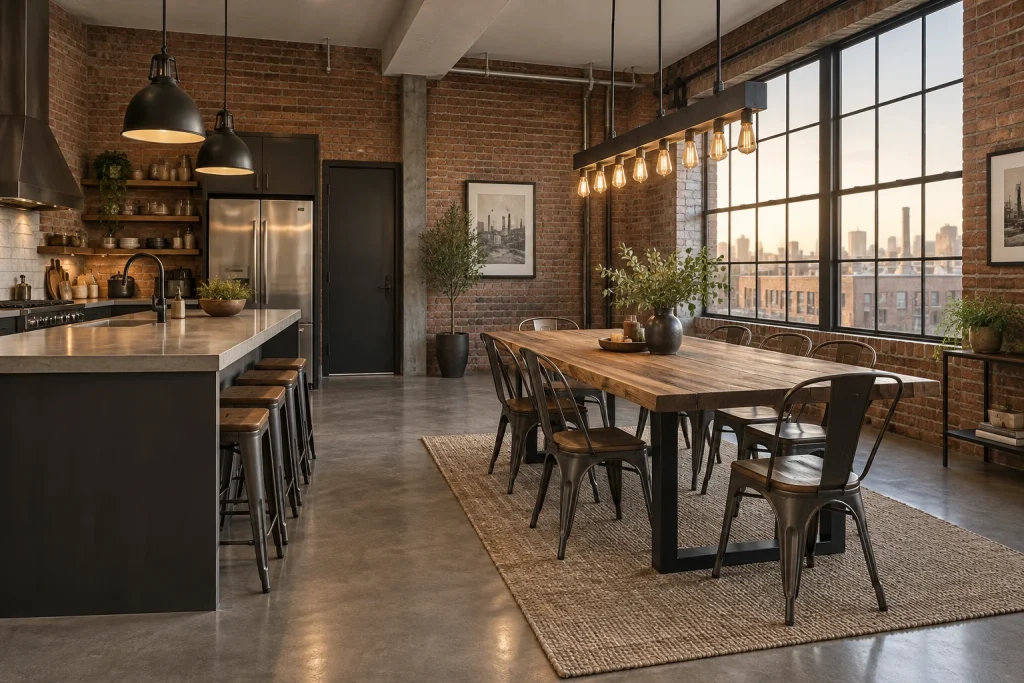
Among statement-dining-room-light-fixtures, a long linear design is a natural match for a rectangular table. Here, a black beam set with exposed filament bulbs follows the length of the wood tabletop, creating a strong horizontal line beneath the tall factory-style windows. Its matte black finish repeats in the table base and metal dining chairs, while the warm bulbs temper the raw brick, concrete floor, and steel-edged kitchen island. The fixture also visually holds the dining area apart from the adjoining kitchen without introducing a bulky shade or blocking the window grid. Two larger black pendants over the island establish a related, but separate, lighting moment nearby.
Why it works: The fixture echoes the table’s long proportions and connects the black metal details already distributed across the open room.
- Black linear beam fixture
- Visible warm filament bulbs
- Rectangular wood table
- Black steel table base
- Brick walls and gridded windows
Design tip: Choose a linear fixture that closely follows, rather than exceeds, the visual length of a rectangular table.
2. Make a Small Table Feel Intentional With a Woven Pendant
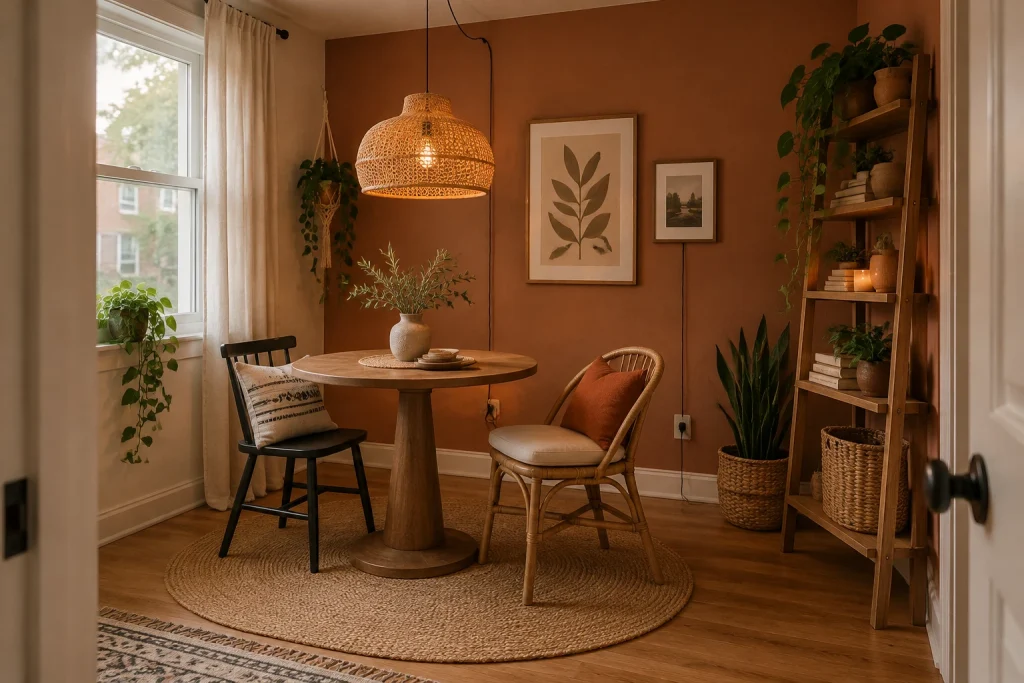
A large woven pendant gives this compact dining corner a clear focal point without requiring a large table. The rounded rattan shade hangs directly over the small pedestal table, where its open weave filters the visible bulb into a warm, textured glow. A black cord runs up the terracotta wall and across the ceiling, becoming part of the composition rather than disappearing. That line relates to the black chair and curtain rod, while the natural fiber shade, round jute rug, wood table, and rattan chair keep the materials cohesive. Framed botanical art, plants, and the ladder shelf build layers around the fixture, yet the unfilled wall area lets its curved silhouette remain easy to read.
Why it works: The pendant repeats the room’s organic textures while its generous volume gives a modest dining setup visual presence.
- Woven rattan pendant
- Visible black cord
- Round wood pedestal table
- Round jute rug
- Rattan and black dining chairs
Design tip: Center an oversized lightweight pendant over a round table to add focus without adding floor-level bulk.
3. Choose Adjustable Arms for Flexible Task Lighting
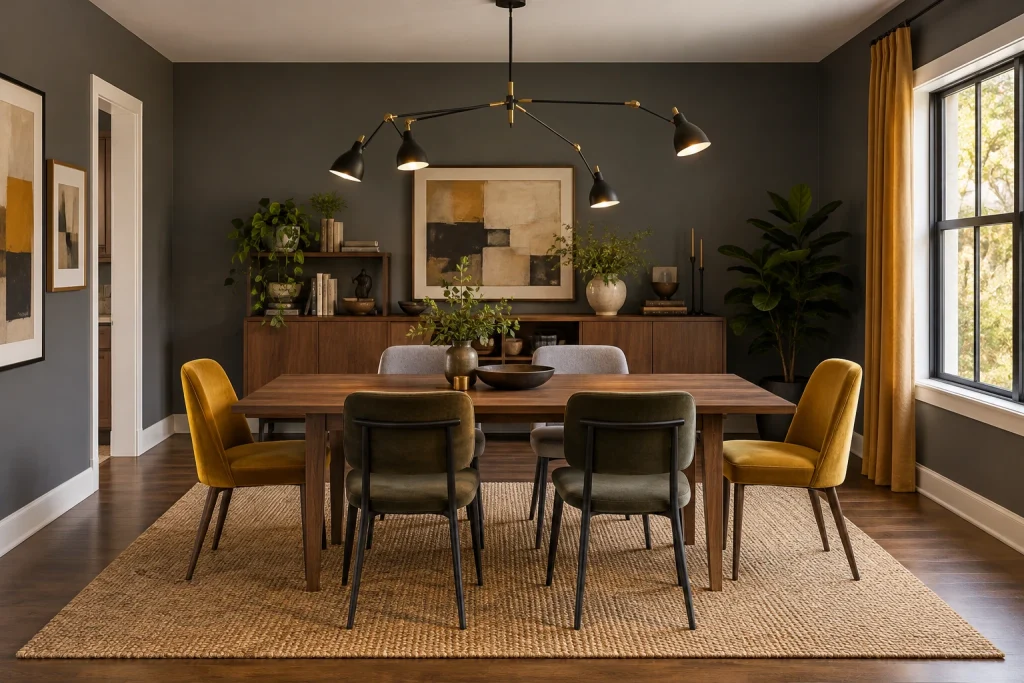
This multi-arm chandelier makes the ceiling a working part of the dining room. Slim black arms extend from a central stem in different directions, and each small black shade points downward toward a separate area of the walnut table. Brass joints and caps introduce a measured contrast against the charcoal walls, picking up the warmth of the mustard chairs and curtain. The fixture’s wide, branching profile suits the broad rectangular tabletop below while preserving an open view across the room. Behind it, the low wood credenza, open shelf, framed art, and tabletop greenery create a grounded horizontal backdrop. Because the individual heads aim independently, the design reads as both sculptural and purpose-driven rather than as a single pool of overhead light.
Why it works: Multiple directional shades break up a large table visually and bring articulation to an otherwise streamlined, rectangular room.
- Multi-arm black chandelier
- Adjustable-looking cone shades
- Brass hardware details
- Walnut rectangular table
- Charcoal wall backdrop
Design tip: For a wide table, look for a fixture with several light heads that can be aimed across its full surface.
4. Pair a Ring Chandelier With Lit Display Cabinets
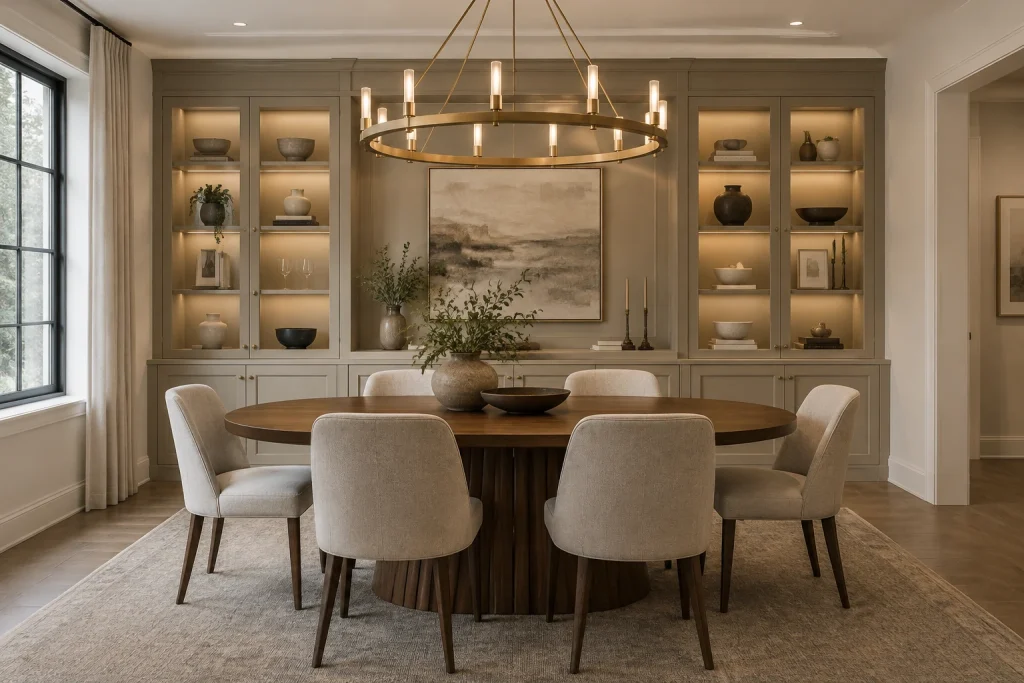
A broad antique-brass ring chandelier introduces an elegant circular form above the oval wood dining table. Its upright candle-style lights sit around the ring, so the silhouette stays open against the paneled built-in cabinetry instead of forming a solid visual block. The cabinetry’s warm shelf lighting creates a second, lower layer of illumination around bowls, books, vessels, and framed objects, while the chandelier remains the primary overhead statement. Cream upholstered chairs and a pale rug soften the brass and walnut finishes, and the large window at left adds a cooler daylight note. The room is tightly edited: centered artwork, restrained tabletop styling, and clear space around the fixture allow its scale and geometry to lead.
Why it works: The open ring contrasts with the cabinetry’s rectilinear grid, while the shared warm tones make the layered lighting feel coordinated.
- Antique-brass ring chandelier
- Candle-style bulbs
- Illuminated built-in shelves
- Oval walnut table
- Cream upholstered dining chairs
Design tip: Use an open-frame chandelier in front of detailed cabinetry so both the fixture and the millwork remain visible.
1. Use a Candle-Style Chandelier to Reinforce Formal Symmetry
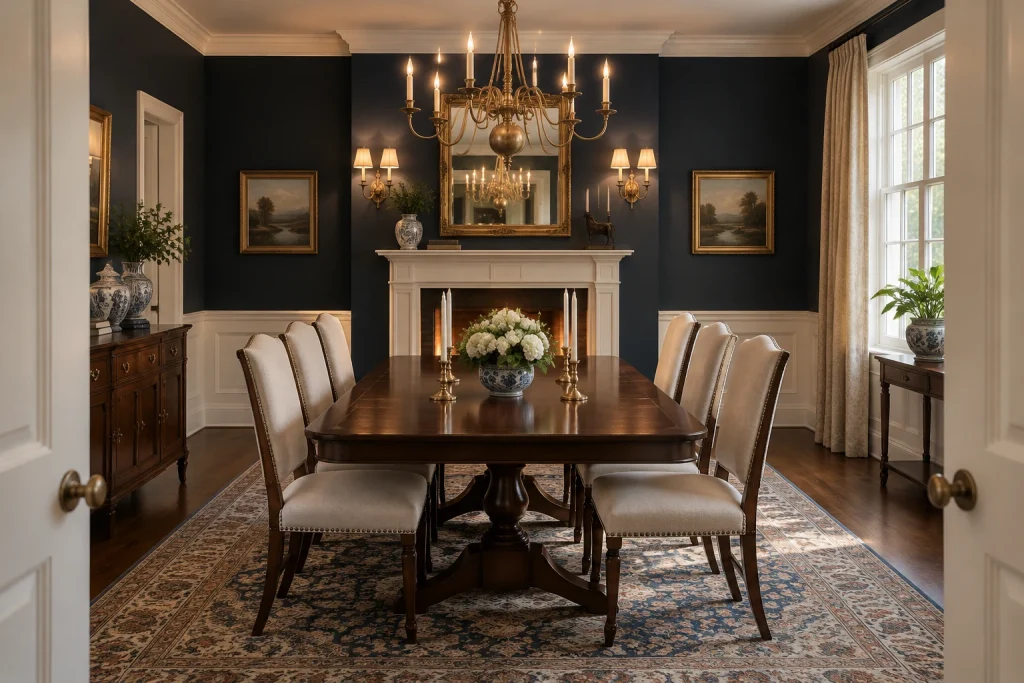
Among statement-dining-room-light-fixtures, a candle-style chandelier is a natural match for a room built on traditional details. Here, the burnished-gold fixture hangs over a long, dark wood dining table and echoes the warm tones of the table, sideboard, mirror frame, and brass candlesticks. Its curved arms and exposed candle bulbs bring an ornamental silhouette to the otherwise tailored setting of deep navy walls, white wainscoting, and ivory upholstered chairs. The fixture also holds its own against the large gilded mirror and white fireplace mantel beyond it. Rather than competing with the room’s collected elements, it repeats their formal language. The centered placement over the table and on-axis fireplace creates a composed, ceremonial focal line from the doorway through the room.
Why it works: The chandelier’s warm metal finish and traditional profile connect the wood furniture, gilded frames, sconces, and tabletop candleholders while providing a clear center above the table.
- Burnished-gold candle-style chandelier
- Dark wood rectangular dining table
- Ivory nailhead-trim dining chairs
- Deep navy walls with white wainscoting
- Gilded mirror and matching wall sconces
Design tip: For a formal look, center a candle-style fixture over the table and repeat its metal finish in smaller accents.
2. Let One Oversized Pendant Define a Minimal Dining Zone
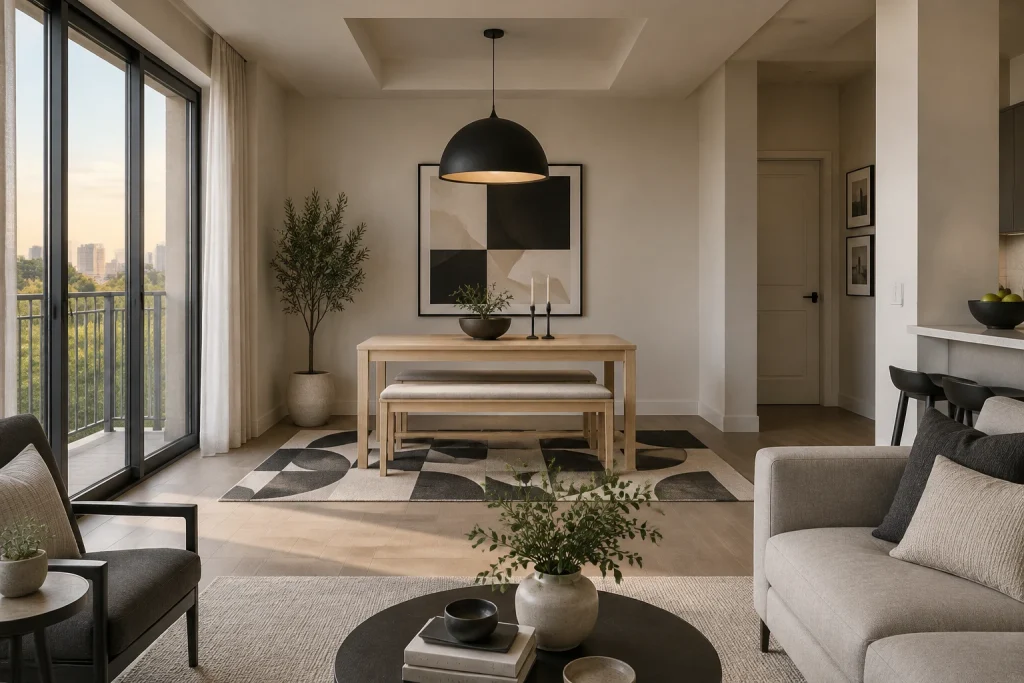
A single matte-black dome pendant gives this pale wood dining table a decisive visual boundary within an open room. The fixture is set inside a shallow rectangular ceiling recess, a detail that frames its round form and makes the dining area feel intentional without adding visual clutter. Below, the table’s clean lines and tucked benches keep the composition low and quiet, so the pendant becomes the strongest dark note overhead. That contrast is repeated in the black-and-cream graphic rug, black candleholders, framed geometric artwork, and nearby dark seating. Large sliding glass doors bring daylight along one side, while sheer curtains soften the window wall. The result shows how statement-dining-room-light-fixtures can organize a compact dining area with one sculptural move rather than a crowded mix of decorative pieces.
Why it works: The pendant’s bold scale and dark finish create a focal point, while the recessed ceiling, pale furniture, and limited black accents keep the surrounding space visually calm.
- Matte-black dome pendant
- Shallow rectangular ceiling recess
- Pale wood dining table
- Upholstered benches tucked beneath the table
- Black-and-cream graphic area rug
Design tip: In a restrained room, choose one pendant with a strong silhouette and repeat its color only in a few grounded details.
Final thoughts
The right statement light fixture makes the dining table feel anchored rather than isolated. Begin with the table’s footprint, then choose a form that either echoes it or creates a purposeful contrast: a long fixture over a rectangular surface, a circular chandelier above a round or oval table, or one substantial pendant for a pared-back setting. Consider what the fixture leaves visible, too. Open rings, clear glass, and slender arms preserve sightlines, while domed, woven, and opaque shades create stronger definition. Finally, repeat the fixture’s finish or mood elsewhere in the room. Black can relate to window frames, chair legs, or art; brass can echo hardware and candleholders; natural fibers can connect with wood, rugs, and woven seating. With the table, ceiling height, surrounding materials, and adjacent spaces in mind, a statement dining room light becomes a cohesive part of the room rather than an isolated decorative gesture.