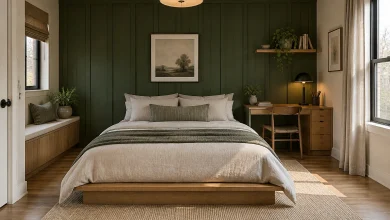
Muted jewel tone bedrooms offer a useful middle ground between pale neutrals and fully saturated color. Shades such as softened emerald, dusty sapphire, sea-glass teal, muted amethyst, garnet, jade, ruby, and forest green bring depth to a room while retaining an understated, livable quality. Their gray, brown, or earthy undertones make them especially adaptable beside walnut, oak, black metal, brass, cream upholstery, and natural-fiber texture. The most successful schemes give color a clear role rather than applying it indiscriminately. A painted feature wall, paneled backdrop, floral wallpaper, upholstered headboard, or thoughtfully chosen bedding can establish the mood, while pale ceilings, warm wood floors, neutral linens, and layered lighting keep the composition balanced. The muted-jewel-tone-bedrooms below show several ways to use these hues—from compact work-and-guest rooms to loft-like retreats—without sacrificing warmth or flexibility.
1. Ground Muted Emerald With Walnut and Linen
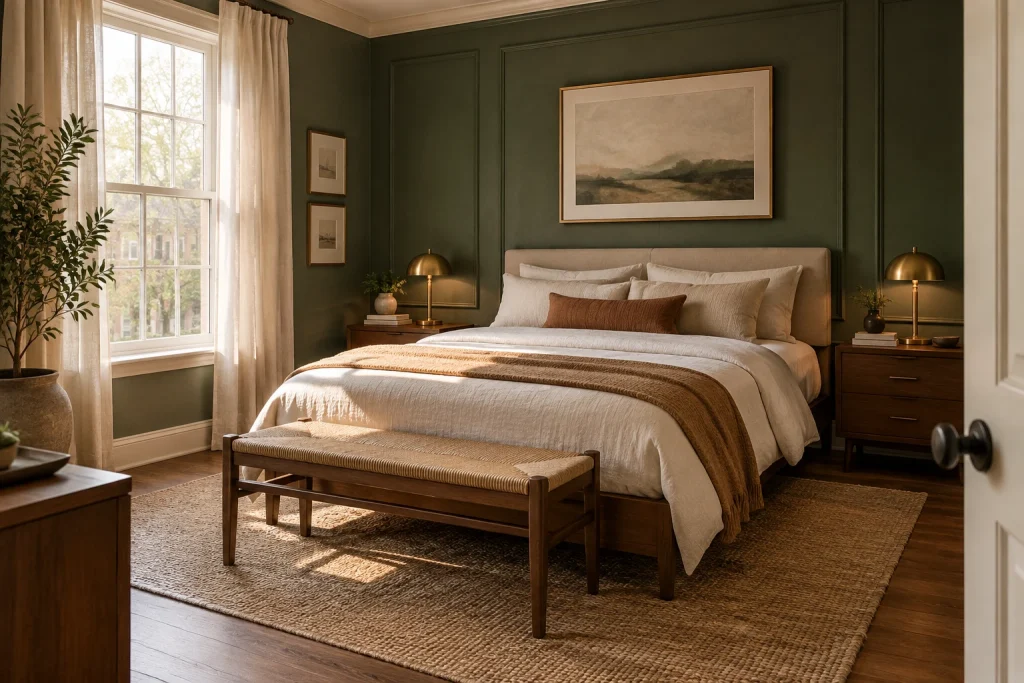
In this muted-jewel-tone bedroom, the deep emerald wall color is softened by traditional panel molding and a pale ceiling, keeping the backdrop tailored rather than heavy. A warm walnut bed frame, matching nightstands, and a slim woven-seat bench establish a consistent wood note against the green. The upholstered headboard, off-white bedding, and layered neutral pillows bring lightness to the center of the room. Brass dome lamps add a warm metallic accent on either side, while the large landscape above the bed repeats the room’s hushed olive, brown, and cream range. A textured natural-fiber rug and a brown throw introduce tactile depth without competing with the wall color. Sheer curtains at the window let daylight filter across the restrained palette.
Why it works: The room limits the strongest color to the walls, then balances it with warm wood, pale textiles, and small brass highlights. That mix gives emerald a settled, enduring presence.
- Deep emerald paneled walls
- Walnut platform bed and nightstands
- Off-white quilt and pillows
- Brass dome table lamps
- Woven bench and textured rug
Design tip: Pair a dark green wall with creamy bedding before adding more saturated accents.
2. Use Dusty Sapphire as a Calm Studio Backdrop
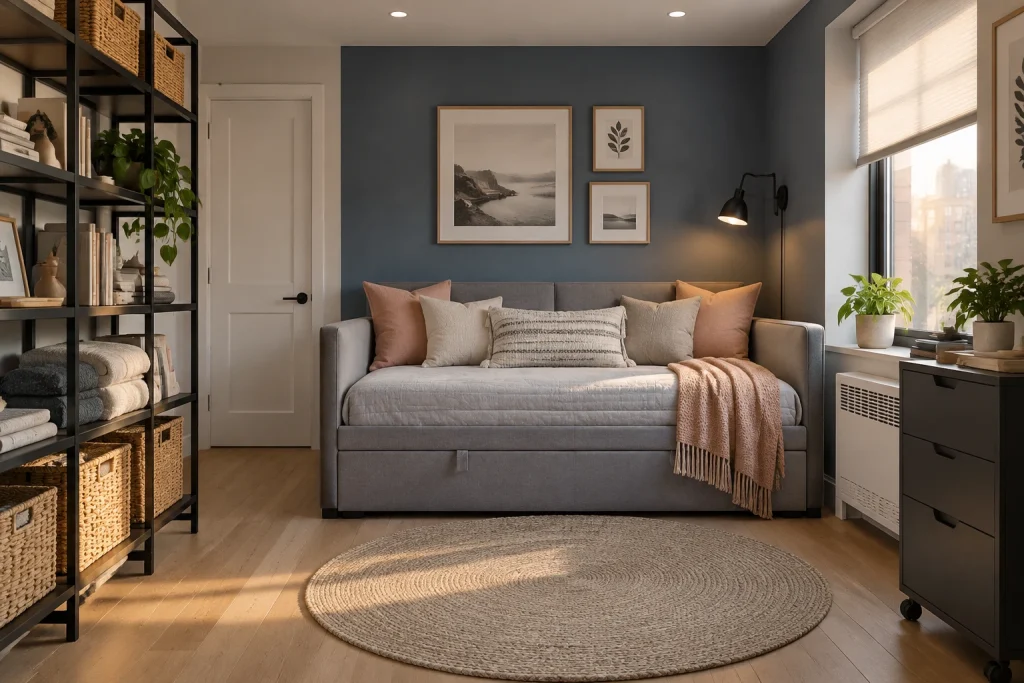
A dusty sapphire feature wall gives this compact sleeping area definition behind the gray sofa bed. The blue has enough gray in it to sit quietly beside the light oak floor, charcoal metal shelving, and soft gray upholstery. Pale peach pillows and a fringed throw add warmth in small, removable doses, while cream cushions prevent the sofa bed from reading as one flat block of gray. Above it, three simply framed prints create a vertical focal point without introducing more color. The open black shelving at left uses baskets, books, folded textiles, and plants to take storage upward. On the opposite side, the dark rolling drawer unit keeps the floor zone visually contained near the window and radiator cover. A round woven rug softens the open center.
Why it works: The muted blue anchors the room while the furnishings stay largely neutral. Warm peach, woven fibers, and pale wood counterbalance its cool cast without making the small space feel busy.
- Dusty sapphire accent wall
- Gray upholstered sofa bed
- Black metal open shelving
- Woven storage baskets
- Peach pillows and throw
Design tip: In a small room, repeat one warm accent color in textiles rather than across multiple large surfaces.
3. Let Muted Teal Frame Natural Loft Materials
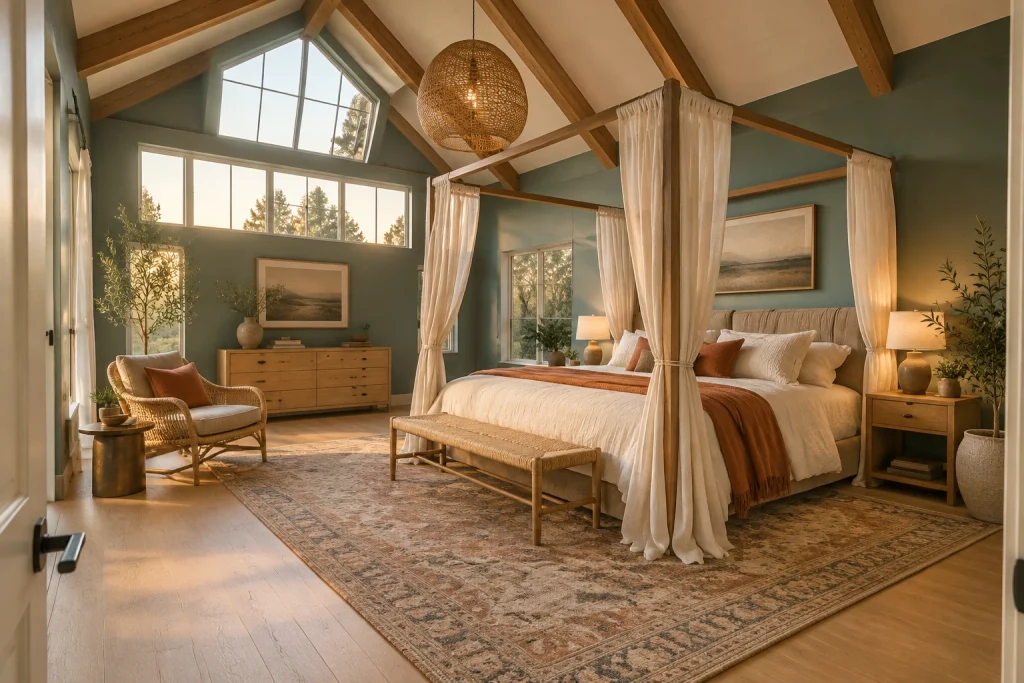
Muted teal walls bring visual depth to this lofty bedroom, while the pale wood ceiling, exposed beams, and broad upper windows keep the envelope bright. The four-poster bed is made more relaxed by airy cream curtains tied to its posts instead of densely draped. Cream bedding sets a quiet base for rust-toned pillows and a folded throw, colors echoed in the patterned rug beneath. The rug is generously scaled, extending beyond the bed toward the woven lounge chair and the bench at the foot. Rattan appears again in the hanging pendant and chair, creating a warm thread that relates to the oak furniture and beams. A low dresser, small side tables, restrained artwork, and leafy plants fill the room without obscuring the strong architecture or open floor around the bed.
Why it works: Teal acts as a cool, matte contrast to the ceiling’s warm timber. Repeating natural woven textures and terracotta accents bridges those temperatures and gives the high-ceilinged room cohesion.
- Muted teal walls
- Exposed wood beams
- Light wood canopy bed
- Cream curtain panels
- Rattan pendant and lounge chair
Design tip: With a vaulted ceiling, use one large rug and a few substantial natural textures instead of many small accessories.
4. Build a Soft Amethyst Work-and-Guest Zone
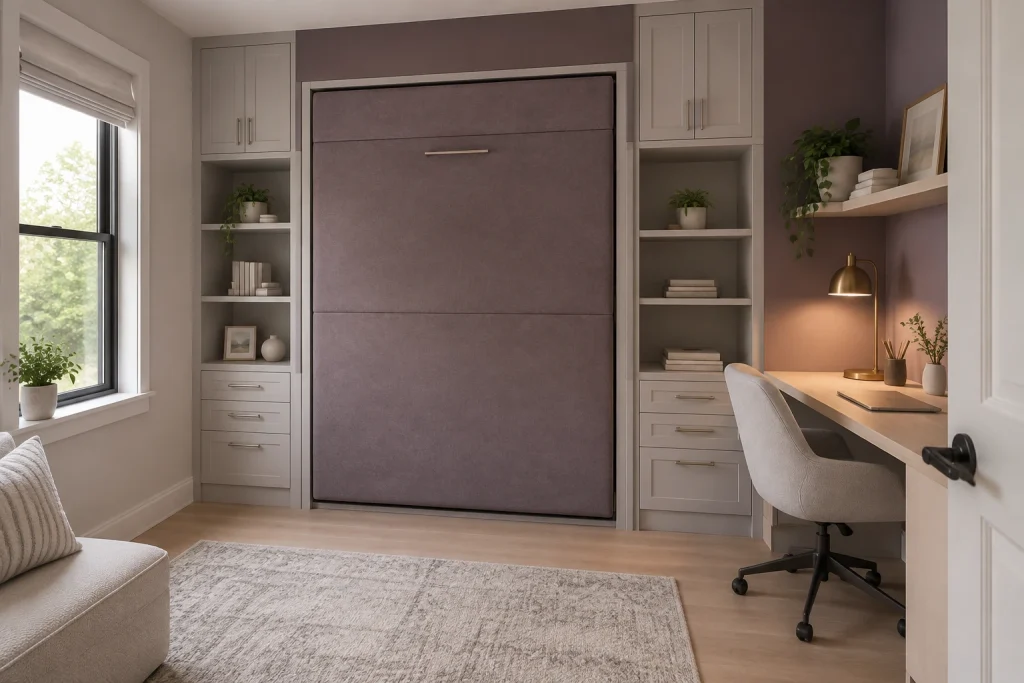
This compact room shows how muted amethyst can bring warmth to a highly organized wall of built-ins. The color sits behind a closed, upholstered wall bed, making the central panel read as part of the architecture rather than a separate piece of furniture. Pale gray cabinetry frames it with upper cabinets, open shelving, and lower drawers, all finished with slim brass pulls. To the right, a pale wood desk runs beneath a floating shelf, where a brass task lamp adds a focused warm glow against the amethyst wall. A white upholstered task chair, light wood floor, and pale patterned rug keep the lower half of the room open and light. Small plants, stacked books, and a framed print give the shelves life without overwhelming the storage-led composition.
Why it works: The subdued purple adds softness to a practical built-in arrangement, while gray cabinetry and pale wood keep its undertone sophisticated and easy to coordinate with neutrals.
- Muted amethyst wall
- Upholstered fold-down wall bed
- Pale gray built-in cabinets
- Integrated wood desk
- Brass task lamp and hardware
Design tip: Use muted purple behind built-ins, then keep large cabinetry in a light neutral to preserve brightness.
1. Dusty Garnet With Brass for Soft Vintage-Modern Drama
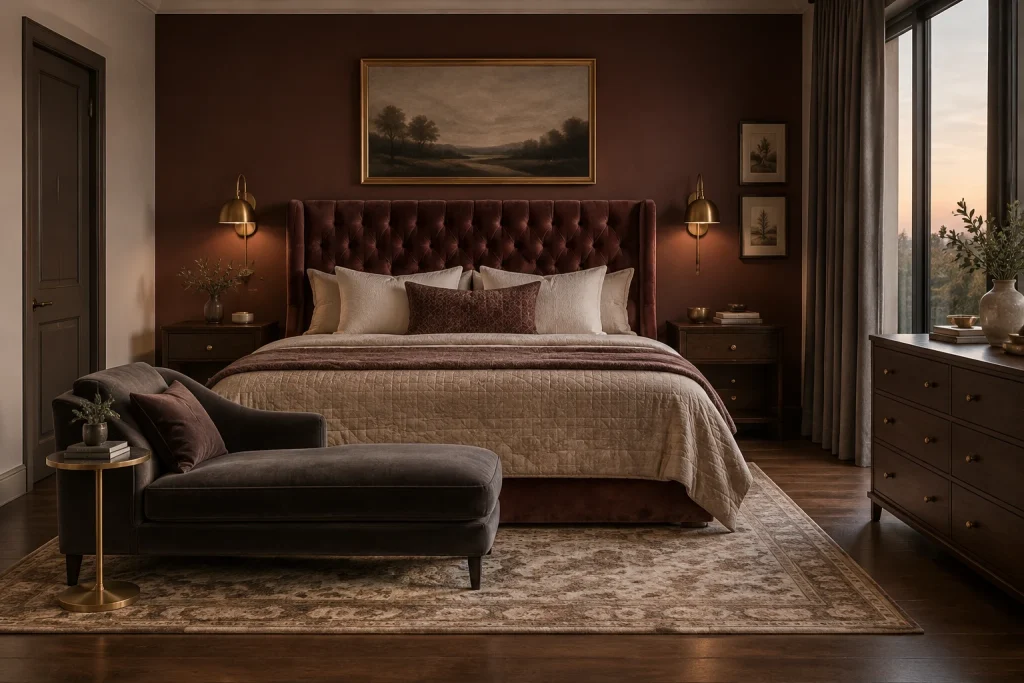
Among muted-jewel-tone-bedrooms, this scheme makes a convincing case for dusty garnet rather than a clearer, brighter red. The color appears on both the wall behind the bed and the tall, deeply tufted velvet headboard, creating one continuous, enveloping focal zone. Cream bedding and a pale patterned rug keep that saturation from dominating the room, while charcoal-gray drapery at the large window adds a quieter counterweight. Brass wall sconces lend warm highlights on either side of the bed and leave the dark wood nightstands visually uncluttered. A charcoal chaise, garnet pillow, framed landscape, walnut dresser, and dark flooring continue the low-luster, layered approach without introducing a competing bright color.
Why it works: Repeating garnet across the wall and headboard gives the bed a strong anchor, while cream, charcoal, walnut, and brass separate the darker tones into distinct, readable layers.
- Dusty garnet wall and tufted velvet headboard
- Cream quilted bedding and pale patterned rug
- Brass swing-arm wall sconces
- Charcoal chaise and full-height drapery
- Dark wood dresser, nightstands, and flooring
Design tip: Pair a muted red with creamy bedding before adding darker charcoal accents.
2. Sea-Glass Teal as a Calm Coastal Accent Wall
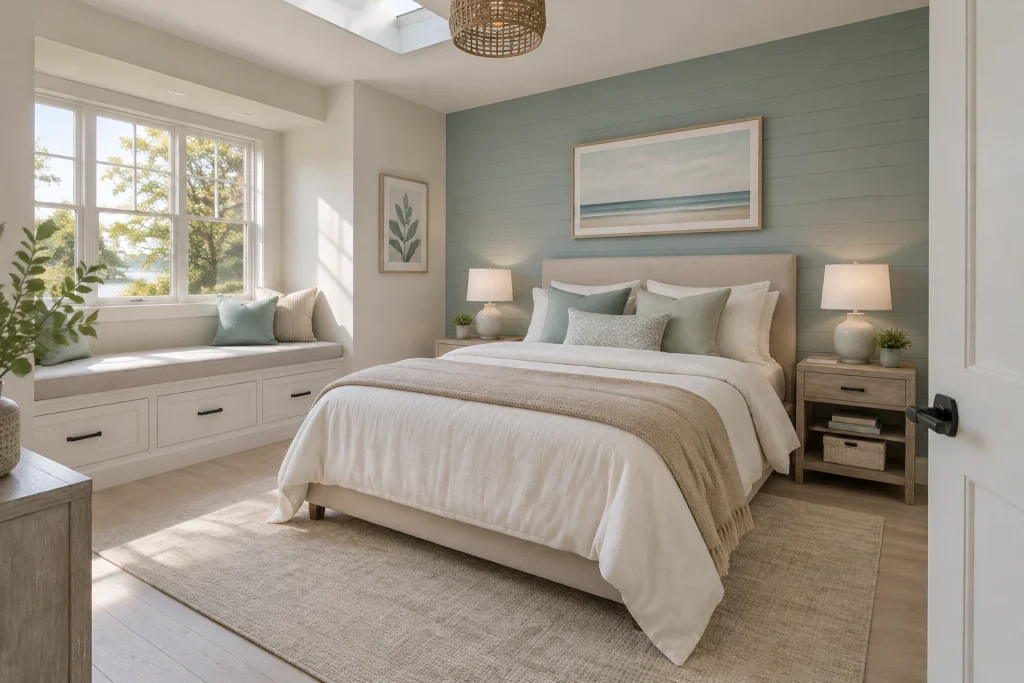
This bedroom uses muted sea-glass teal in a measured way: on the horizontal-plank wall behind the bed, not across every surface. Its gray-green cast sits comfortably beside the warm white walls, pale wood floor, sandy rug, and light wood nightstands. The upholstered bed and white bedding preserve a bright center, with soft teal and sage pillows connecting the bed to the accent wall. At left, a built-in window bench repeats the room’s pale finish and adds visual weight below a broad multi-pane window. Natural-fiber texture appears again in the woven pendant, fringe throw, and rug, giving the restrained palette a coastal direction without relying on overt nautical decoration. Framed botanical and ocean imagery echo the colors already present.
Why it works: The teal is contained to one architectural plane, so it reads as color with depth rather than a theme. Pale neutrals and daylight keep the composition open and gentle.
- Sea-glass teal horizontal-plank accent wall
- White bedding with teal and sage pillows
- Built-in window bench with black pulls
- Light wood nightstands and pale flooring
- Woven pendant and sandy textured rug
Design tip: Use a gray-based teal on one wall, then repeat it in only two or three small textiles.
3. Muted Jade and Blond Oak for a Quiet Japandi Layer
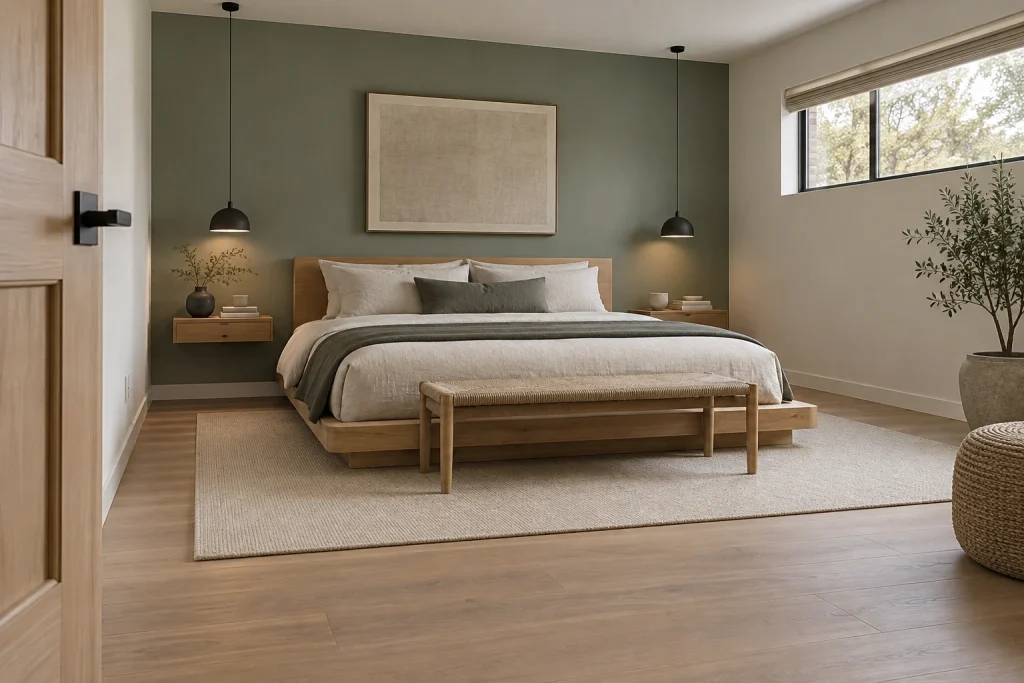
A muted jade feature wall provides the strongest color in this pared-back room, yet its softened, earthy cast allows the blond-oak platform bed to remain equally important. The low bed, slim floating night shelves, and woven bench all keep the furniture close to the floor, emphasizing the broad open expanse of pale wood flooring. Off-white bedding is built up with subtly textured pillows and a dark gray-green throw; the palette feels connected without appearing matched. Two black pendant lights descend beside the bed, giving the symmetrical composition crisp definition. A large neutral artwork, woven rug, ceramic vessel, and leafy branch introduce texture and organic shape while preserving the room’s considerable negative space. The high, narrow window brings light to the otherwise quiet side wall.
Why it works: Jade, oak, and off-white have similarly subdued undertones. That tonal agreement lets textural differences—woven fibers, linen-like bedding, wood grain, and matte ceramic—do the visual work.
- Muted jade wall behind the platform bed
- Blond-oak platform bed and woven bench
- Floating wood night shelves
- Black pendant bedside lights
- Off-white rug and layered neutral bedding
Design tip: For a minimalist bedroom, limit the accent color to the bed wall and one textile layer.
4. Muted Sapphire Against Charcoal for Controlled Contrast
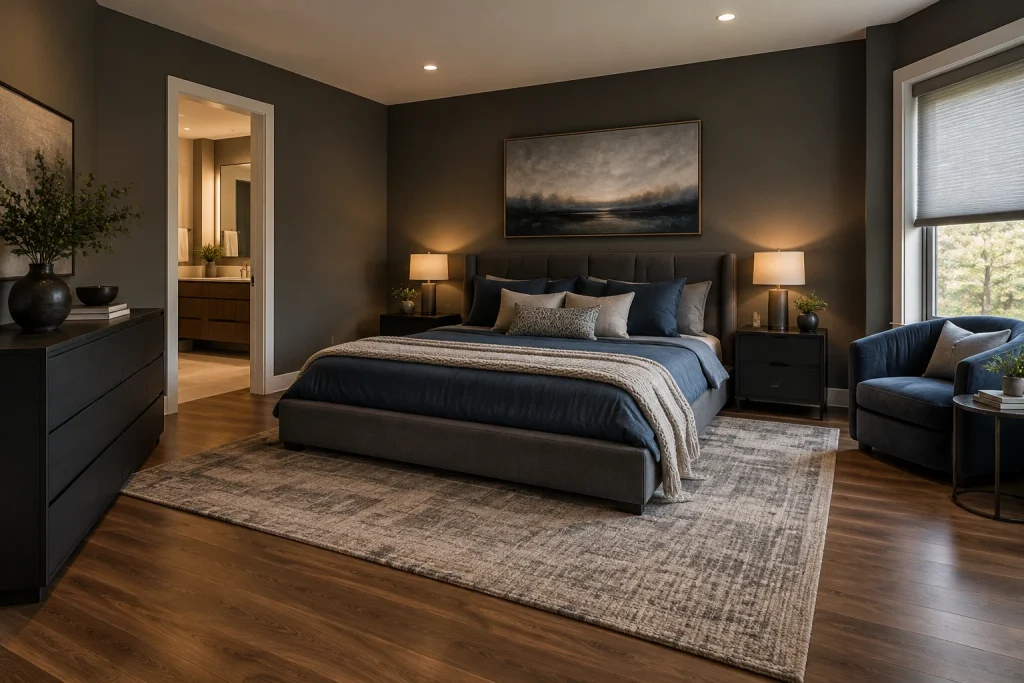
Dark walls need not make a bedroom feel visually flat, as this charcoal setting demonstrates. The charcoal-gray wall and upholstered bed create a deep backdrop for muted sapphire bedding and the velvet-look chair placed by the window. Rather than introducing a second bright hue, the room shifts through closely related values: black nightstands and dresser, smoky gray pillows and rug, creamy lampshades, and a warm taupe throw. Walnut-toned flooring supplies a necessary warm plane under the cooler walls and blue textiles. Table lamps bring pools of warm light to each side of the bed, while the large landscape above it carries the room’s blue-gray range upward. The patterned rug softens the wide stretch of wood flooring and defines the bed area.
Why it works: The contrast comes from value and texture, not sharp color changes. Sapphire stands out against charcoal, while warm wood and cream prevent the dark palette from becoming uniform.
- Charcoal-gray walls and upholstered bed
- Muted sapphire bedding and accent chair
- Matte black dresser and nightstands
- Warm-toned wood floor
- Gray patterned rug and cream textured throw
Design tip: In a charcoal bedroom, repeat the blue accent in one upholstered piece and the bedding, then keep the remaining colors neutral.
1. Ground Muted Ruby With Black and Soft Neutrals
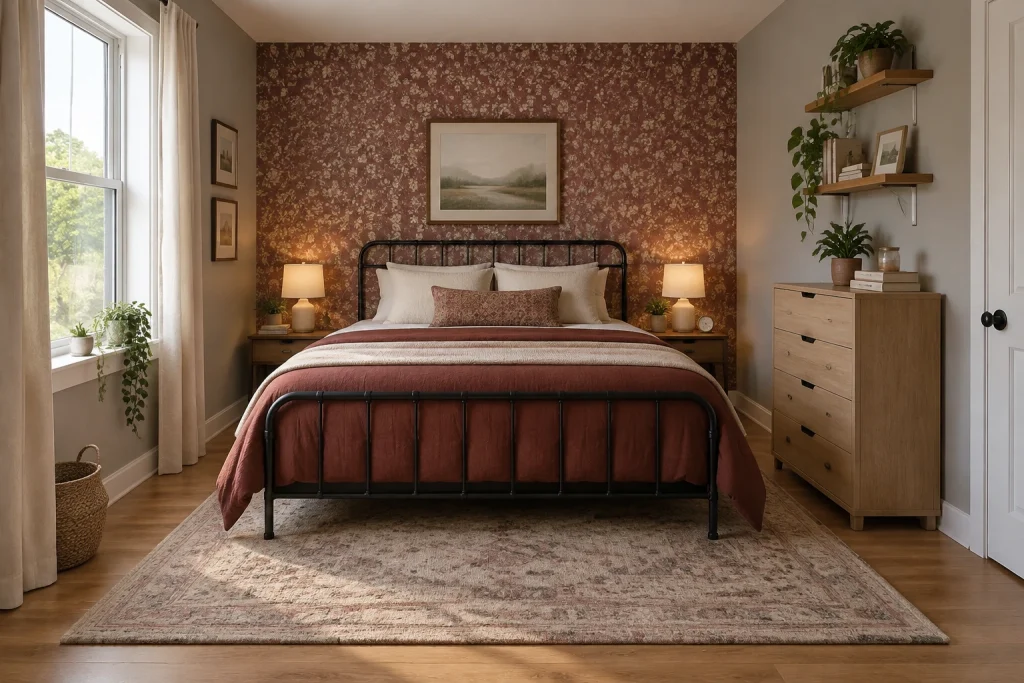
Muted ruby gives this bedroom its warmth without taking over the room. The color appears in the floral wallpaper behind the bed, the duvet, and the small patterned lumbar pillow, creating a focused, tone-on-tone backdrop rather than a single sharp hit of color. A simple black metal bed frame outlines the bed against the print and introduces a crisp, practical-looking contrast. White pillows, a pale quilt, soft gray walls, and a faded rug keep the red-brown tones from feeling heavy. Warm table lamps on the matching wood nightstands reinforce the low-key palette, while daylight from the tall window adds a lighter counterpoint. The result shows how muted-jewel-tone-bedrooms can feel layered even when the strongest color is concentrated at the bed wall.
Why it works: Repeating ruby at different scales—the wall, duvet, and pillow—makes the color intentional. Black metal, pale bedding, and gray walls give the scheme enough contrast and breathing room.
- Muted ruby floral wallpaper panel
- Black metal bed frame
- Ruby duvet and patterned lumbar pillow
- White pillows and pale quilt
- Soft gray walls with warm wood furniture
Design tip: Repeat one muted jewel tone in a wall treatment, bedding, and one small accent rather than adding several unrelated colors.
2. Pair Forest Green With Cottage-Scale Pattern
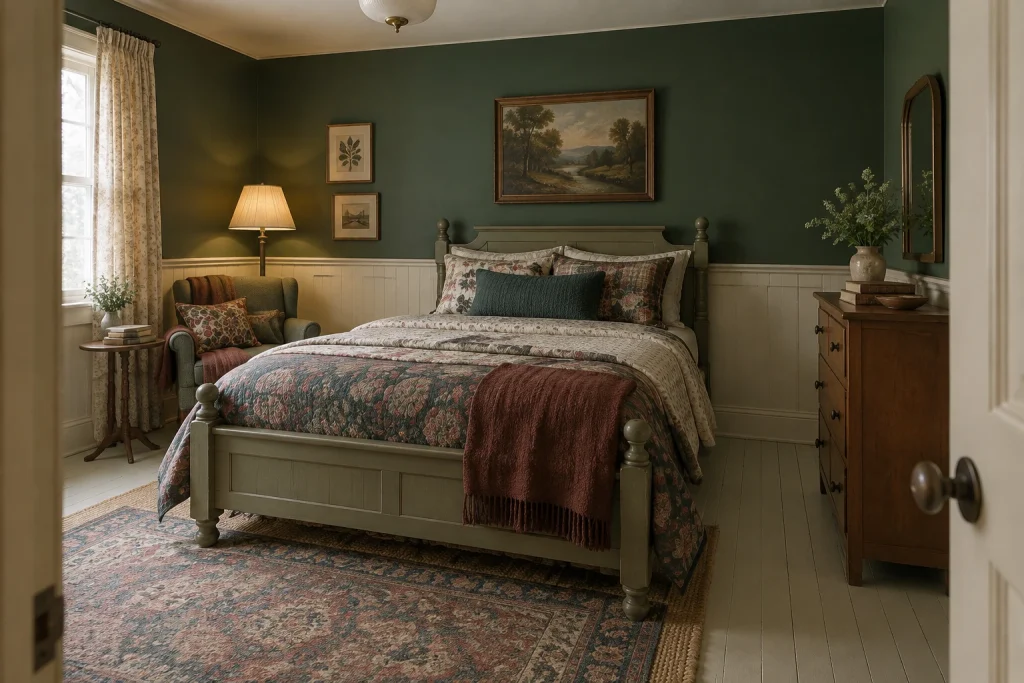
A deep, muted forest green fills the upper walls in this bedroom, giving the painted bed and cream wainscoting a defined, enveloping backdrop. The color is not left on its own: a landscape painting in a dark wood frame, a botanical print, a narrow arched mirror, and the green upholstered chair all carry the room’s earthy direction. The bed layers floral pillows, a pale quilt, a floral coverlet, and a rust-colored fringed throw. Their subdued reds, dusty blues, creams, and greens work because they share a softened finish rather than matching exactly. Cream trim, the white ceiling, and the painted floor brighten the perimeter. At the left, a floor lamp and small round table create a compact reading corner; a dark wood dresser adds useful visual weight on the opposite side.
Why it works: The forest wall establishes a calm field for varied textiles, while cream architectural details divide the dark color and preserve brightness. Repeated aged-looking wood tones help the patterns read as a collection.
- Muted forest green walls
- Cream painted wainscoting and trim
- Painted green wood bed
- Floral and geometric layered bedding
- Rust fringed throw and dark wood dresser
Design tip: When mixing bedroom patterns, keep the wall color solid and let one shared muted color, such as forest green, link the textiles.
Final thoughts
A muted jewel tone can make a bedroom feel more considered without locking it into a short-lived look. Keep the larger supporting surfaces calm, choose wood and textile finishes that add warmth, and repeat the main hue in only a few connected elements. Whether the direction is emerald and walnut, sapphire and charcoal, teal and oak, or ruby with soft gray, the goal is balance: enough depth to create atmosphere, with enough lightness and texture to make the room restful.