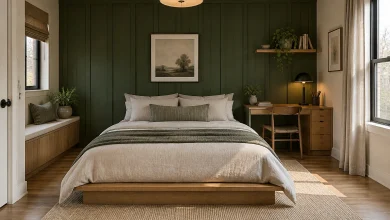
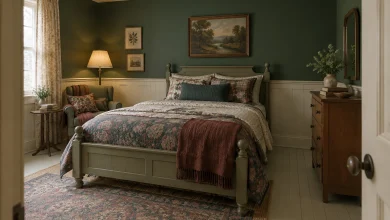
A well-lit bedroom needs flexibility: enough overall illumination to move through the room comfortably, focused light for reading or working, and softer details that make the space feel settled at night. That is the value of a layered approach. Rather than relying on one ceiling fixture, combine an ambient source—such as a pendant, chandelier, recessed lights, or cove lighting—with task lighting at the bed or desk and accents that highlight artwork, shelving, headboards, or architectural details. These layered-bedroom-lighting-ideas illustrate how fixtures at different heights can shape both function and atmosphere. Symmetrical pendants and bedside sconces can organize a bed wall, while swing-arm lights, desk lamps, and floor lamps bring illumination exactly where it is needed. Picture lights, concealed strips, and softly lit storage add depth without making the room feel overly bright. Daylight also belongs in the plan, with shades that moderate glare while preserving a connection to the window.
1. Pair Pendant Symmetry With Focused Reading Light
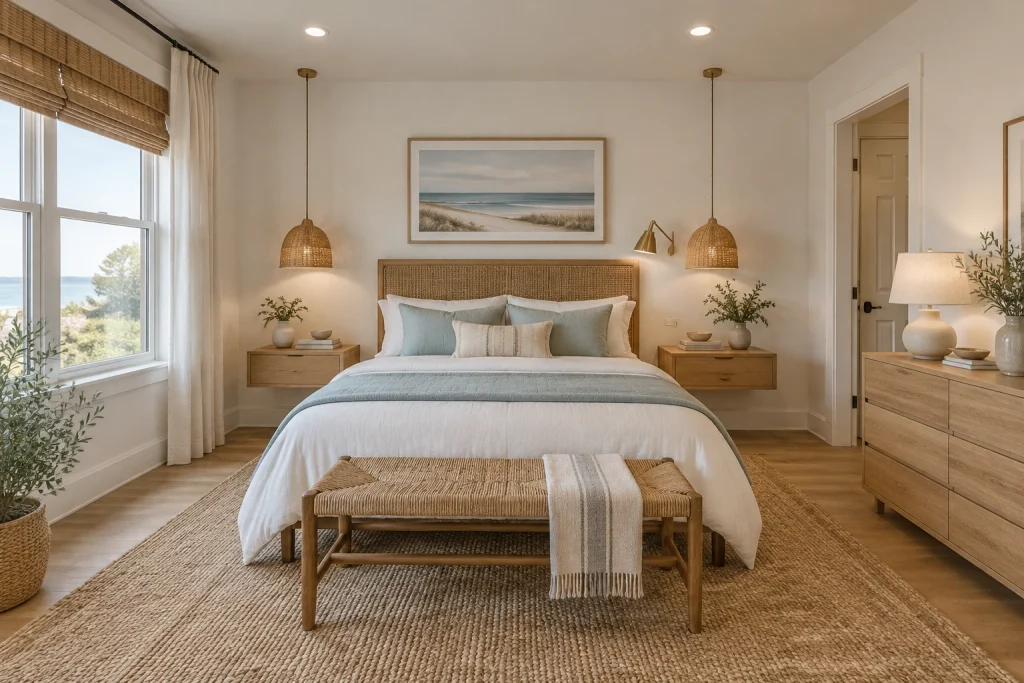
This bedroom builds a calm layered-bedroom-lighting-ideas scheme around the bed wall. Two woven pendant shades hang evenly over the floating wood nightstands, giving the rattan headboard a warm, textured frame. Recessed ceiling lights provide an even wash across the white ceiling and floor, while the brass adjustable light beside the right side of the bed directs a more focused pool of illumination toward the pillows. Across the room, a white-shaded table lamp brightens the dresser surface and its large mirror. Daylight enters through the broad window at left, softened by a woven Roman shade and white curtains. The mix feels cohesive because the fixtures repeat the room’s natural materials instead of competing with the sea-blue bedding, pale walls, and light oak furniture.
Why it works: Ambient, bedside, and dresser lighting each have a distinct visual role, while woven and brass finishes add warmth to the pale palette.
- Paired woven pendants above floating nightstands
- Recessed ceiling lights
- Adjustable brass bedside light
- White-shaded lamp on the dresser
- Large window with woven shade and curtains
Design tip: Use matching bedside pendants to free nightstand surfaces for essentials.
2. Light a Compact Sleep Zone From Several Heights
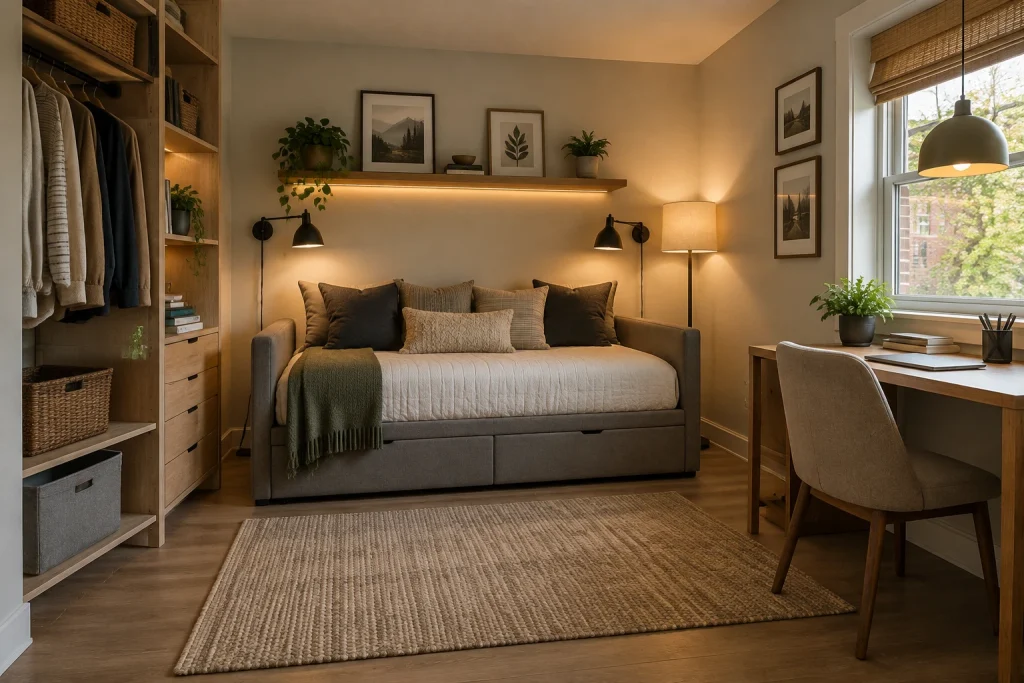
In this compact room, light is distributed vertically rather than concentrated in one ceiling fixture. A floor lamp beside the daybed sends a soft glow onto the wall, helping define the sleeping area without taking up tabletop space. Two black swing-arm wall lights flank the daybed, their shades aimed downward for more localized illumination. Above, a long wood shelf is washed with a concealed warm strip of light, which brings attention to the framed art, books, and plants without adding visual bulk. Additional warm light appears inside the open wood storage at left. At the window-side desk, a large dark pendant hangs over the work surface, creating a separate visual zone. The varied sources make the modest footprint look organized and intentional, even with the wardrobe, bed, and desk in close view.
Why it works: The room separates sleep, storage, and desk areas through light placement, with wall-mounted and shelf lighting preserving the limited floor and surface area.
- Two black swing-arm wall lights
- Warm under-shelf illumination
- Tall floor lamp beside the daybed
- Lit open storage shelving
- Dark pendant over the desk
Design tip: In a small bedroom, prioritize wall and shelf lighting before adding another table lamp.
3. Use Warm Accents to Animate a Dark Bedroom
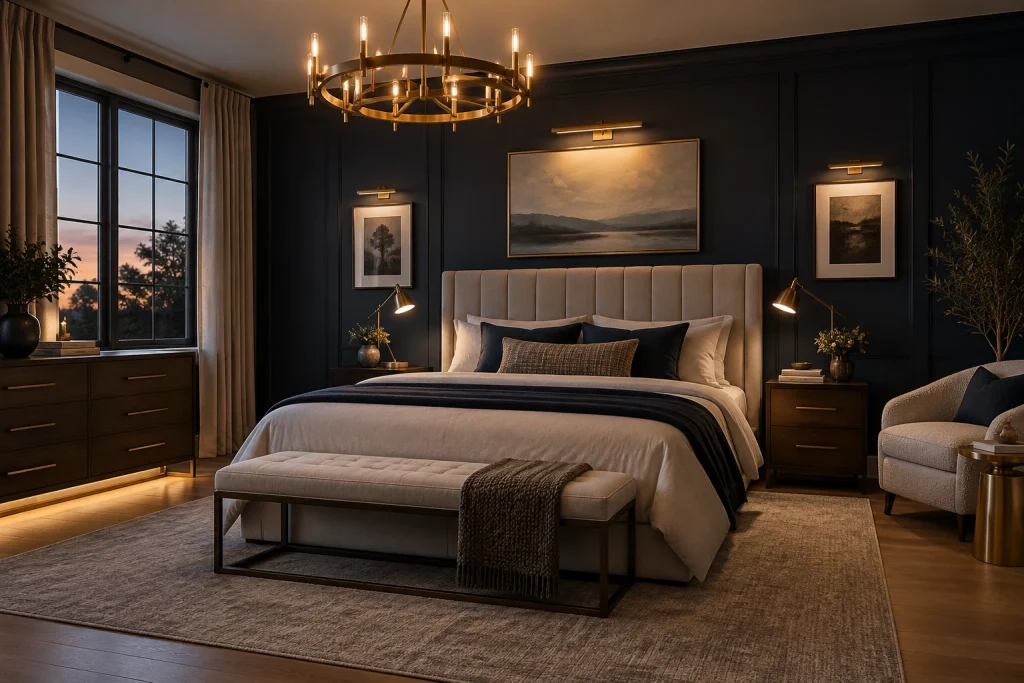
A deep navy paneled wall gives this bedroom a dramatic backdrop, and the lighting keeps it from reading flat. The brass ring chandelier supplies the broadest layer, scattering warm points of light above the bed and across the ceiling. Three picture lights create deliberate accents: one over the large landscape and one above each smaller framed work. Their focused beams establish a gallery-like rhythm across the wall. At bed level, slim brass reading lights angle toward the pillows, adding a more precise task layer without interrupting the tall upholstered headboard. A concealed light glows beneath the dark wood dresser at left, outlining the floor and lower edge of the furniture. The pale upholstered bed, bench, curtains, and chair reflect the warm light, providing contrast against the charcoal and navy finishes.
Why it works: Lighting at the ceiling, wall, bedside, and floor gives the dark envelope dimension while brass details visually link every layer.
- Brass ring chandelier with exposed bulbs
- Three brass picture lights
- Adjustable bedside reading lights
- Illuminated dresser base
- Matte dark paneled wall
Design tip: Against dark walls, add at least one low-level light source to keep furniture from visually disappearing.
4. Let Daylight Lead, Then Add Gentle Evening Layers
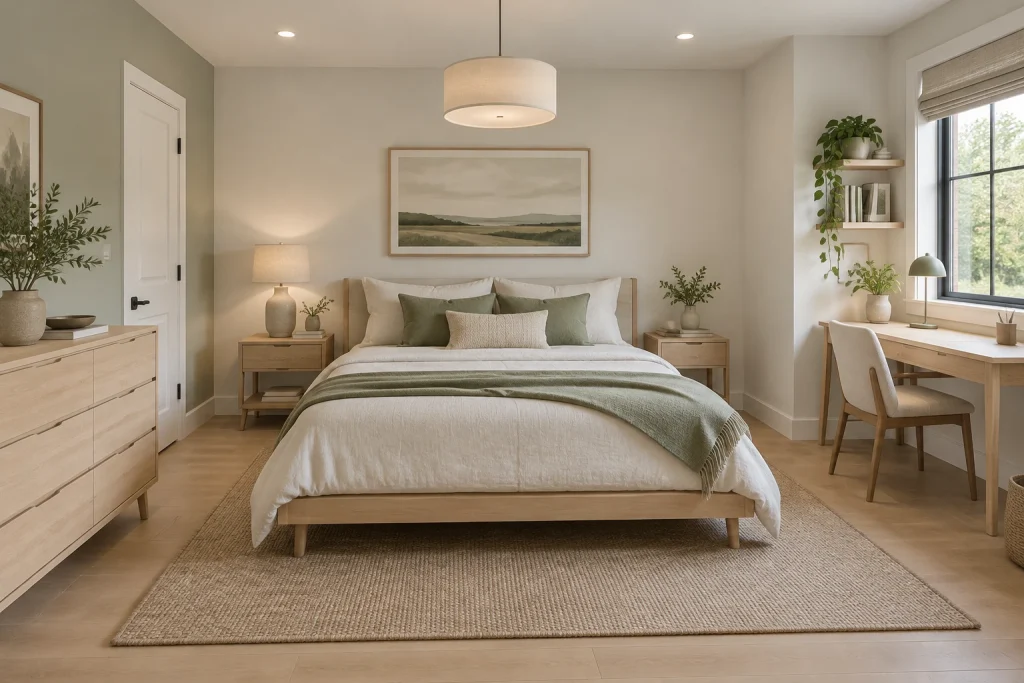
This pale, pared-back bedroom treats daylight as its first lighting layer. The large right-side window brightens the desk, pale wood furniture, woven rug, and soft white bedding, while the light-filtering Roman shade maintains the restrained palette. For evening, a simple white drum pendant centers above the low wood bed and provides an uncluttered overhead focal point. Two recessed ceiling lights add another broad source without crowding the ceiling. Smaller lamps address close-range needs: a ceramic table lamp warms the left nightstand, and a compact green desk lamp gives the work surface a directed glow. The arrangement remains visually quiet because the fixtures are modest in scale and limited in finish. Muted green pillows, a throw, plants, and the landscape artwork echo the desk lamp’s subtle color.
Why it works: The lighting supports the room’s minimal composition: daylight defines the space, while restrained overhead and task fixtures add warmth without visual clutter.
- Large window with a woven Roman shade
- Centered white drum pendant
- Two recessed ceiling lights
- Ceramic bedside table lamp
- Green desk lamp
Design tip: Keep task lamps compact and finish-coordinated when the room relies on a minimal palette.
1. Midcentury Layers That Give Each Zone Its Own Glow
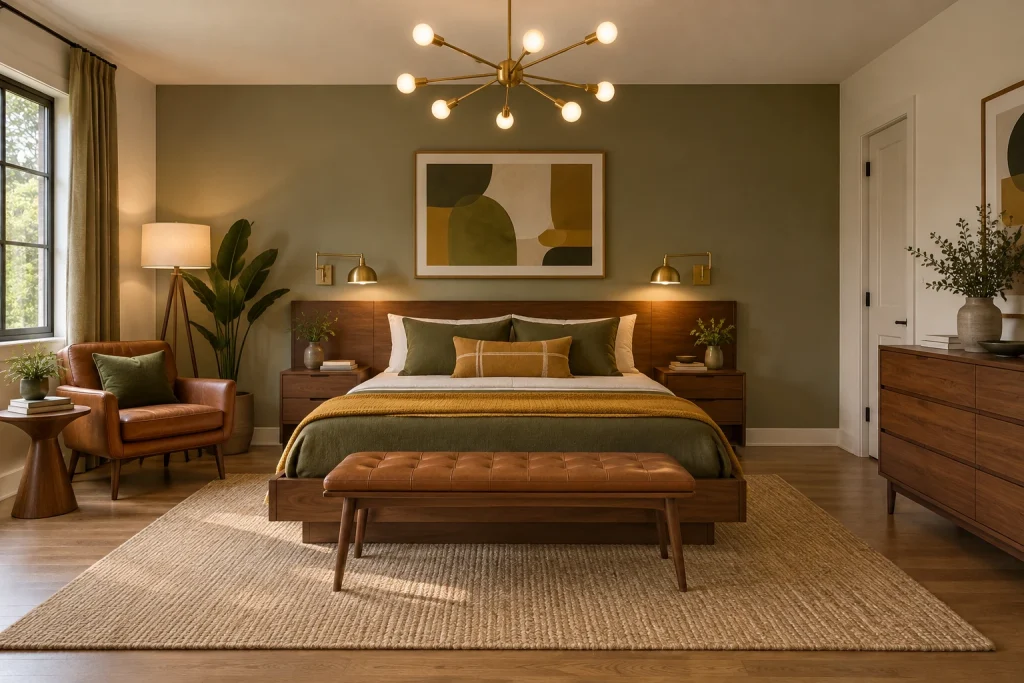
This layered-bedroom-lighting-ideas approach starts with a brass-toned sputnik fixture that spreads a warm, decorative pool of light across the center of the room. It is balanced by a pair of compact swing-arm sconces mounted directly above the walnut nightstands, placing focused light at either side of the bed without crowding the surfaces. At the window end, a tripod floor lamp brightens the leather chair and its small round table, defining a separate reading or lounging corner. Daylight enters through the large left-hand window, while the olive accent wall, walnut headboard, and mustard bedding hold their depth under the warmer artificial light. The result is a clear progression from broad ambient illumination to directed bedside light and a softer corner accent.
Why it works: Each light source has a distinct visual job, so the room feels layered rather than uniformly lit.
- Brass-toned sputnik ceiling fixture
- Paired swing-arm bedside sconces
- Tripod floor lamp beside the leather chair
- Large window with olive drapery
- Walnut bed wall and nightstands
Design tip: Place reading sconces high enough to clear stacked pillows, then aim them down toward the mattress.
2. Bohemian Warmth Built Around Soft Pools of Light
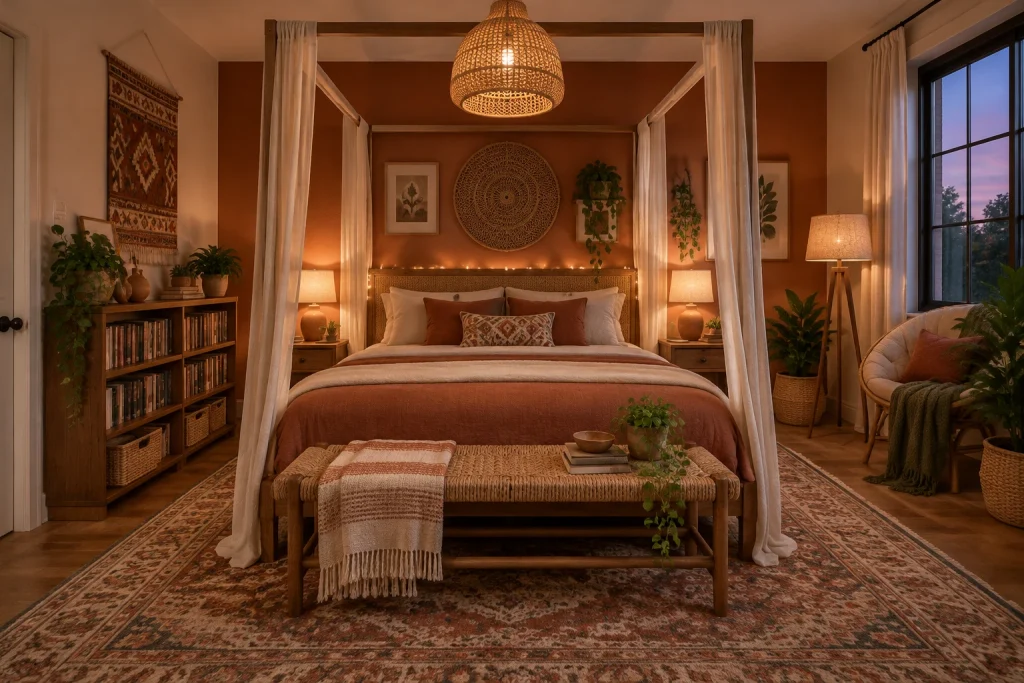
Here, light reinforces the bed’s canopy as the room’s main architectural frame. The woven pendant hangs centrally within the wood canopy, its open rattan shade casting a patterned, warmly filtered glow. Small string lights trace the upholstered headboard, creating a low-level accent that outlines the bed after the brighter lamps are switched off. Matching table lamps on both nightstands provide an even, practical layer beside the pillows, while the tripod floor lamp illuminates the chair by the right-hand window. These sources sit at different heights—from pendant to headboard to tabletop and floor—giving the terracotta wall and mixed textiles a more dimensional evening presence. The visible twilight beyond the window adds a cool counterpoint to the room’s amber-toned lighting.
Why it works: The lighting is distributed across the canopy, bed, and seating area, which makes the layered textiles feel intentional rather than visually heavy.
- Woven rattan pendant
- String lights along the headboard
- Matching bedside table lamps
- Tripod floor lamp near the chair
- Terracotta accent wall and canopy bed
Design tip: Use string lights as a quiet outline, not the primary source; bedside lamps should still provide usable illumination.
3. Architectural Lighting for a Calm, Tailored Bed Wall
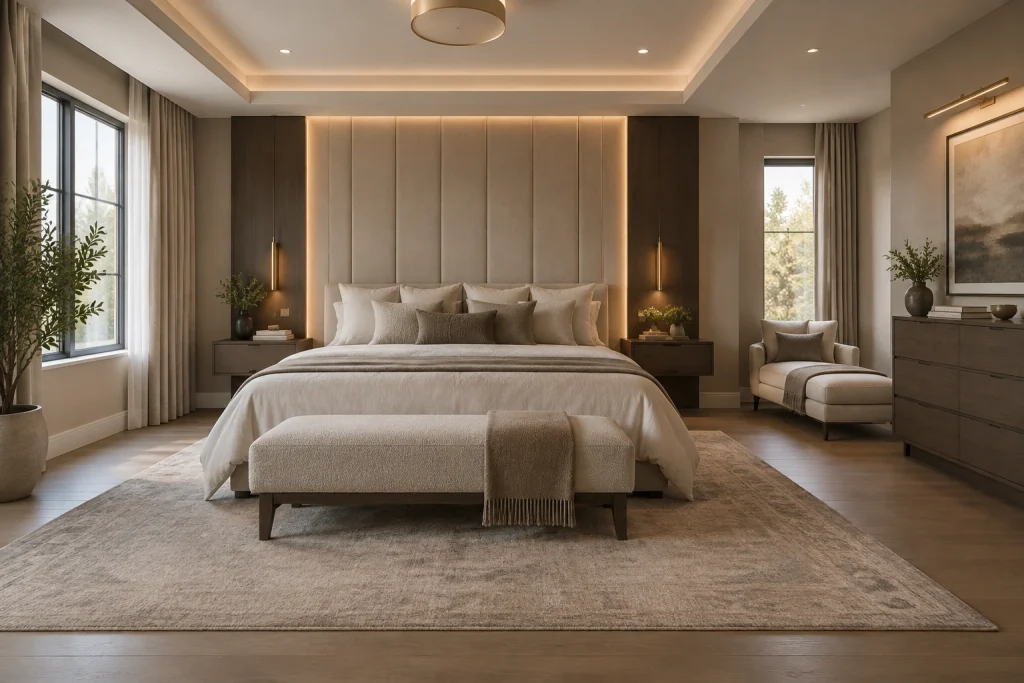
This bedroom treats the headboard wall as a composed lighting feature. A concealed cove around the recessed ceiling washes the perimeter in soft, indirect light, while small recessed downlights supply a quieter general layer overhead. Behind the tall upholstered headboard, narrow vertical lines of warm light separate the pale panels from the dark wood sections on either side, emphasizing the bed’s centered position. Slim vertical fixtures beside the floating nightstands add a more focused bedside layer without introducing visible lamps on the surfaces. Across the room, a linear picture light draws attention to the large framed artwork above the dark dresser. The restrained mix of concealed, recessed, vertical, and art-focused lighting keeps the taupe-and-cream palette visually calm while giving the room definition at night.
Why it works: Most of the illumination is integrated into the architecture, allowing the furnishings and upholstered wall to remain the focus.
- Perimeter cove lighting
- Recessed ceiling downlights
- Illuminated vertical headboard detailing
- Slim bedside wall fixtures
- Picture light above framed art
Design tip: Put cove, downlight, and bedside layers on separate controls so the room can shift from dressing to winding down.
4. A Study-and-Sleep Lighting Plan for a Compact Bedroom
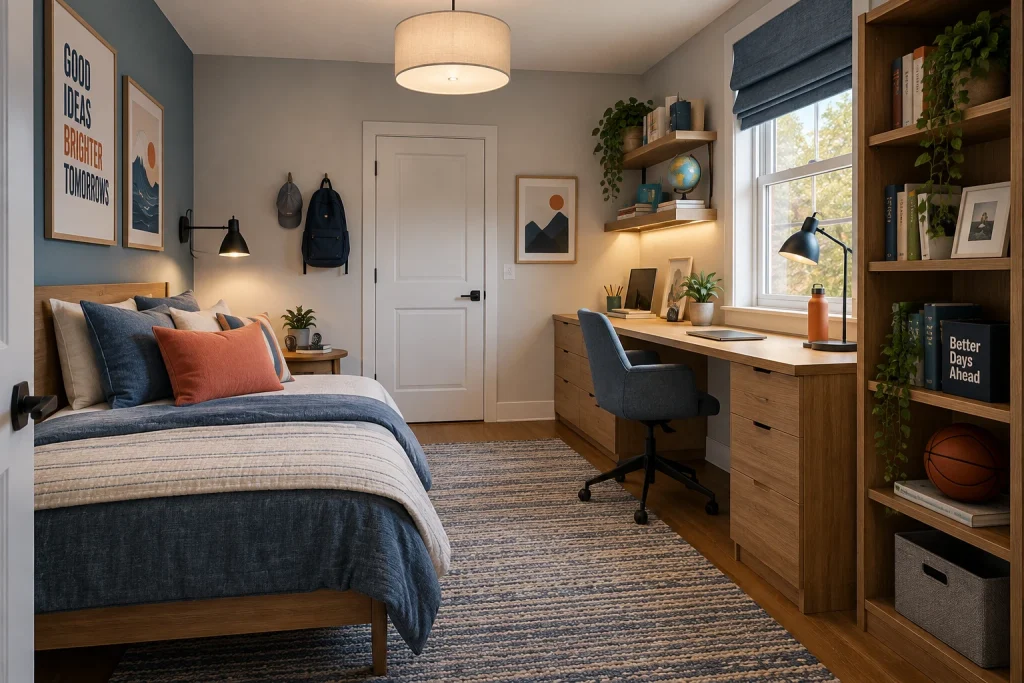
This compact room separates study and sleep with light placed for each activity. A drum pendant centered overhead supplies an even general layer, while the black desk lamp directs brighter light onto the wood work surface beneath the window. A second black swing-arm sconce is mounted at the bed, creating a dedicated reading light that does not require the overhead fixture to be on. Under the pair of floating shelves, a warm strip of light adds a softer glow above the desk and highlights the books, globe, and small objects displayed there. Natural daylight comes through the right-hand window, close to the desk, while the denim-blue bed textiles and coral pillow remain visually distinct under the warmer electric light. This is a practical layered-bedroom-lighting-ideas formula for one room with two daily functions.
Why it works: Task lighting stays concentrated at the desk and bed, while the pendant and under-shelf glow prevent the narrow room from feeling harshly lit.
- Central drum pendant
- Adjustable black desk lamp
- Black swing-arm bedside sconce
- Under-shelf light at the desk
- Window positioned beside the work surface
Design tip: Aim a desk lamp across the work surface from the side to limit shadows from the writer’s hand.
1. Pair a Statement Chandelier With Bedside Pools of Light
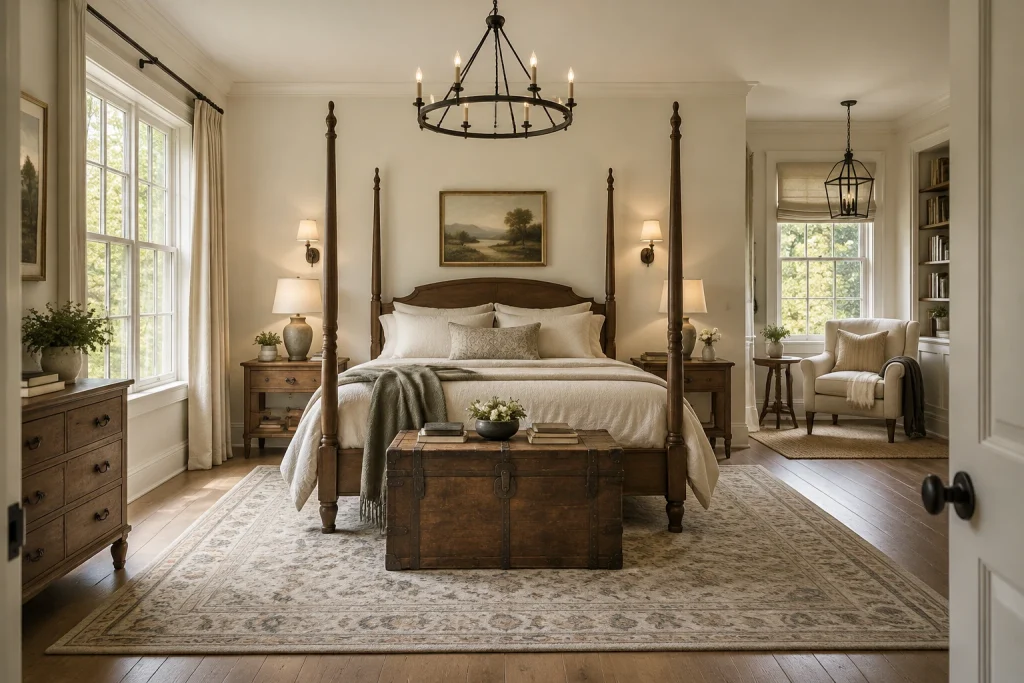
This bedroom makes layered-bedroom-lighting-ideas feel especially coherent by giving each fixture a clear visual role. An iron ring chandelier establishes the room’s broad, warm glow and echoes the dark wood four-poster bed without competing with it. At the bed, matching shaded wall sconces create a soft layer against the cream wall, while ceramic table lamps on the wood nightstands bring light down to a useful reading height. Across the room, a lantern-style pendant marks the sitting area beside the window and armchair. The result is a comfortable progression from central illumination to focused bedside light and a smaller, atmospheric zone at the window. Cream curtains, pale bedding, and the patterned rug keep the darker iron and wood details from making the scheme feel heavy.
Why it works: The fixtures share a traditional silhouette and dark metal finish, but vary in scale and placement, so the room gains depth rather than visual repetition.
- Iron ring chandelier with candle-style bulbs
- Matching shaded bedside sconces
- Ceramic table lamps on wood nightstands
- Lantern pendant over the window-side sitting area
- Dark wood four-poster bed that anchors the lighting composition
Design tip: Use matching bedside sconces for symmetry, then reserve a distinct pendant for a separate corner or seating zone.
2. Build a Hotel-Like Bed Wall With Compact Layers
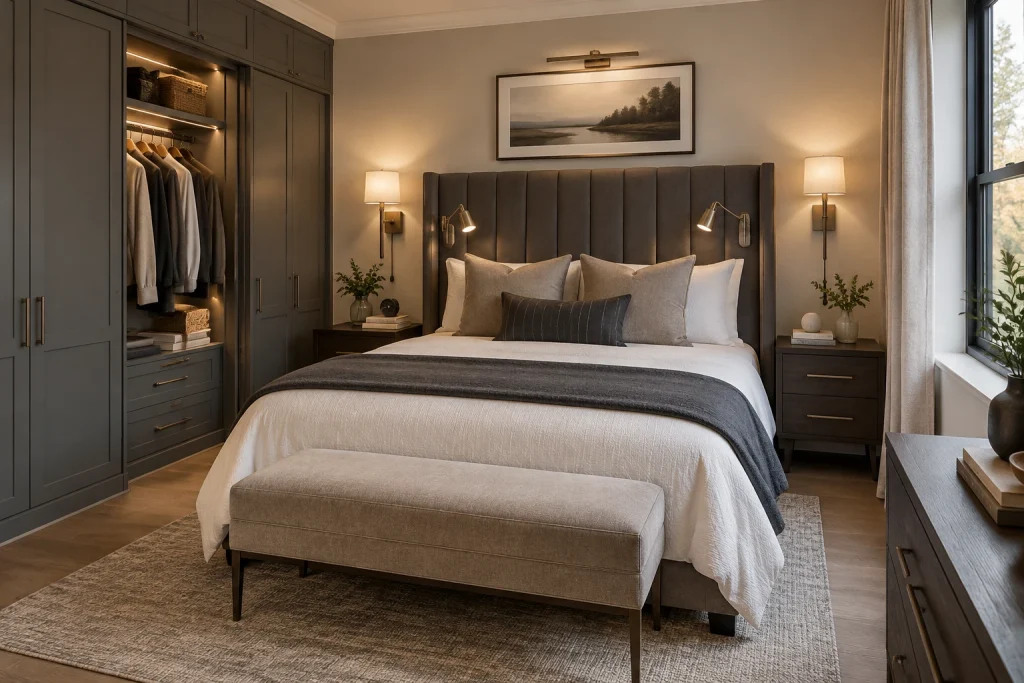
A tall charcoal upholstered headboard turns this compact bedroom into a disciplined lighting backdrop. Two shaded wall lamps frame the bed with warm, even illumination, while the slim swing-arm reading lights mounted on the headboard provide tighter, directional light for each side. Above, a narrow picture light washes the framed landscape rather than asking the bedside lamps to do every job. The open portion of the charcoal built-in closet introduces another practical layer: shelf and hanging-rail lighting makes the clothing area visible and adds a subtle glow along the left wall. These layers are closely coordinated in dark metal, soft shades, and warm light, which helps the room retain a calm hotel-inspired character despite the number of sources. Daylight through the large right-side window offsets the deeper charcoal cabinetry and headboard.
Why it works: Wall-mounted and headboard-mounted fixtures preserve nightstand surfaces while separating ambient, reading, art, and closet illumination into distinct functions.
- Tall channel-tufted charcoal headboard
- Paired shaded wall lamps beside the bed
- Individual swing-arm reading lights
- Slim picture light above framed artwork
- Illuminated open closet shelves and hanging rail
Design tip: In a small bedroom, mount reading lights at the headboard and use a picture light above art to add layers without adding floor or tabletop clutter.
Final thoughts
The strongest bedroom lighting plans give each source a distinct job. Start with a broad ambient layer, then add task lights for reading, dressing, or desk work. Finish with accents that draw attention to art, shelving, a headboard, or a seating area. Whether the room is compact and practical, dark and dramatic, or pale and minimal, the same principle applies: distribute light across heights and zones instead of concentrating it in a single fixture. With separately controlled layers, the bedroom can shift more easily from a bright morning routine to focused evening reading and a softer, restful end to the day.