Hallways work hardest when their details create both a route and a reason to pause. Layering a narrower runner over a larger natural-fiber or textured rug can define the path while adding softness underfoot. Sculptural pendants, sconces, chandeliers, and picture lights bring dimension overhead and along the walls, while a compact gallery, mirror grouping, or single artwork gives the corridor a destination. These hallway-runner-sculptural-lighting ideas show how to balance textiles, illumination, storage, and art in entries, landings, and long connecting passages.
1. Soften a Narrow Hall With Layered Natural Runners
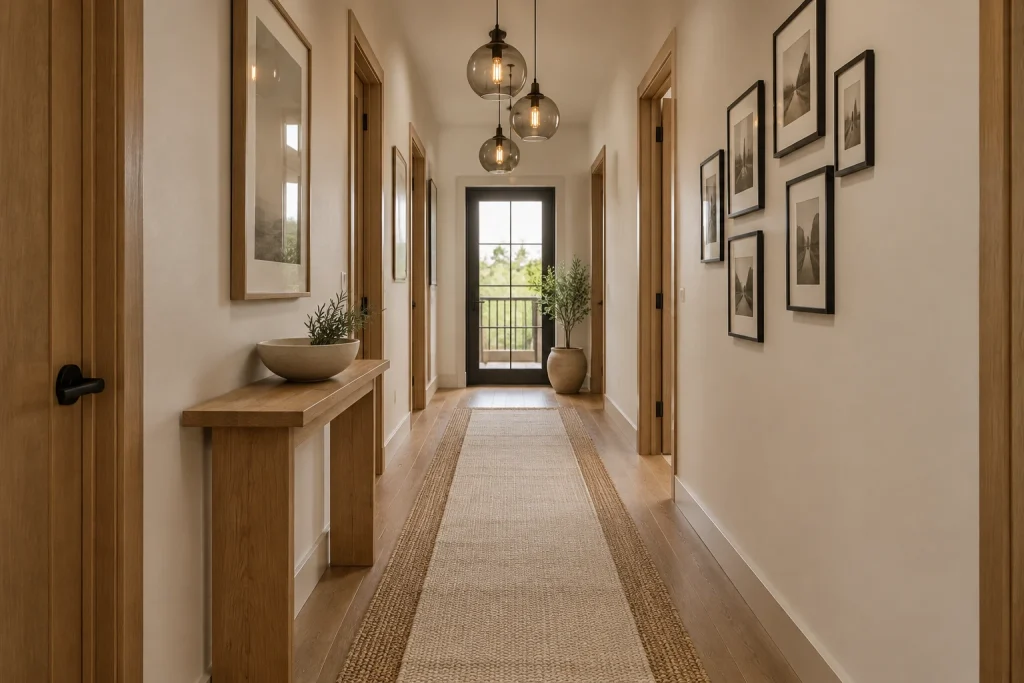
This hallway-runner-sculptural-lighting approach starts at floor level: a cream runner sits neatly inside a wider, nubby jute layer, creating a long band of texture against warm wood flooring. The exposed jute border gives the pale center definition without introducing a strong pattern. Above, four smoked-glass globe pendants hang at varied heights down the centerline, their visible filament bulbs echoing the warm wood door frames and slim oak console. A shallow bowl, leafy branches, and a small framed-photo arrangement on the opposite wall add interest while keeping the surfaces visually spare. At the end, the dark-framed glazed door provides a crisp focal point and pulls daylight through the corridor.
Why it works: Tone-on-tone rug layers add depth without making the already linear space feel busier, while the pendants turn the ceiling into a second decorative plane.
- Cream center runner over a textured jute base
- Four staggered smoked-glass pendants
- Slim oak console with a sculptural bowl
- Small black-framed photo grouping
- Warm wood door frames and pale walls
Design tip: Choose an upper runner narrower than its base layer so a consistent border remains visible.
2. Anchor a Generous Foyer With Pattern and Brass
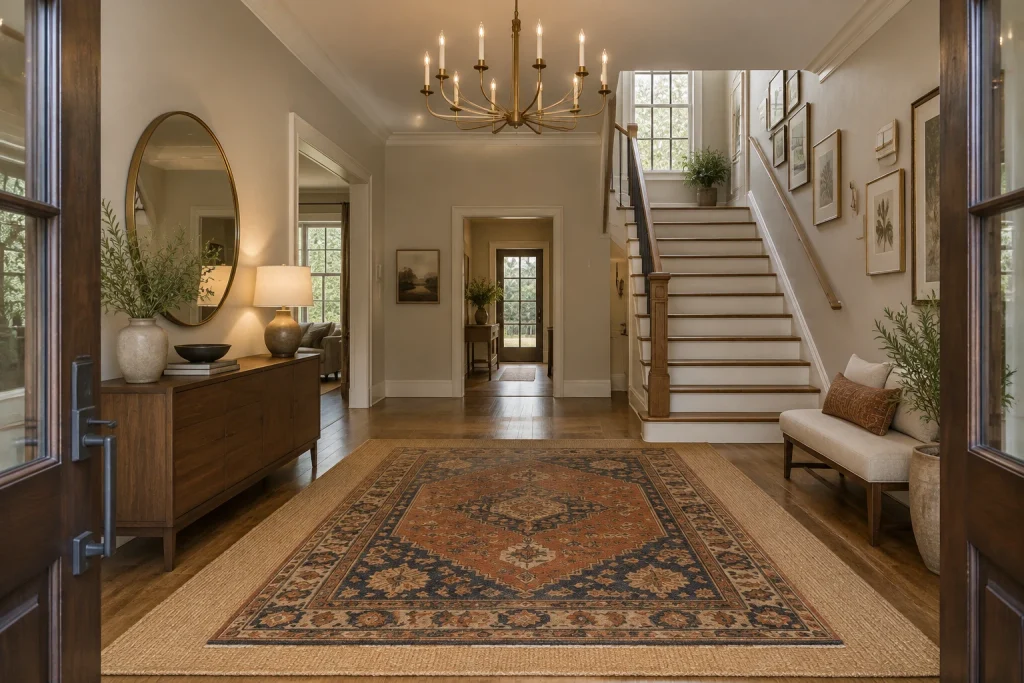
In this entry, a large rust-and-navy patterned rug is layered over a broad natural-fiber base, making the floor the room’s central composition. The patterned layer is positioned inside the lighter perimeter, so its detailed border remains easy to read from the open front doors. A branched aged-brass chandelier spreads horizontally overhead, balancing the rug’s broad footprint and filling the tall volume without a heavy central shade. Dark walnut furniture grounds the warm palette: a low credenza holds a ceramic vase, bowl, books, and table lamp beneath an oval mirror, while a pale upholstered bench sits beside the staircase. Framed botanical and landscape-style art climbs the stair wall, extending the foyer’s collected character upward.
Why it works: The natural base rug quiets the ornate pattern, while repeated warm wood, brass, and rust tones make the varied furnishings read as one scheme.
- Patterned rust-and-navy area rug
- Oversized natural-fiber base rug
- Branched brass chandelier with candle-style bulbs
- Walnut credenza and oval mirror
- Upholstered bench with a rust accent pillow
Design tip: Layer a patterned rug within a larger neutral one to give a sizable entry a clearly defined center.
3. Use Stripes to Lead the Eye Through a Storage Hall
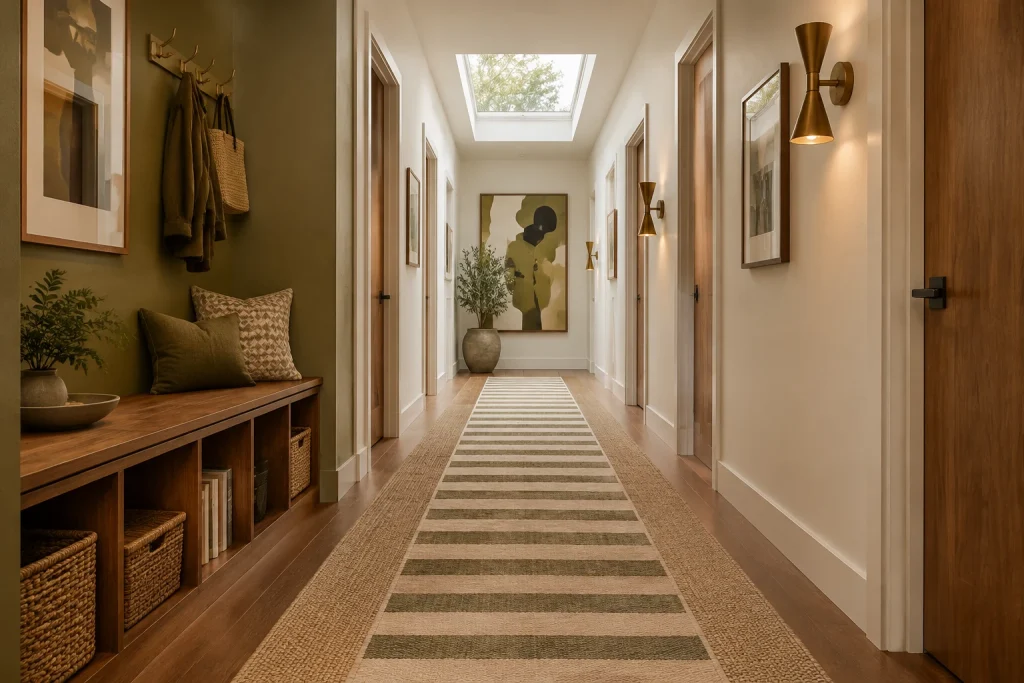
A long striped runner establishes a clear route through this mid-century-leaning corridor. Its muted olive and cream bands sit on a wider, textured neutral rug, pairing graphic order with a softer, pebbled-looking edge. On the left, an olive accent wall frames a low teak bench with open cubbies holding woven baskets and books; cushions and a shallow bowl make the storage wall feel considered rather than utilitarian. Brass coat hooks above carry a jacket and tote, while double-cone brass sconces repeat along the white wall to the right. At the far end, a large abstract painting in olive, cream, and black becomes the visual destination below a rectangular skylight. Wood doors and trim keep the mixed materials warm.
Why it works: The runner’s repeated horizontal bands visually lengthen the hall, and the olive accents connect the storage zone, art, and floor textile without overwhelming the white walls.
- Olive-and-cream striped runner
- Wider neutral textured rug beneath
- Teak bench with open cubbies
- Woven storage baskets and brass coat hooks
- Double-cone brass wall sconces and skylight
Design tip: Repeat one accent color in the runner and end-wall art to make a long corridor feel deliberately connected.
4. Add Warmth to Concrete With a Double Rug Layer
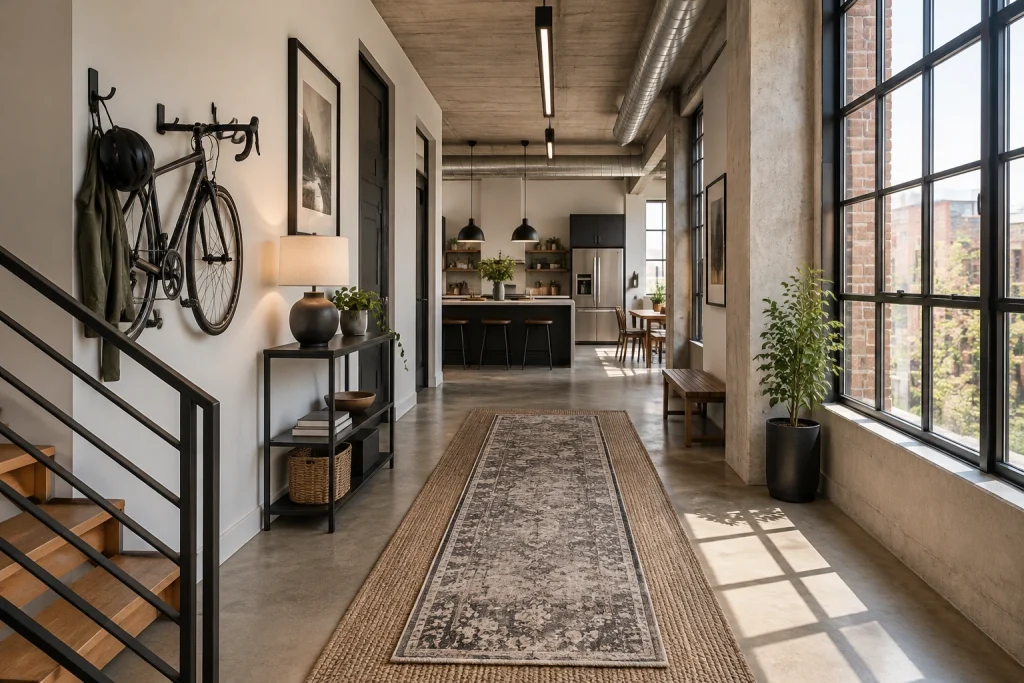
This industrial passage uses a narrow distressed-pattern runner over a larger woven base to soften the expanse of gray concrete flooring. The outer rug’s warm brown texture creates a generous frame around the weathered charcoal-and-cream pattern, which aligns with the length of the corridor. A black linear ceiling fixture and exposed silver ductwork emphasize the space’s strong horizontal direction, while black window mullions, stair railings, and a slim metal console repeat the dark metal vocabulary. The console is styled simply with a lamp, plants, books, a bowl, and a woven basket. A wall-mounted bicycle, helmet, and jacket make the entry wall functional; a wood bench and tall potted plant occupy the window side. The view ends at the open kitchen area.
Why it works: Textiles introduce warmth and pattern into a hard-surfaced setting, while the black linear fixtures and frames give the layered rugs a disciplined architectural context.
- Distressed patterned runner over a woven brown base
- Concrete floor and exposed ceiling ductwork
- Black linear pendant fixtures
- Slim black metal console with table lamp
- Grid windows, wood bench, and wall-mounted bicycle
Design tip: Use a low-profile rug base beneath a narrower patterned runner to preserve the crisp, streamlined feel of industrial finishes.
1. Build Warmth With a Layered Neutral Runner
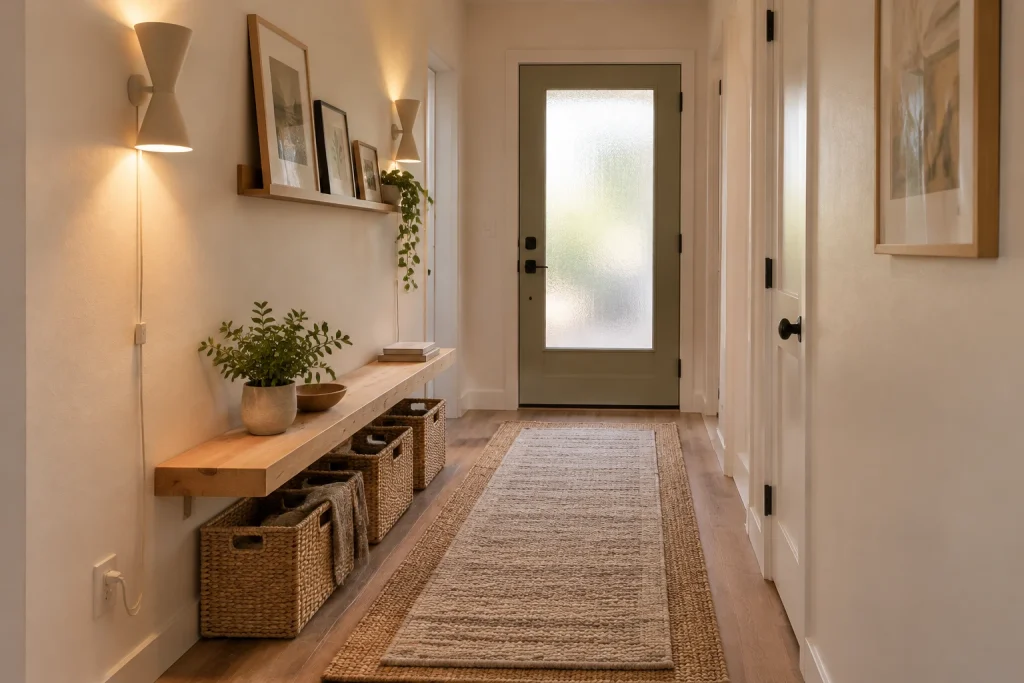
A layered runner gives this slim entry a more considered texture without crowding the floor. The outer rug is a chunky, natural-looking weave with a narrow, lighter runner centered on top; the two pieces create a clear border and a softer landing zone at the door. Along one wall, a thick pale-wood floating bench keeps the floor visible beneath it, while woven baskets line up below. Above, a shallow wood picture ledge holds casually leaned framed prints, and three sculptural wall sconces cast warm up-and-down pools of light. Their visible cords run neatly down the wall to an outlet, adding a practical, non-hardwired look. The frosted-glass door brightens the end of the hall without sacrificing privacy.
Why it works: The runner layers add dimension, while the bench, art ledge, and sconces keep every accent on one side of the narrow passage.
- Natural-fiber-look outer runner
- Lighter textured runner centered on top
- Pale wood floating bench
- Woven storage baskets
- Corded sculptural wall sconces
Design tip: Center the top runner precisely so the wider base reads as an intentional border.
2. Pair Indigo Pattern With Natural-Fiber Texture
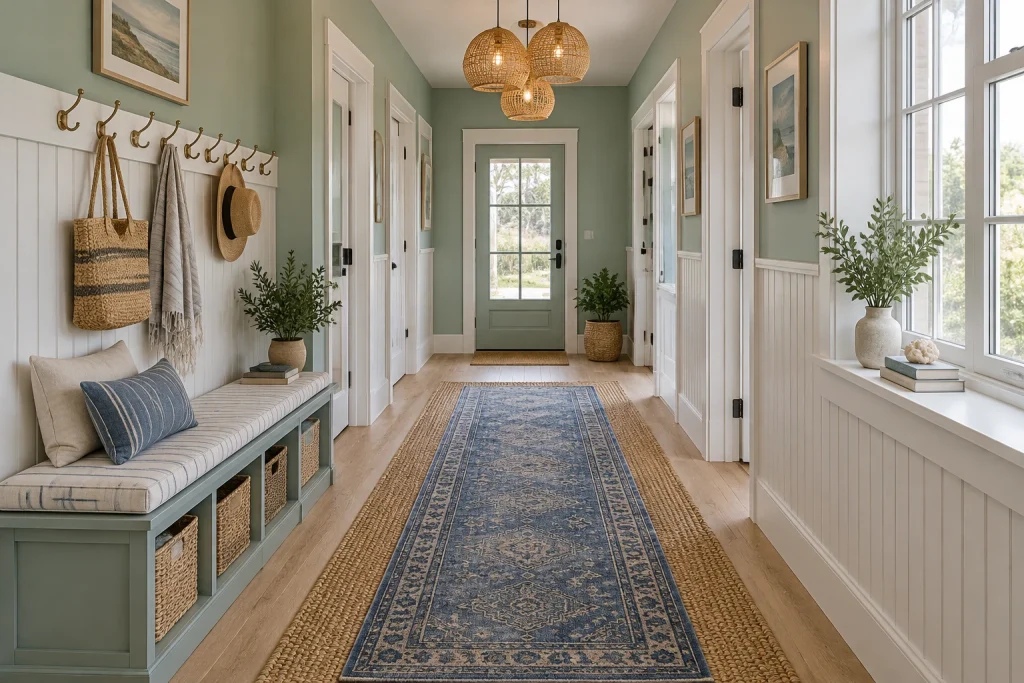
This hallway uses a broad woven natural-fiber rug as a grounding layer, then centers a faded indigo patterned runner over it. The contrast is simple but effective: the woven perimeter brings warmth and texture, while the blue runner establishes a long visual line toward the glass-paneled door. Soft green walls and white beadboard wainscoting reinforce the relaxed palette. A painted green bench provides a contained drop zone, with striped seat cushions, two pillows, and woven baskets fitted into open cubbies below. Above it, a white hook rail holds a bag, a throw, and straw hats. Overhead, three woven pendant shades hang at staggered heights, turning functional lighting into a focal point. On the opposite side, tall windows and a deep ledge introduce daylight and a small arrangement of books, a vessel, and greenery.
Why it works: Natural fibers, faded blue, painted beadboard, and rattan lighting repeat an easygoing material language without making the corridor feel overly themed.
- Indigo patterned runner
- Woven natural-fiber base rug
- Painted storage bench with baskets
- Brass-toned hook rail
- Cluster of woven pendant shades
Design tip: Choose a low-profile top runner so its edges stay visually crisp over a textured base.
3. Use a Dark Envelope to Spotlight a Jewel-Toned Runner
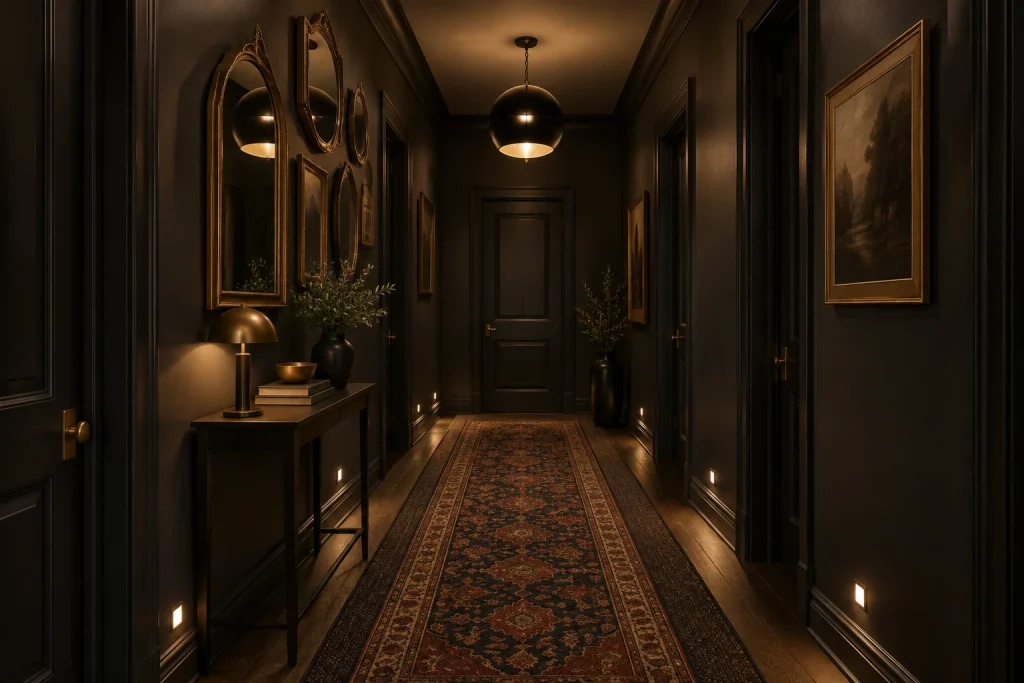
Deep charcoal walls, doors, trim, and ceiling details turn this corridor into a dramatic backdrop for a richly patterned runner. The runner’s rust, muted red, and tan motifs sit within a darker surrounding floor layer, giving the center of the hall a clearly defined path. A black dome pendant hangs directly over the runner, its warm interior glow echoed by low wall lights near the baseboards. At left, a slim black console is styled sparingly with a small brass-toned lamp, books, a shallow bowl, and a dark vase of branches. Above it, an assortment of antique-looking gold-framed mirrors creates a vertically layered gallery. More framed art and a tall dark vessel with branches add rhythm farther down the hall. The restrained warm lighting keeps the dark finish legible rather than flat.
Why it works: The dark envelope unifies the long, narrow surfaces, allowing the patterned runner, brass-toned frames, and pools of light to carry the visual interest.
- Jewel-toned patterned center runner
- Dark floor layer framing the runner
- Black dome pendant
- Gold-framed mirror gallery
- Slim console with a small lamp
Design tip: In a dark hall, repeat warm light at ceiling, tabletop, and low-wall levels for clearer depth.
4. Continue the Stair Runner Across the Landing
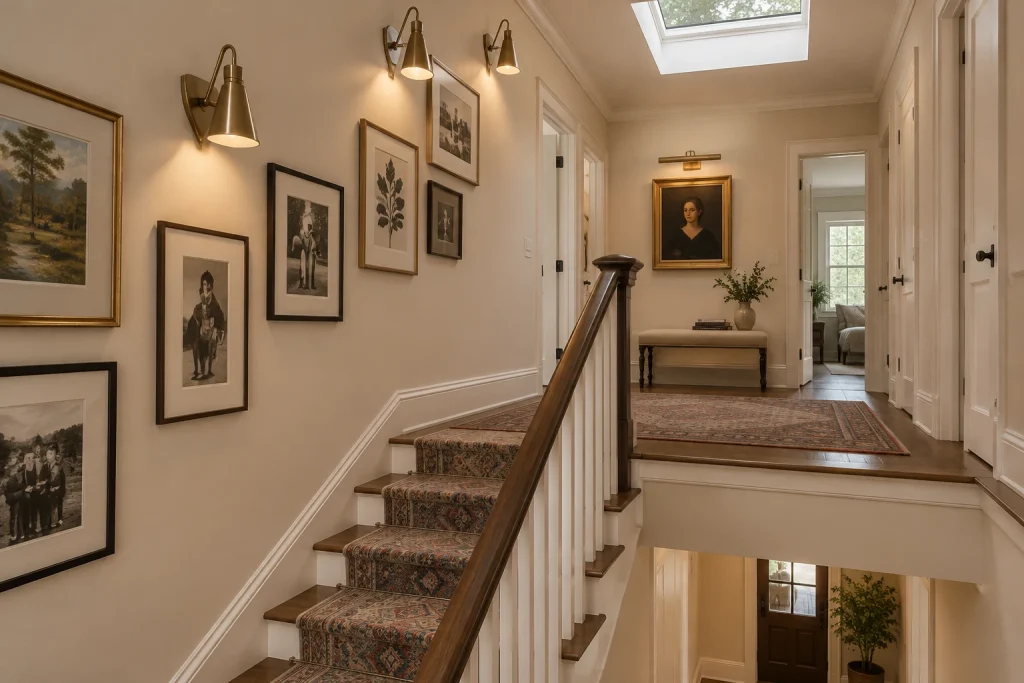
The patterned runner begins on the wood stair treads and continues across the upper landing, visually linking the two levels with one repeating motif. Its muted rust, blue, and cream palette works comfortably with the dark stained handrail and warm neutral walls. A photo and art gallery follows the diagonal rise of the staircase, mixing black, gold, and natural wood frames in varied sizes. Three brass-toned wall sconces trace the ascent above the collection, while a picture light highlights the framed portrait at the landing. A small upholstered bench is placed against the far wall with a short stack of books and a vase of greenery, leaving the center of the landing open. Overhead daylight enters through a rectangular skylight, balancing the warmer wall lighting and drawing attention to the upper hall.
Why it works: Repeating the runner beyond the last step makes the landing feel connected to the staircase, while the ascending gallery turns a blank transition wall into a destination.
- Coordinating stair and landing runners
- Mixed-frame staircase gallery
- Brass-toned wall sconces
- Portrait with a picture light
- Upholstered landing bench
Design tip: Align a stair gallery with the handrail angle, then keep the upper landing wall arrangement more level and contained.
1. Build a Gallery Hall Around One Precise Runner
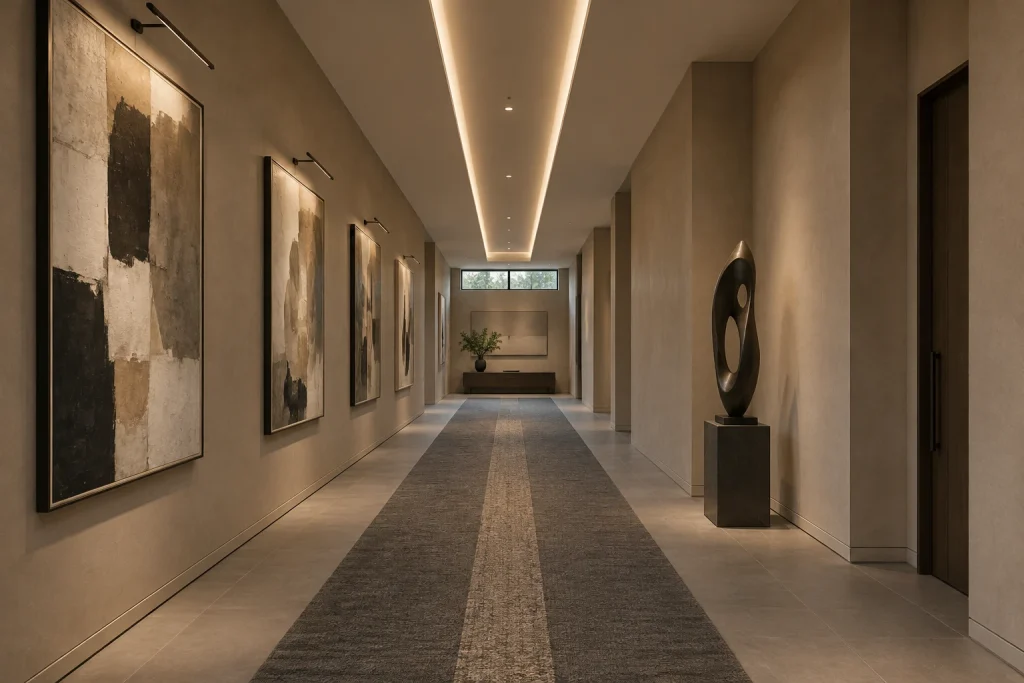
This wide hallway uses a single charcoal-gray runner with a lighter, finely textured stripe running through its center. The rug establishes a strong axis without covering the pale tile perimeter, so the floor still reads as part of the composition. Along the left wall, large vertical abstract artworks are evenly spaced and individually lit by slim black picture lights. Above, a long recessed ceiling channel casts warm linear light down the length of the hall, while small recessed spots add a second, quieter rhythm. On the right, a dark abstract sculpture sits alone on a square pedestal, giving the otherwise spare wall a focal pause. The result is hallway-runner-sculptural-lighting used with disciplined restraint rather than visual clutter.
Why it works: The runner, ceiling light, and art arrangement all reinforce the hall’s length, while warm taupe walls soften the crisp geometry and negative space lets each artwork register.
- Charcoal runner with a centered lighter stripe
- Long recessed linear ceiling light
- Large black-framed abstract art
- Slim black picture lights
- Dark sculptural object on a pedestal
Design tip: Center one long runner, then leave a consistent border of exposed flooring on both sides.
2. Layer a Practical Entry Path With Storage and Color
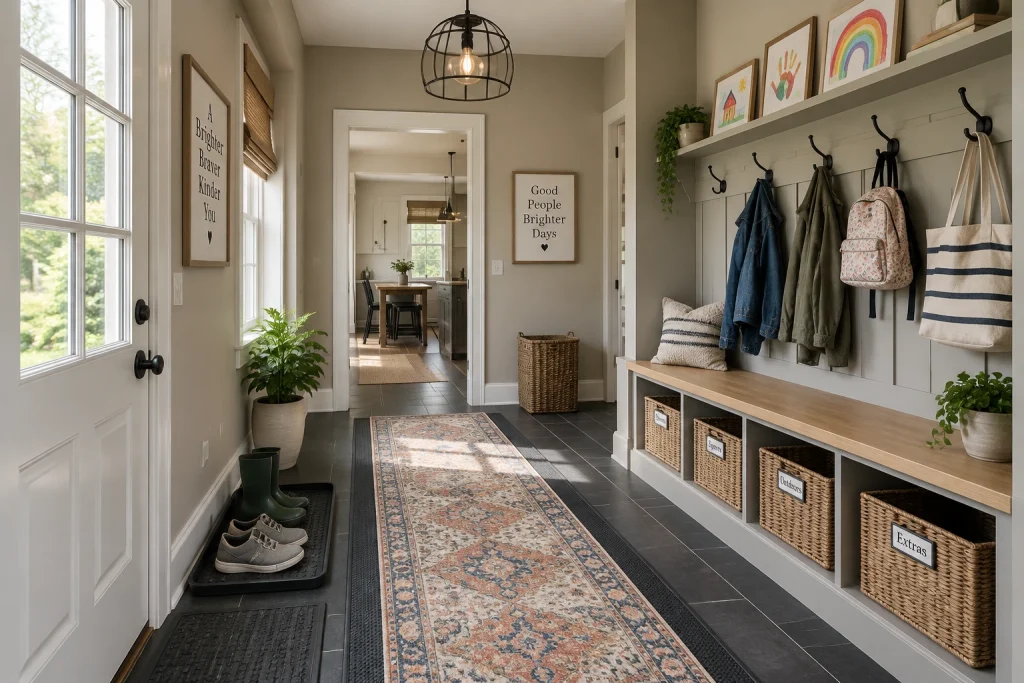
Here, a patterned runner in muted rust, blue, and cream is layered over a larger dark mat on a charcoal tile floor. The pairing creates a defined route from the white back door toward the interior doorway while keeping the more decorative textile away from the floor’s edges. A black tray beside the door collects rain boots and sneakers, reinforcing the entry’s practical purpose. Across from it, a long wood-topped bench combines a perch with open cubbies fitted with woven baskets; visible labels include “Sports,” “Outdoors,” and “Extras.” Black hooks hold jackets, a backpack, and a striped tote beneath a shelf displaying framed children’s drawings and small plants. A black wire-cage pendant adds an industrial outline overhead without competing with the colorful runner.
Why it works: Hard-working zones are visually distinct: shoes gather by the door, bags and outerwear hang above the bench, and the layered rugs soften the long tile passage.
- Patterned runner layered over a dark mat
- Black shoe tray by the door
- Wood bench with woven storage baskets
- Wall-mounted black coat hooks
- Wire-cage pendant with an exposed bulb
Design tip: Use a low-profile mat under a narrower runner to define the path without overwhelming the tile floor.
Final thoughts
A successful hallway does not need many furnishings; it needs a clear visual structure. Start with a runner or layered rug arrangement that suits the floor and the hall’s proportions, then choose lighting that reinforces the direction of travel and provides warmth at key moments. Finish with edited storage and a small gallery wall, mirror collection, or sculptural accent. Together, these elements turn an overlooked pass-through into a practical, composed part of the home.