Open shelves work best when they are treated as active kitchen storage first and a display second. The most successful arrangements give everyday plates, bowls, glasses, and jars clear places while using repetition, negative space, and a limited material palette to keep the overall view calm. From whiteware on oak shelves to glassware against brick, labeled pantry jars in walnut cabinetry, and plant-led displays near windows, these open-shelving-kitchen-styling ideas show how to build a shelf composition that is both useful and visually considered.
1. Build a Useful Whiteware Rhythm
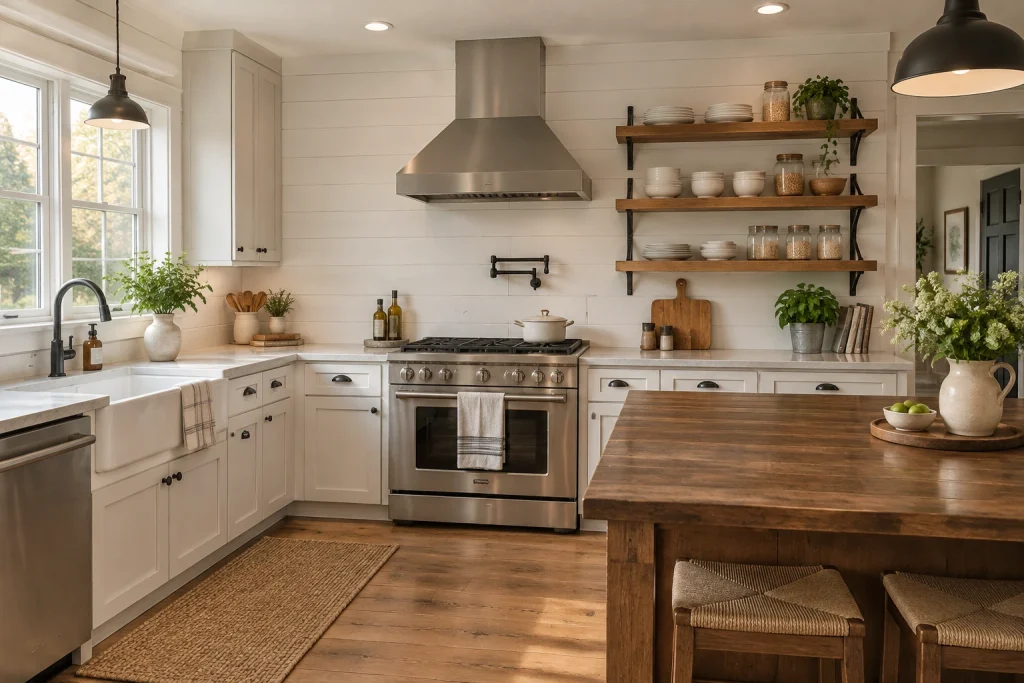
For open-shelving-kitchen-styling that feels orderly rather than precious, this arrangement relies on repetition. Three oak shelves on black metal brackets hold stacks of white plates, bowls, and small serving pieces, with clear jars of dry goods spaced among them. The limited white-and-wood palette relates directly to the shiplap wall, pale cabinetry, and wood island, while the stainless range provides a crisp focal point beside the display. A potted plant and a trailing stem soften the straight shelf lines without obscuring the dishes. Keep the most substantial stacks low and central, then use the top shelf for lighter visual notes: a jar, smaller plate stacks, and greenery. The result reads as a working collection with breathing room between groups.
Why it works: Repeated white ceramics create visual calm, while wood, glass, and plants add enough contrast to prevent the shelves from looking flat.
- Three thick oak shelves
- Black metal shelf brackets
- Stacks of white plates and bowls
- Clear glass storage jars
- Potted and trailing greenery
Design tip: Group everyday dishes in compact stacks, leaving visible gaps between each cluster.
2. Let Empty Shelf Space Do the Editing
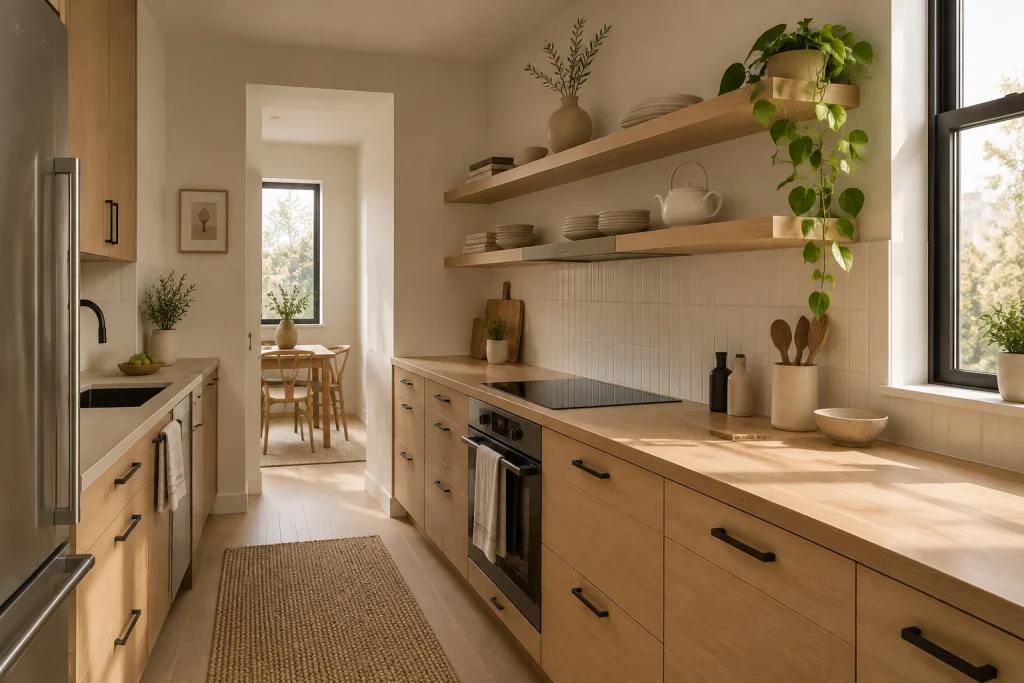
This pale-wood shelving uses restraint as its main styling device. Two long floating shelves carry only a few low stacks of neutral dishes, a rounded ceramic vase with branches, a white teapot, a small pile of books, and one trailing plant. The plant occupies the far right edge and draws the eye vertically toward the window, while the remaining objects sit in short, quiet groupings. Below, the pale wood counter remains largely clear around the black cooktop; a utensil crock, bottles, cutting boards, and a bowl are gathered rather than dispersed. Warm sunlight from the right picks up the grain of the cabinetry and shelves. In a narrow kitchen, this sparse approach keeps open storage from visually compressing the wall.
Why it works: A restricted palette and widely spaced objects preserve a sense of openness, while varied silhouettes keep the composition from becoming rigid.
- Pale floating wood shelves
- Neutral ceramic dish stacks
- Rounded vase with leafy branches
- White ceramic teapot
- Single trailing green plant
Design tip: Limit each shelf to a few grouped moments instead of filling its full length.
3. Pair Glassware With Industrial Structure
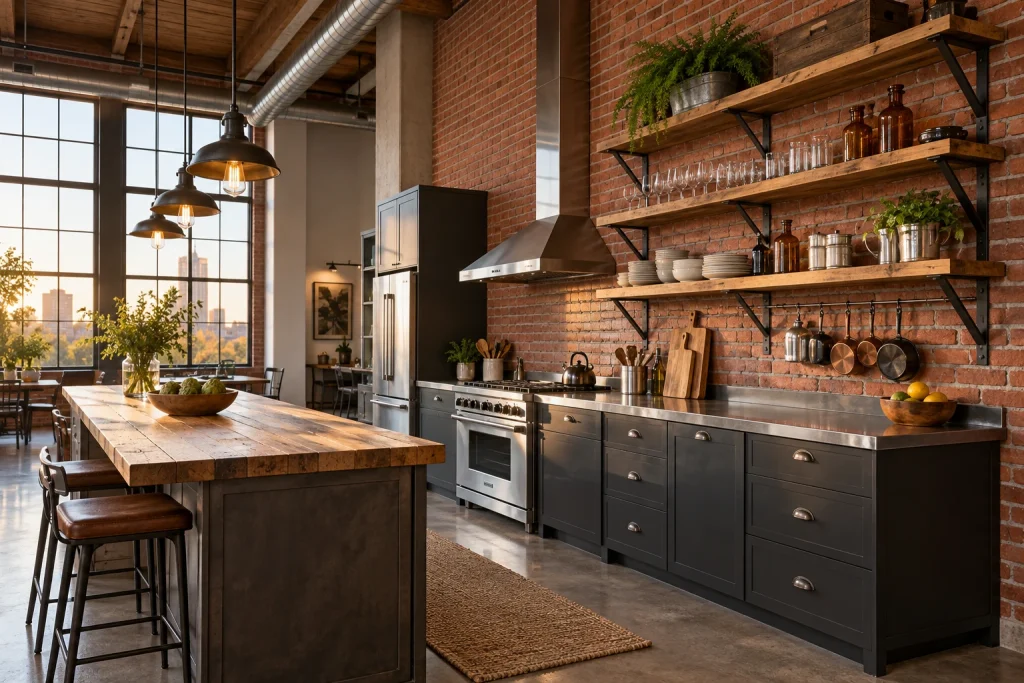
Against the exposed brick, the open shelving becomes part storage and part architectural texture. Reclaimed-wood boards are held by substantial black steel brackets, creating strong horizontal bands above the dark cabinetry and stainless counter. The middle shelf gives clear glassware a dedicated run, with wine glasses and tumblers arranged in a linear grouping; nearby amber bottles introduce a warmer, darker note. Lower shelves hold neat stacks of white plates and bowls, metal canisters, and more bottles, while leafy plants in metal containers break up the brick-and-metal surfaces. A rail beneath the shelves adds a second storage layer for hanging pots and pans. The display feels cohesive because repeated materials—wood, black metal, clear glass, and warm brown glass—reappear throughout the wall.
Why it works: The shelves use repetition and material contrast to organize a large brick wall without competing with the range or the island.
- Exposed red brick backdrop
- Reclaimed-wood shelves
- Black steel brackets and rail
- Grouped stemware and tumblers
- Amber glass bottles and metal planters
Design tip: Reserve one shelf run for glassware, then anchor the adjacent shelves with opaque dish stacks.
4. Style a Dark Shelf With Tone and Texture
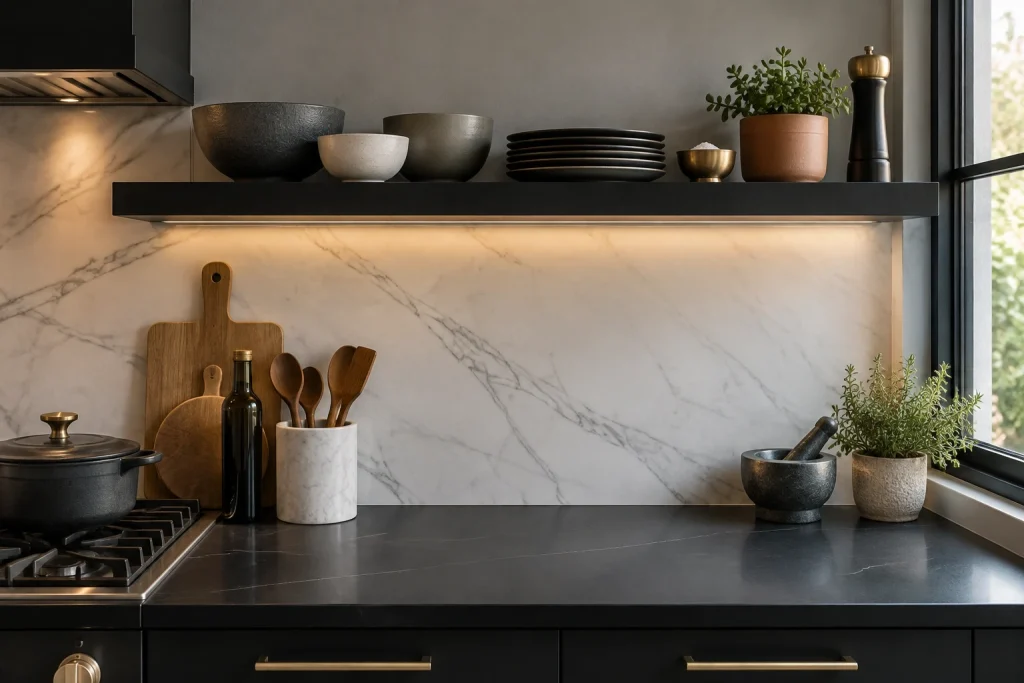
A single wide matte-black shelf makes a deliberate frame for a tightly edited collection. Large charcoal bowls, a small pale bowl, a stack of black plates, a brass-toned bowl, a terracotta plant pot, and a tall black mill create a sequence of changing heights and finishes. Their dark, earthy surfaces stand out against the veined white marble backsplash, while the shelf’s underlighting draws a clean line across the stone. On the counter, the arrangement stays concentrated at either side: cutting boards, a dark bottle, and a marble utensil crock sit near the cooktop, while a mortar and pestle and a small herb-like plant sit near the window. The broad expanse of uncovered black countertop is essential to the composed, modern effect.
Why it works: Black, marble, wood, brass, and greenery provide distinct textures, and generous empty counter space gives each grouping visual weight.
- Wide matte-black floating shelf
- Black and charcoal ceramic bowls
- Stacked black plates
- White veined marble backsplash
- Brass-toned accents and green plants
Design tip: On a dark shelf, mix matte ceramics with one or two reflective accents rather than adding more colors.
1. Use Baskets to Soften a White Open-Shelf Wall
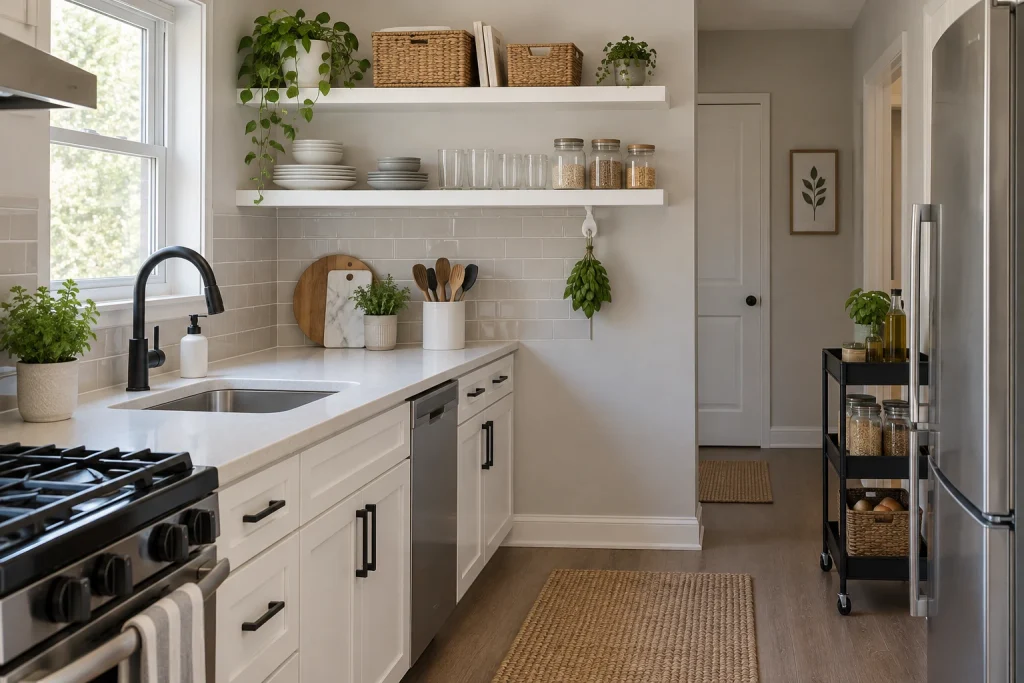
Two long white shelves turn the wall above the backsplash into useful display storage while keeping the counter below largely open. On the lower shelf, white plates and bowls are stacked in compact groups, then balanced by a tidy line of clear drinking glasses and lidded dry-goods jars. The upper shelf shifts toward concealed storage with two woven baskets, while a few books and trailing plants break up the horizontal composition. A white hook below the shelf holds a hanging bunch of greenery, adding interest without taking up counter space. At the far right, a slim black rolling cart continues the storage solution with bottles, jars, and a woven bin. Black faucet and cart details sharpen the otherwise pale palette.
Why it works: The arrangement assigns each shelf a clear role: everyday dishes below, bulkier catchall storage above. Repeated whites keep the varied objects visually calm, while wicker and greenery add warmth.
- Two white wall shelves
- Woven storage baskets
- Stacks of white dishes
- Clear glassware and lidded jars
- Slim black rolling cart
Design tip: Group open-shelf items by function, then use matching baskets to hide less display-worthy supplies.
2. Let a Deep Teal Backdrop Unite an Eclectic Mix
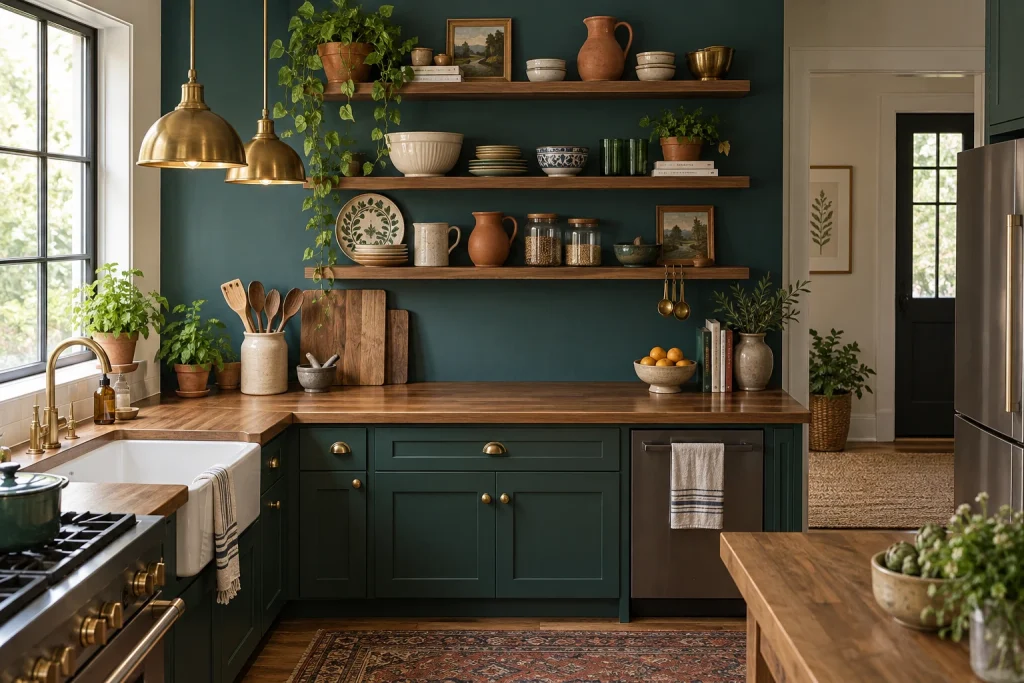
Against a saturated teal wall, three dark wood shelves hold an intentionally varied mix of ceramics, glassware, framed art, books, pantry jars, and plants. The styling avoids a rigid matching set: a terracotta pitcher sits near cream bowls and a brass bowl on the top shelf, while patterned ceramics, green glasses, and stacked plates create shifts in color and texture below. Trailing vines move vertically across the shelves, softening their straight lines. The counter continues the layered look with cutting boards, a utensil crock, a stone mortar and pestle, books, a bowl of citrus, and a leafy vase, yet a broad stretch of wood counter remains visible at center. Brass pendants and brass cabinet hardware echo the warm tones of the shelves and pottery.
Why it works: The teal backdrop provides one strong field behind many different finishes. Repeated notes of green, cream, warm wood, and brass make the assortment read as collected rather than scattered.
- Deep teal wall
- Three dark wood shelves
- Terracotta and cream ceramics
- Brass pendant lights
- Trailing and potted greenery
Design tip: For an eclectic shelf, repeat two or three colors across every row instead of matching every object.
3. Make a Kitchen Corner Work Harder With Wraparound Shelves
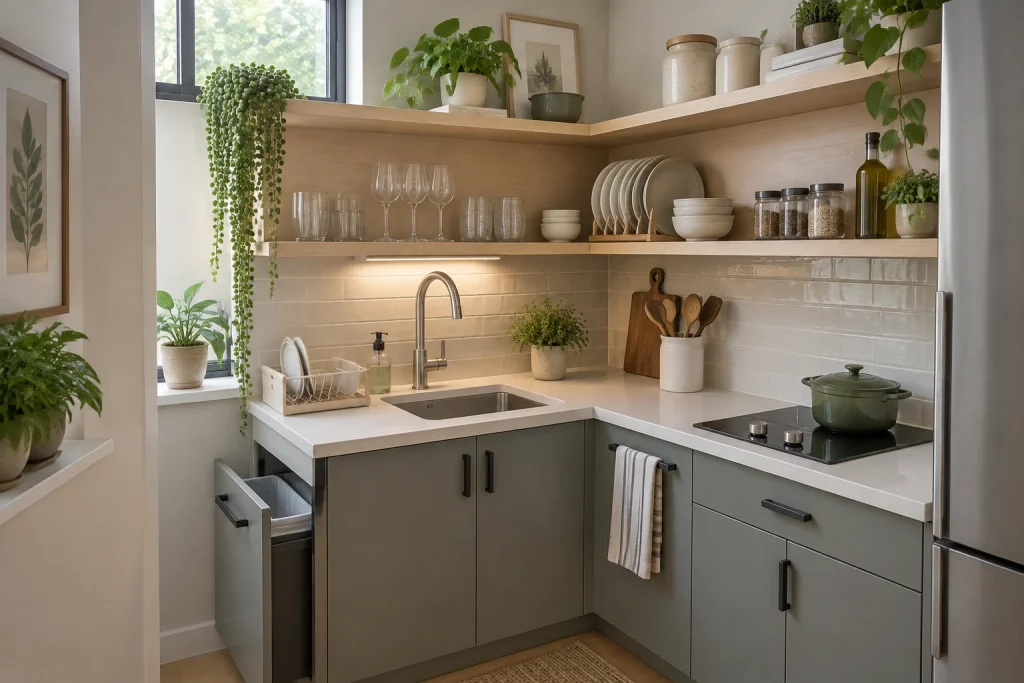
Light birch shelves wrap around the corner above the sink, turning an otherwise awkward junction into a continuous display and storage zone. The lower run is organized for frequent use: drinking glasses stand in neat clusters at left, stemware occupies the corner, plates sit vertically in a wooden rack, and small bowls and clear jars finish the right side. Above, the styling becomes more decorative and pantry-like, with ceramic canisters, books, a framed botanical print, and several plants. A trailing plant drops from the high shelf beside the window, adding a vertical counterpoint to the low, horizontal shelves. Under-shelf lighting brightens the tile backsplash and sink, while the counter remains mostly clear apart from a drying rack, soap, herbs, utensils, and a cutting board.
Why it works: The wraparound construction takes advantage of two walls without interrupting the work surface. Separating daily glassware and dishes from higher decorative pieces gives the corner an easy visual hierarchy.
- L-shaped light wood shelves
- Grouped drinking glasses and stemware
- Vertical plate rack
- Under-shelf light
- Trailing plants by the window
Design tip: Keep the lowest shelf for the items you reach for most, and reserve the upper shelf for plants and canisters.
4. Build a Pantry Display Around Practical Jar Storage
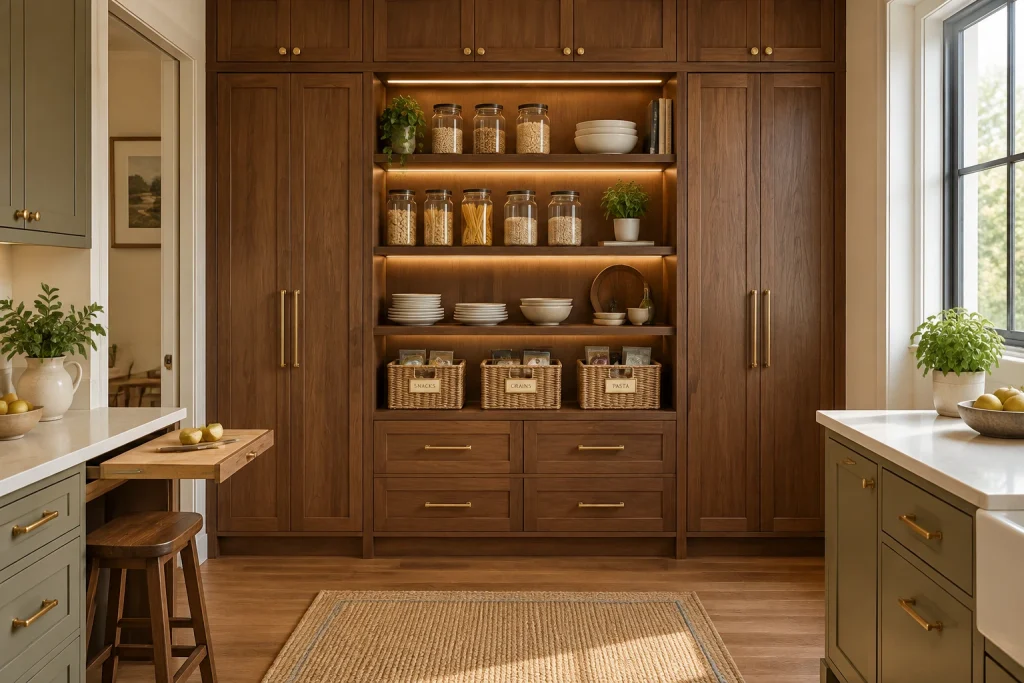
A warm walnut pantry wall frames a centered bank of illuminated open shelves, giving everyday provisions a tailored presentation. Clear jars of dry goods line the upper two shelves in orderly rows, their similar shapes creating rhythm against the wood interior. Cream bowls and plates are stacked low on the next shelf, with a small wood board and a few books adding restrained variation. Three woven bins on the lowest open shelf are visibly labeled “SNACKS,” “GRAINS,” and “PASTA,” making the storage system legible at a glance. Closed walnut cabinets flank the display and continue overhead, while drawers below keep the composition grounded. Nearby, a wood pull-out board, low stool, sage cabinetry, brass hardware, and a sunlit potted plant continue the warm, functional material mix.
Why it works: The built-in combines uniform clear containers with concealed cabinetry, so the open center looks ordered rather than overfilled. Integrated shelf lighting highlights the useful display and adds depth to the wood surround.
- Walnut built-in cabinetry
- Lit open pantry shelves
- Uniform clear dry-goods jars
- Labeled woven bins
- Stacked cream dinnerware
Design tip: Use one jar style for visible dry goods, then label lower bins by broad categories rather than individual ingredients.
1. Build a Bar Shelf Around Glassware and Negative Space
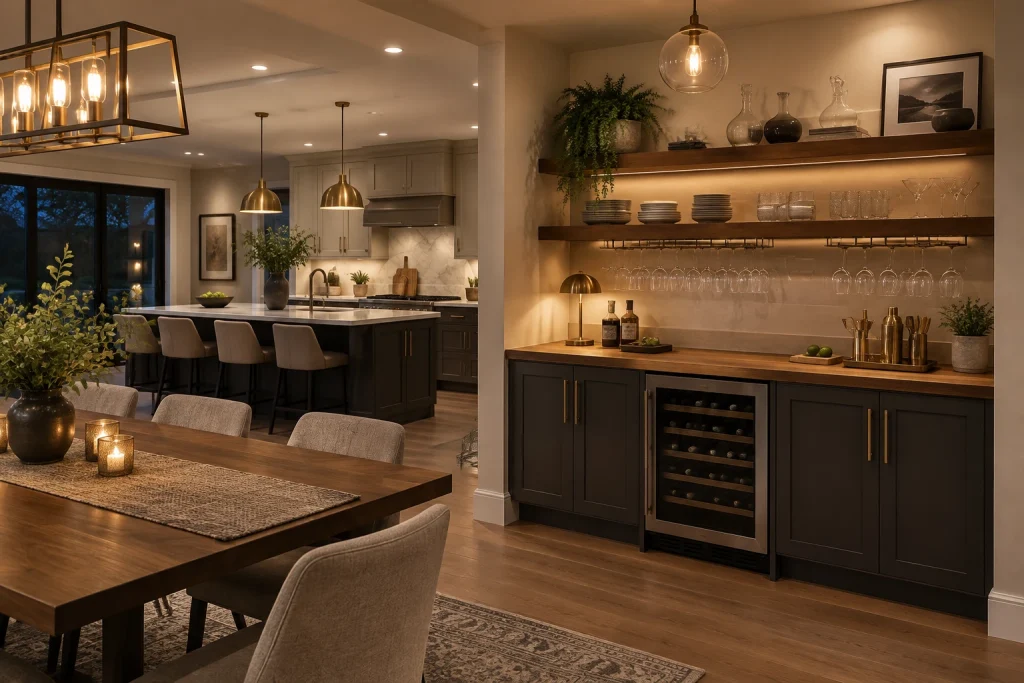
For open-shelving-kitchen-styling with a more entertaining-minded focus, let the shelf system do two jobs: display and service. Here, warm wood shelves gather smoky decanters, clear bottles, a framed black-and-white print, and a full fern-like plant on the upper level. The lower shelf shifts toward use, with compact stacks of plates, textured tumblers, highball glasses, and a small set of coupe glasses at the far right. Beneath it, rows of inverted stemware hang from slim metal racks, leaving the walnut counter unobstructed except for a small lamp, bottles, a tray of limes, bar tools, and a potted plant. Dark cabinetry and a glass-front wine refrigerator ground the arrangement below.
Why it works: The composition moves from decorative objects at the top to everyday barware at hand level, while the hanging glasses turn unused vertical space into organized storage. Repeated clear glass keeps the varied objects from feeling visually heavy against the dark cabinetry.
- Two thick walnut open shelves
- Under-shelf racks holding inverted stemware
- Small grouped stacks of plates and tumblers
- Smoky glass decanters and clear bottles
- Countertop bar tools, citrus tray, and compact wine refrigerator
Design tip: Keep the shelf directly above hanging stemware lightly styled so glasses remain easy to reach and visually distinct.
2. Let Greenery Lead, Then Tuck In Useful Dishware
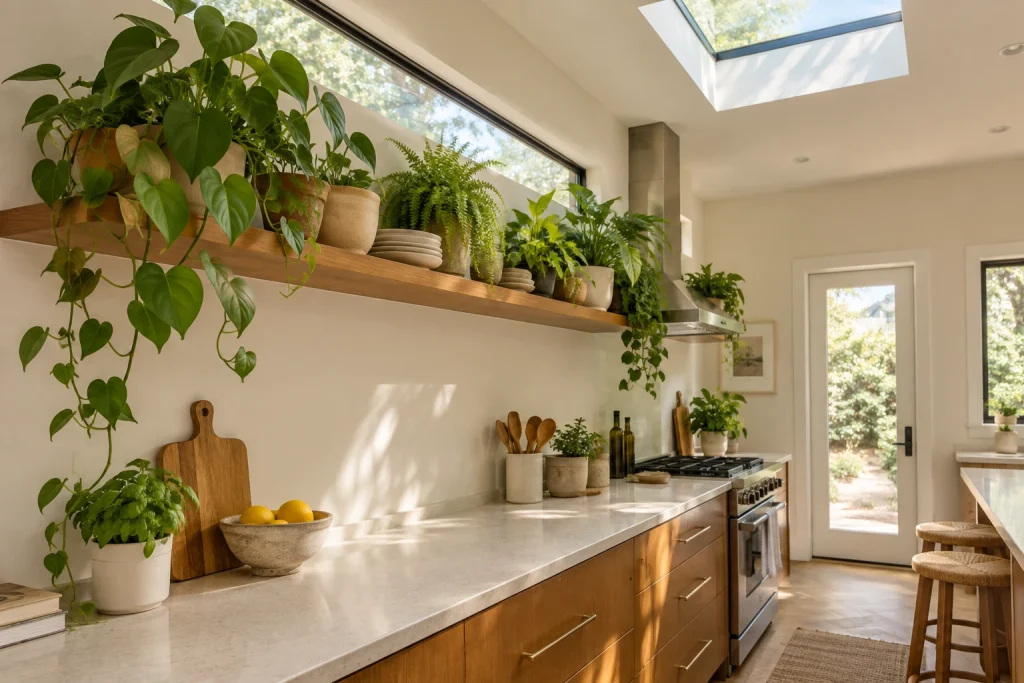
This open shelf treats plants as the main collection, not as occasional accents. A large trailing, heart-leaf plant anchors the left end, followed by a sequence of leafy plants and ferns in clay, stone-colored, and white pots. Small stacks of pale plates appear between the pots, supplying a practical note without competing with the foliage. The wood shelf sits beneath a long high window, and a skylight adds more daylight overhead, making the greens especially prominent against the white walls. Below, the pale stone counter stays largely open. A cutting board, lemon-filled bowl, utensil crock, small potted herbs, and a few bottles form compact stations rather than a continuous line of objects.
Why it works: The shelf has a clear hierarchy: leafy volume first, quiet neutral dishware second. Repeating natural pot colors and wood tones connects the elevated display to the cabinetry and cutting boards, while the mostly clear counter preserves visual breathing room.
- Long natural-wood open shelf beneath a high window
- Trailing heart-leaf vine at the left edge
- Ferns and leafy plants in varied neutral pots
- Small stacks of pale plates integrated among plants
- Pale stone countertop with contained prep accessories
Design tip: Place trailing plants at shelf ends, then trim or guide vines so they do not fall across the main counter surface.
Final thoughts
A well-styled open shelf does not need to hold everything. Start by grouping the items you reach for most, such as plates, bowls, glasses, or dry-goods jars, and repeat similar shapes to create order. Then vary the display with a few purposeful elements—baskets, books, a framed print, warm-toned vessels, or greenery—and leave open areas around them. Whether the setting is bright and minimal, industrial, deeply colored, or bar-focused, the goal is the same: make daily storage easy to use while allowing the shelf materials, backdrop, and collected objects to create a composed kitchen view.