Open kitchen shelves work best when they are edited for the way the kitchen is actually used. Rather than filling every inch with decor, start with the items you reach for often—plates, bowls, glasses, pantry jars, cutting boards, or cooking tools—then add a few elements that bring contrast and softness, such as greenery, artwork, woven texture, or warm metal. The most successful open-kitchen-shelf-styling arrangements also rely on clear visual structure. Group like items together, vary the height of each cluster, and leave enough breathing room for the shelf material and backsplash to show. Whether your look is minimal, farmhouse-inspired, moody, boho, or family-focused, these ideas make open storage feel composed while keeping it useful.
1. Balance Everyday Ceramics With Greenery
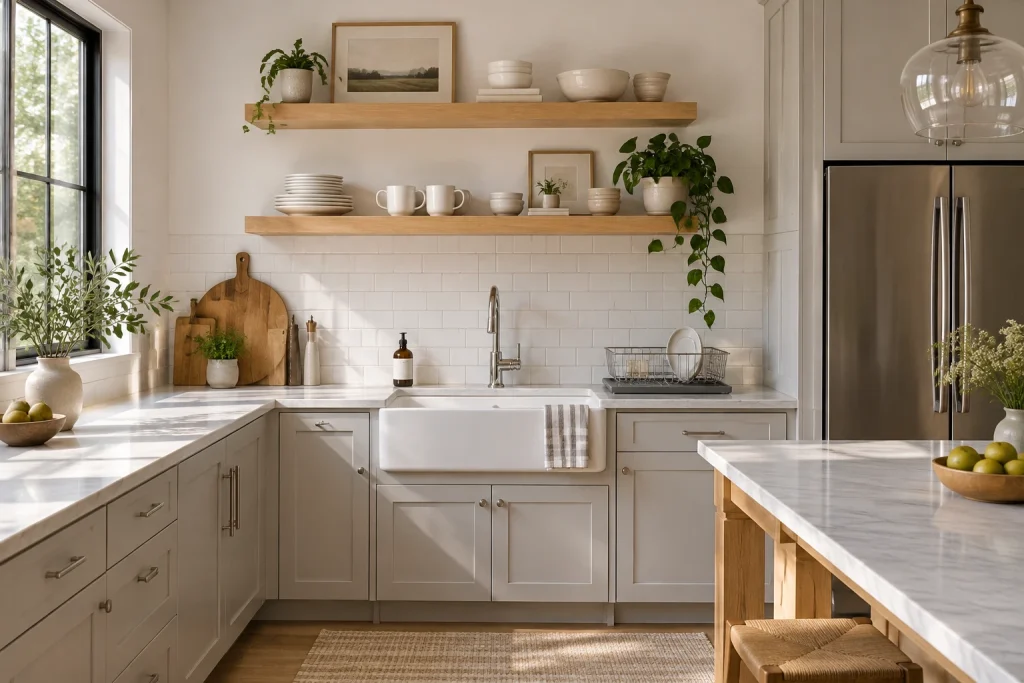
For open-kitchen-shelf-styling above a sink, this arrangement shows how a restrained palette can still feel layered. Two pale oak shelves carry cream bowls, stacked plates, mugs, and small neutral vessels, with framed artwork adding a vertical pause behind the objects. Plants do much of the softening work: one trails from the upper shelf, while another fuller plant anchors the right side of the lower shelf. The shelf styling is intentionally quieter than the counter below, where wood cutting boards, a small potted plant, and a few bottles gather near the backsplash. Keep the center near the faucet visually open, rather than filling every available surface, so the sink remains the functional focal point.
Why it works: Repeated cream ceramics create continuity, while wood, greenery, and framed art introduce contrast without disrupting the calm composition.
- Staggered pale oak shelves
- Cream plates, bowls, and mugs
- Small framed landscape artwork
- Trailing and potted greenery
- White subway-tile backsplash
Design tip: Group everyday dishware in low stacks, then add one plant at the end of each shelf.
2. Make Cooking Tools Part of the Display
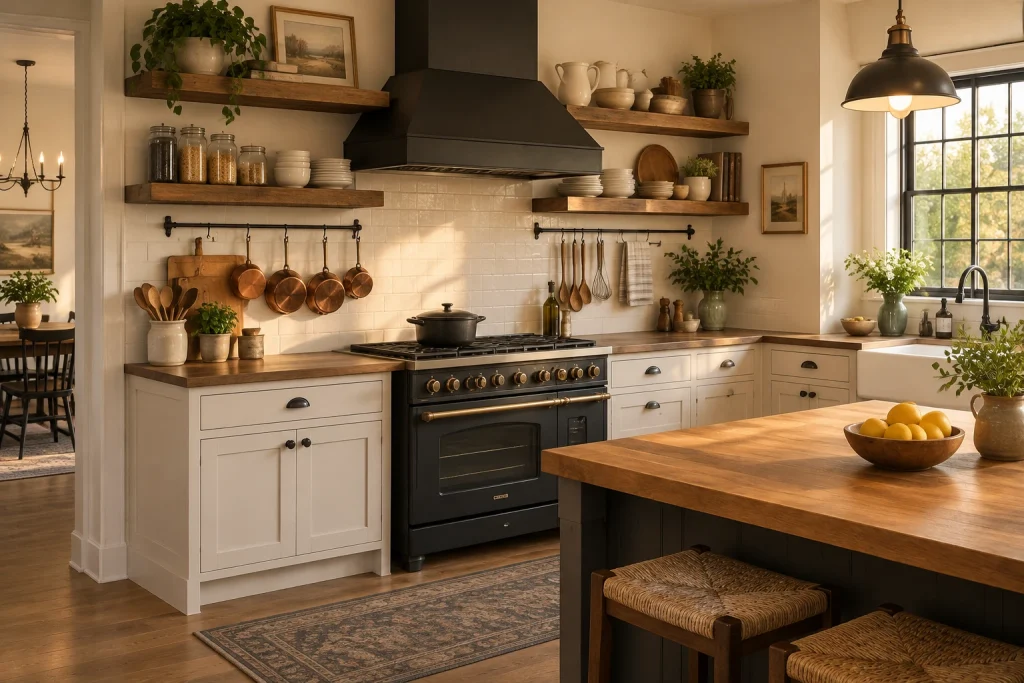
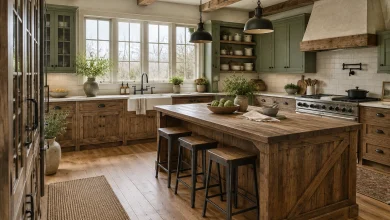
This farmhouse-leaning wall treats open shelving and a hanging rail as one working composition. Thick, dark wood shelves flank the black range hood and hold clear pantry jars, stacked white dishes, pitchers, crocks, books, small plants, and a few boards. Below, black rails keep copper pans, wooden utensils, a whisk, and a dish towel visible against the light tile backsplash. The result has useful density, but it is organized by zone: food storage and dishes sit on shelves, while tools hang directly over the counters and range. Copper provides the warm accent that connects the dark range, wood counters, and cream cabinetry. The butcher-block island echoes the shelves without competing with the cooking wall.
Why it works: The shelves supply visual weight around the centered hood, while the rails turn frequently used tools into a rhythmic, accessible layer.
- Chunky dark wood shelves
- Matte black range hood and rails
- Copper pans on hooks
- Clear dry-goods jars
- Cream ceramic dish stacks
Design tip: Use one rail finish and repeat it across hooks, pans, or utensil holders for a more cohesive display.
3. Let Negative Space Set the Tone
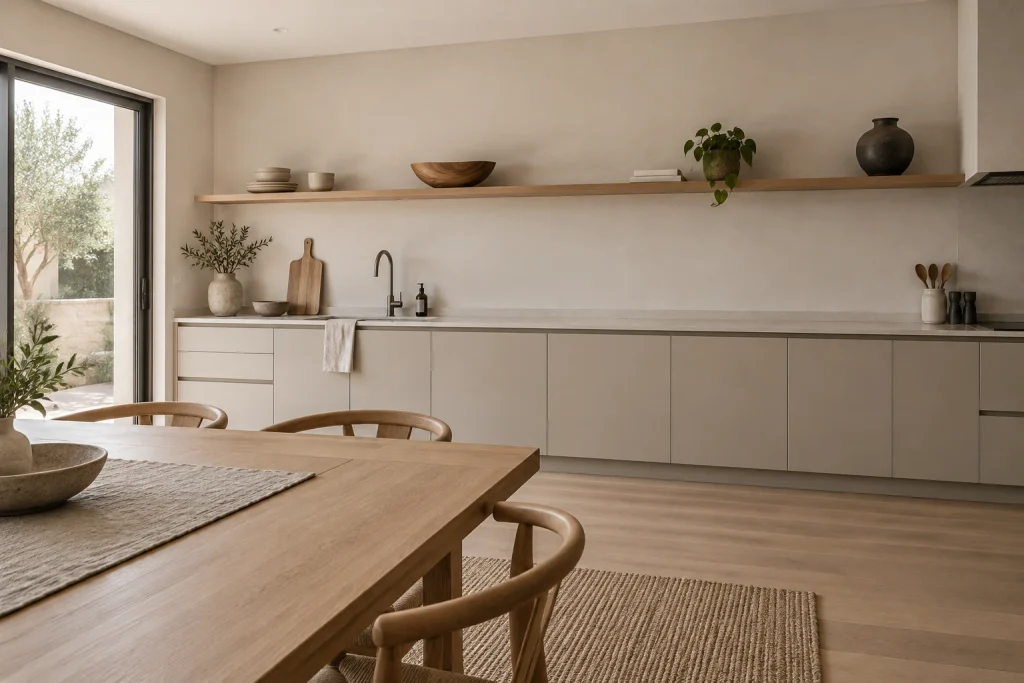
Minimal open-kitchen-shelf-styling depends as much on what is left out as what is displayed. Here, a single long, slim oak shelf is spread with a few deliberately separated groupings: a short stack of pale bowls at the left, a sculptural wood bowl near the middle, a small plant beside white books, and a dark rounded vase at the far end. Their spacing makes the shelf itself part of the composition. Below it, the long pale counter remains almost entirely clear, with only a leafy branch in a stoneware vase, cutting boards, a soap bottle, and a compact utensil grouping near the ends. The uninterrupted cabinet fronts and quiet beige surfaces reinforce the measured, low-contrast scheme.
Why it works: Wide gaps let individual forms register clearly, and the dark vase acts as a controlled visual counterpoint to the pale ceramics and oak.
- Single thin oak floating shelf
- Widely spaced neutral ceramics
- Sculptural wooden bowl
- Dark rounded vase
- Long uncluttered pale counter
Design tip: After placing each shelf object, remove one piece or widen the gap before adding anything else.
4. Build Texture Through Layers, Not Clutter
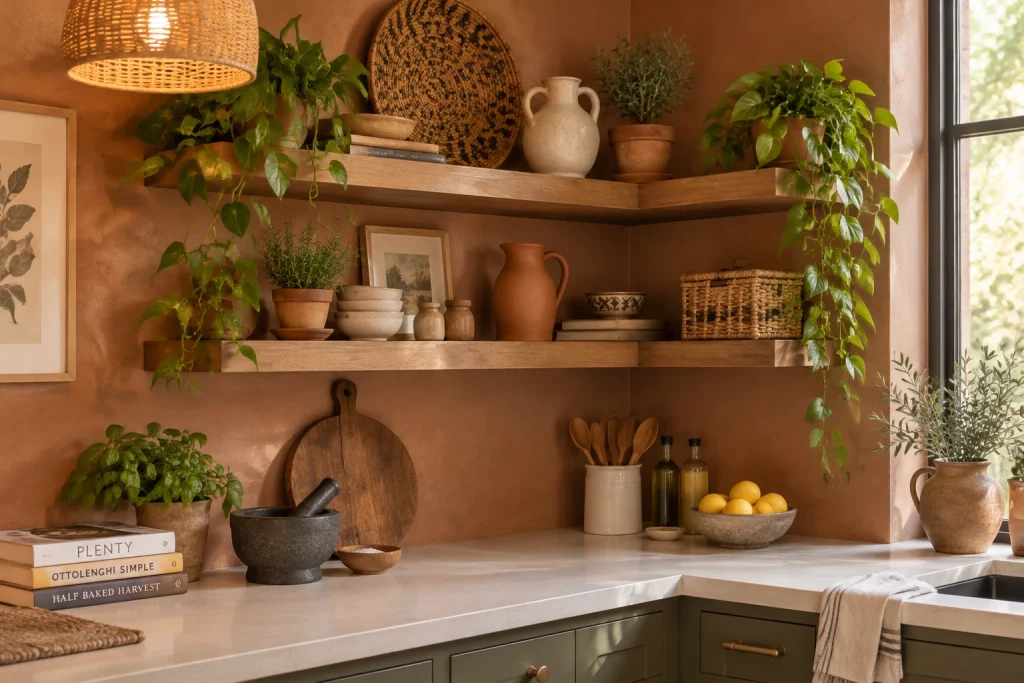
These corner shelves show how a fuller boho display can stay readable through material repetition and height changes. Against the terracotta-colored wall, woven baskets, earthenware pitchers, bowls, small vessels, books, and framed artwork form compact still-life groupings. The large round woven tray at the back of the upper shelf gives the display a strong backdrop, while several trailing plants soften the straight shelf lines and extend the composition downward. On the lower shelf, a tall terracotta pitcher sits among stacked bowls, books, and a woven basket, creating varied silhouettes without relying on bright color. The counter continues the natural-material story with a stone mortar and pestle, cutting board, wood utensils, bottles, lemons, and leafy plants, while a clear stretch of countertop remains between groupings.
Why it works: Terracotta, wood, woven fibers, and green foliage recur across the shelves and counter, giving a collection of different objects a common visual language.
- Staggered corner wood shelves
- Round woven wall tray
- Earthenware pitchers and bowls
- Trailing green plants
- Woven storage basket
Design tip: Place one large flat woven piece behind smaller objects to create depth without crowding the shelf edge.
1. Build a Display Wall Around Useful Kitchen Pieces
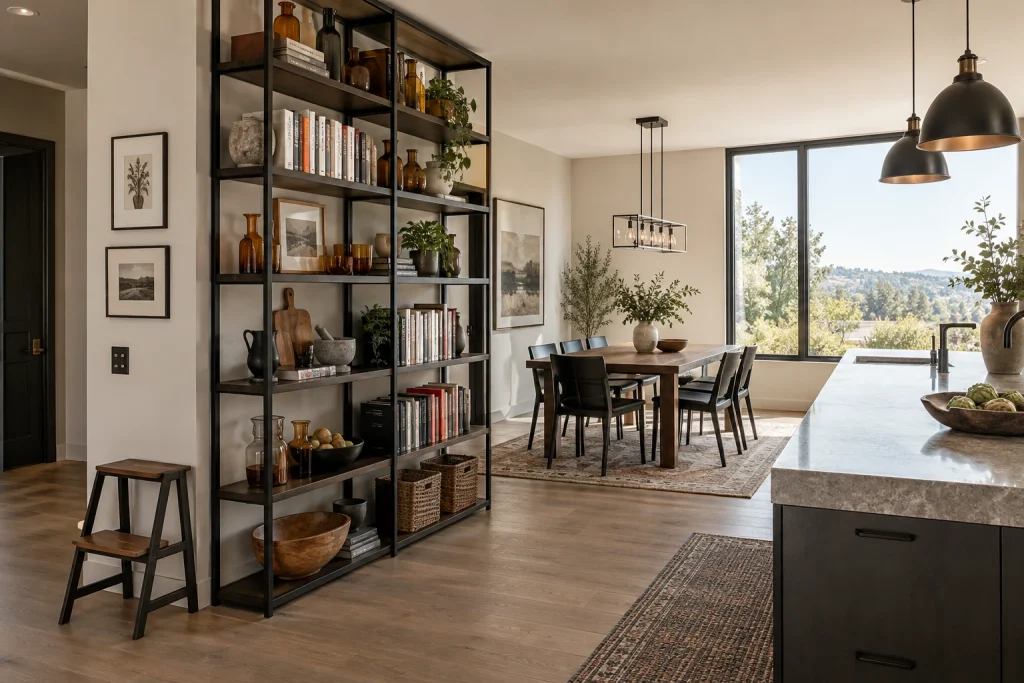
For open-kitchen-shelf-styling with architectural presence, use a tall black metal frame to give everyday objects a clear structure. Here, the ceiling-height unit layers cookbooks, amber bottles, clear glass vessels, stoneware, wooden bowls, cutting boards, framed art, and woven baskets across broad dark shelves. The arrangement avoids a rigid, store-display look by shifting between upright books, low horizontal stacks, and a few taller objects. Green plants soften the black frame and echo the leafy branches on the nearby dining table. A small wood-and-black step stool sits beside the shelving, while the open view toward the table and large window keeps the display connected to the larger room rather than visually closed off.
Why it works: The black grid creates order, while repeated warm wood, amber glass, and greenery make the large unit feel collected instead of heavy.
- Ceiling-height black metal frame
- Cookbook stacks and upright spines
- Amber glass bottles and clear vessels
- Wood cutting boards and bowls
- Trailing and potted greenery
Design tip: Repeat two or three materials on several shelves, then leave a few shelf sections partially open.
2. Make Small-Space Shelves Do Double Duty
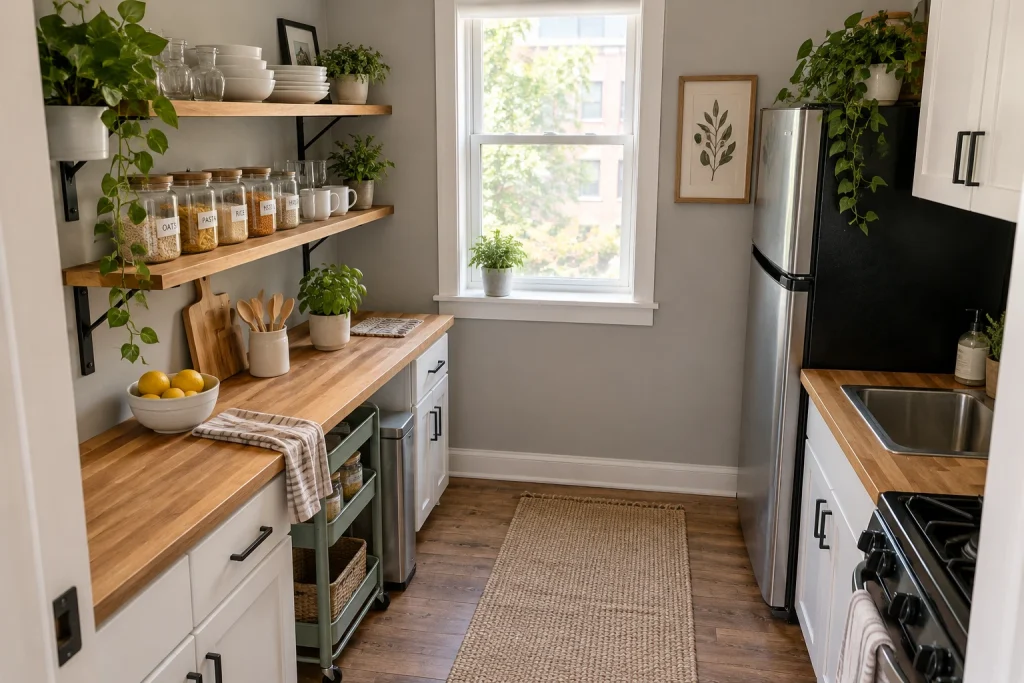
In this narrow kitchen, three natural-wood wall shelves turn the left wall into a practical storage zone without crowding the work surface below. The top shelf holds stacked white bowls and plates with clear glasses, while the middle shelf groups labeled glass jars with white mugs. Plants appear at the shelf ends and trail down the wall, bringing softness to the gray backdrop. The lowest shelf stays closer to counter height and shares the scene with cutting boards, a utensil crock, and a potted plant on the wood counter. A slim green rolling cart fits beneath the counter edge, and the centered window adds daylight to the aisle. The styling is useful because like items are clustered rather than scattered.
Why it works: Clear jars, white dishes, and light wood keep the shelves visually light, while the repeated plant pots add rhythm without competing with the stored items.
- Three wood shelves with black brackets
- Labeled glass pantry jars
- Stacked white dinnerware
- White mugs and clear drinking glasses
- Trailing plants and small potted herbs
Design tip: Reserve one shelf for food storage and another for dishes so restocking stays straightforward.
3. Organize Pantry Shelves by Category and Scale
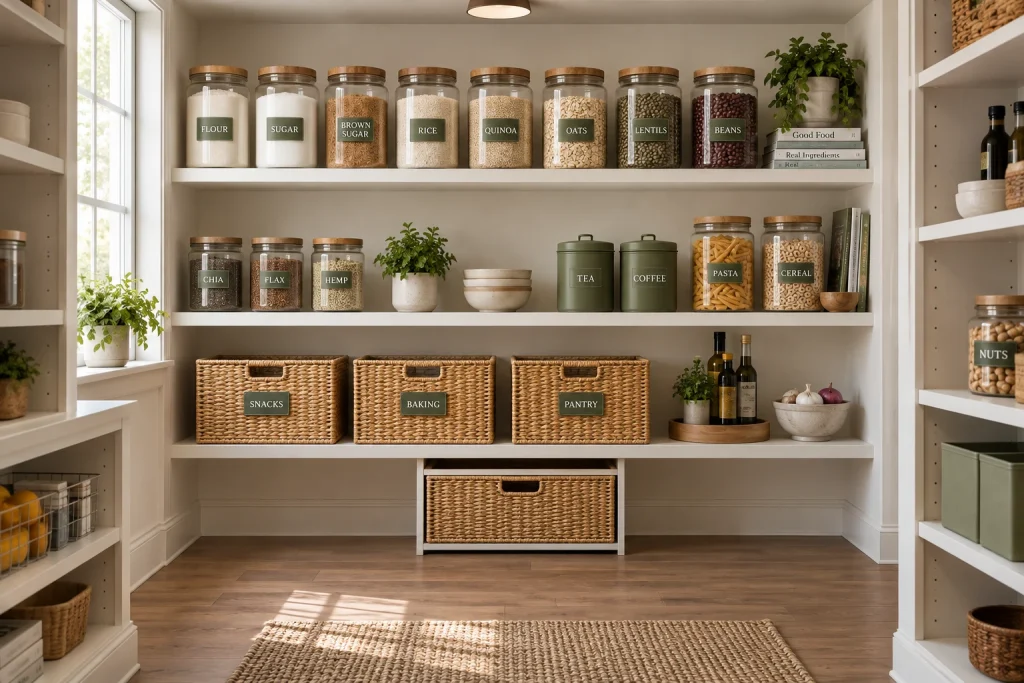
This pantry arrangement makes open storage feel deliberate through repetition. Large glass canisters with wood lids form a clean line across the top shelf, each finished with a dark green label. The next shelf mixes smaller labeled jars on the left with green tea and coffee canisters, pasta and cereal containers, stacked bowls, a small plant, and a short row of books. Below, three large woven baskets labeled for snacks, baking, and pantry items establish a strong horizontal band. At the right, a tray groups bottles beside a bowl of garlic and onions. The center of the middle shelf remains comparatively open, giving the display a pause between storage groupings. A single woven pull-out basket sits beneath the lower shelf.
Why it works: Uniform containers make varied dry goods read as one composition, and woven baskets conceal less display-friendly supplies while adding texture.
- Matching glass canisters with wood lids
- Dark green category labels
- Large woven storage baskets
- Green tea and coffee canisters
- Small plant and stacked bowls
Design tip: Use matching containers for staples, then assign baskets to broader categories that do not need to stay visible.
4. Contrast Dark Shelves With Warm Metals and Wood
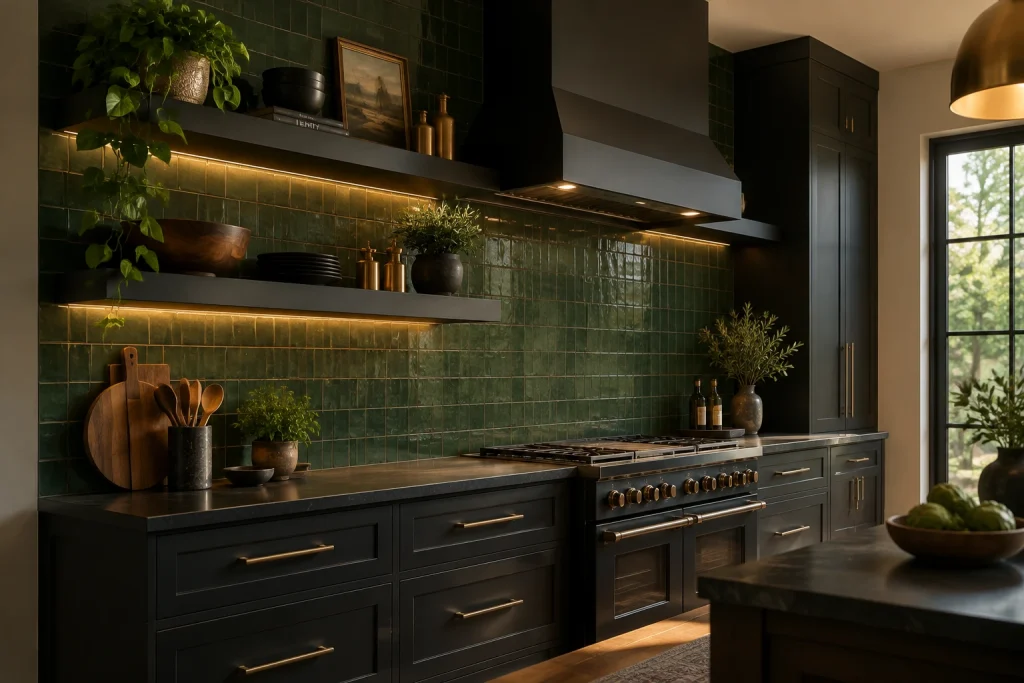
Matte black floating shelves become part of the dramatic backdrop in this kitchen, set against glossy deep green tile. The top shelf combines a trailing plant, stacked black bowls, a framed landscape, books, and brass-toned bottles. On the shelf below, a wood bowl, black plates, brass-toned dispensers, and a dark planter create a lower, more horizontal composition. Warm under-shelf lighting traces the shelves and brings out the tile’s reflective surface. The black range hood and dark cabinetry continue the moody palette, while brass hardware and range details connect with the shelf accents. Most of the tiled wall around the cooktop remains uncovered, so the shelf styling reads as a contained display rather than spreading across the entire cooking wall.
Why it works: The limited palette of black, green, brass, and wood produces depth, and the lighting gives the objects definition against the dark surfaces.
- Matte black floating shelves
- Glossy deep green tile
- Warm under-shelf lighting
- Brass-toned bottles and hardware
- Black dishware and wood bowls
Design tip: In a dark scheme, use a warm light strip beneath shelves to define objects and prevent the display from disappearing into the wall.
1. Build a Low Shelf That Makes Breakfast Easy to Reach
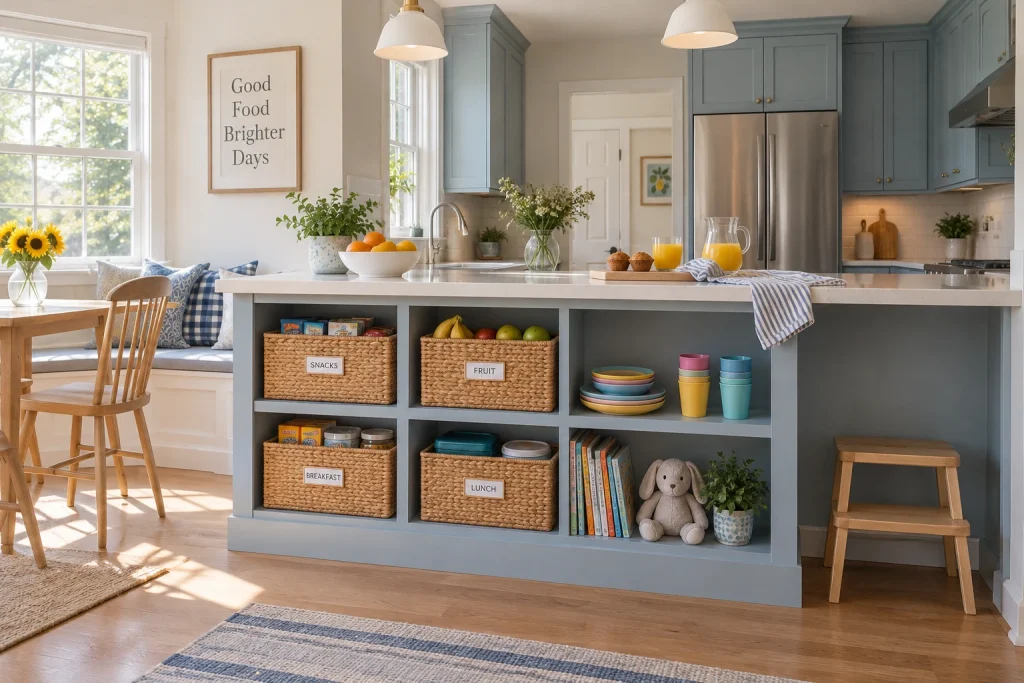
For open-kitchen-shelf-styling that feels useful rather than purely decorative, this blue breakfast counter turns its low cubbies into a clearly organized family station. Four woven baskets create a consistent base, while their simple labels—“Snacks,” “Fruit,” “Breakfast,” and “Lunch”—make the categories immediately legible. Above and beside them, the arrangement shifts to grab-and-go items: a bowl of bananas and apples, stacks of colorful plates, and matching cups. The lower right cubby adds a softer, personal note with children’s books, a stuffed bunny, and a small potted plant. Keep the shelf colors tied to the room: blue cabinetry, natural woven fiber, and cheerful dishware echo the window-seat textiles and the sunny breakfast counter.
Why it works: Repeated baskets provide visual order, while open compartments reserve space for both food and everyday kid-oriented items.
- Labeled woven storage baskets
- Low blue open cubbies
- Stacks of colorful plates and cups
- Children’s books and a stuffed bunny
- Natural wood step stool
Design tip: Use matching baskets for food categories, then leave one cubby open for dishes that can be grabbed without unpacking a bin.
2. Treat Open Bar Shelves Like a Serving Display
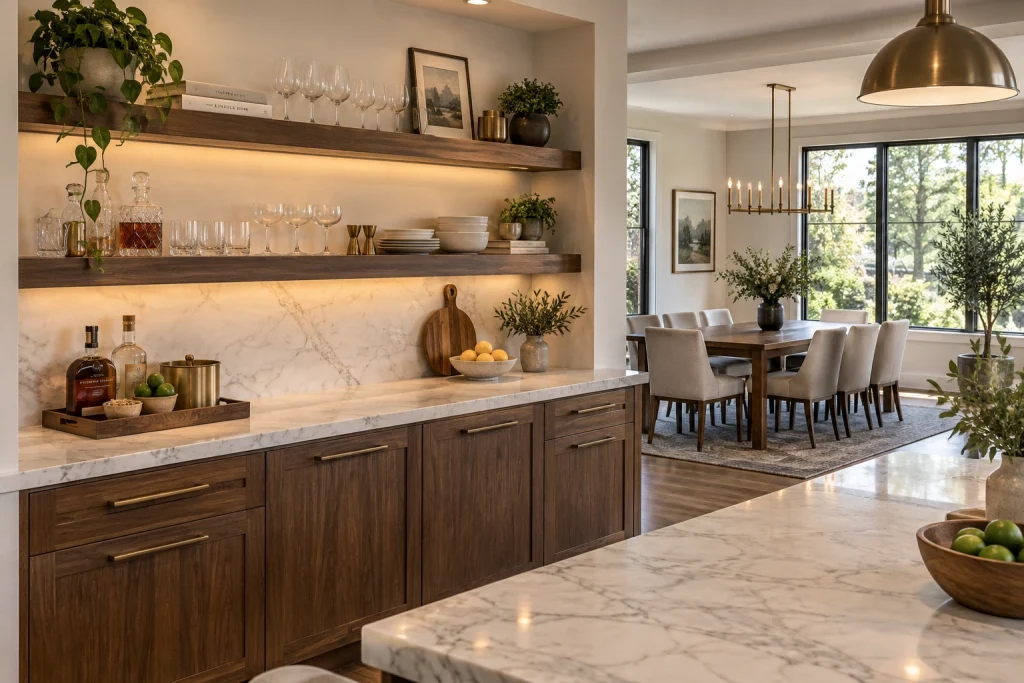
These two walnut shelves show how open kitchen shelving can serve a bar setup without looking crowded. Stemware is arranged in clean runs across both levels, with decanters and a cut-glass bottle grouped at the left of the lower shelf. On the right, stacked white plates and bowls form a useful serving zone, balanced by small brass-toned vessels, books, framed art, and leafy plants. The dark wood shelves connect directly to the closed lower cabinets, while the pale veined stone backsplash and countertop brighten the composition. A wood tray below gathers bottles, limes, and a small bowl into one portable-looking cluster. The adjacent dining table remains visible beyond the counter, reinforcing the shelf’s role as a transition between kitchen prep and table service.
Why it works: Glass, ceramics, wood, and greenery are distributed in distinct groups, so the display reads as composed inventory instead of miscellaneous storage.
- Two thick walnut floating shelves
- Rows of clear stemware
- Decanters and bottles grouped together
- Stacked white serving plates and bowls
- Brass-toned accents and leafy plants
Design tip: Arrange glassware in rows, then anchor each shelf with one opaque object—such as stacked bowls, framed art, or a planter—to keep it from feeling visually weightless.
Final thoughts
A Pinterest-ready open shelf display does not need to be precious or overfilled. Use everyday pieces as the foundation, repeat a limited set of colors or materials, and create distinct zones for dishes, pantry goods, tools, or serving supplies. Then adjust the balance with a plant, framed piece, tray, or empty stretch of shelf. Keep the arrangement flexible as your routines change. A few well-placed objects, clear categories, and intentional negative space will make open kitchen shelves feel personal, practical, and visually settled.