Terrazzo brings color, texture, and a sense of movement to interiors without requiring an elaborate palette. Its speckled aggregate can anchor a large surface, such as an island or fireplace surround, or define a smaller moment, including a shower niche, stair riser, or floor border. The key is to give the material a clear role: let it frame a zone, create one focal wall, or add pattern beneath otherwise simple furnishings. These terrazzo-accent-ideas illustrate ways to pair warm wood, quiet cabinetry, matte black details, and pale walls with terrazzo in kitchens, bathrooms, entries, and living spaces.
1. Let a Terrazzo Island Set the Kitchen’s Tone
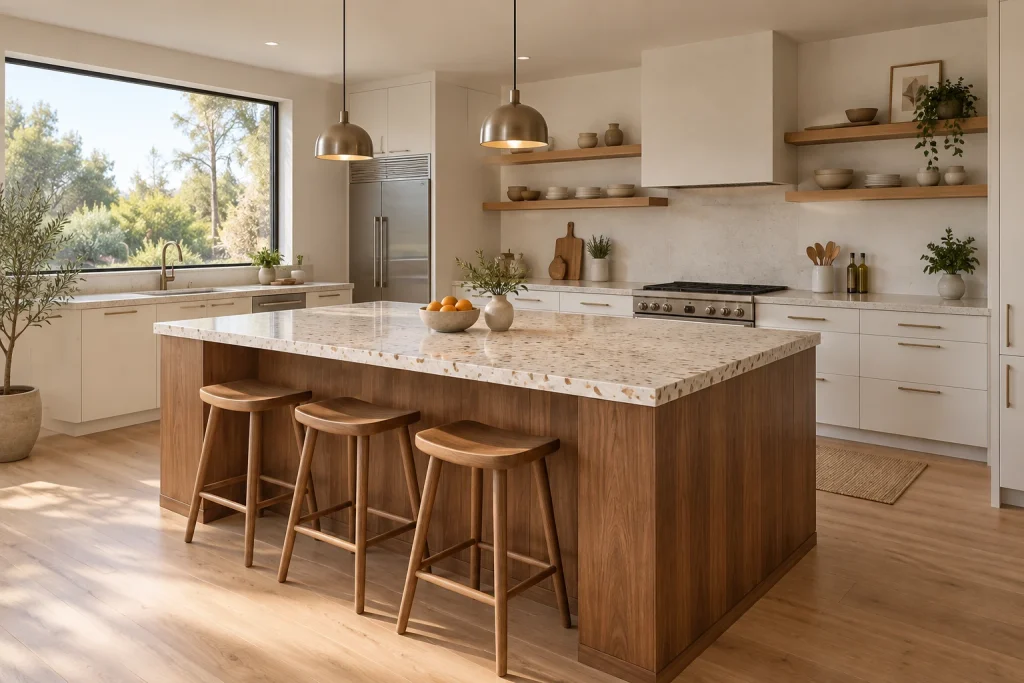
A creamy terrazzo countertop turns the broad wood-clad island into the kitchen’s visual anchor. Its scattered ochre, tan, and soft gray chips bring movement to an otherwise quiet palette of pale cabinetry, white walls, and light wood flooring. The slab’s substantial squared edge makes the surface read as one deliberate volume rather than a decorative overlay. Three curved wood stools echo the island base and keep the seating side warm and simple. Brass-toned pendants, open wood shelves, pottery, and a few leafy plants reinforce the relaxed, natural material mix without competing with the stone. A bowl of oranges and a small vase are the only items occupying the island surface, so the terrazzo remains easy to see.
Why it works: The chip colors bridge the walnut-toned island, light cabinetry, and brass-toned lighting, giving a large patterned surface a cohesive role.
- Creamy terrazzo with ochre and gray aggregate
- Wood-clad island base
- Three low-back wood stools
- Brass-toned pendant lights
- Open wood shelving
Design tip: Pair a busy terrazzo slab with plain cabinet fronts and restrained countertop styling.
2. Use Terrazzo as a Floor Medallion Around a Tub
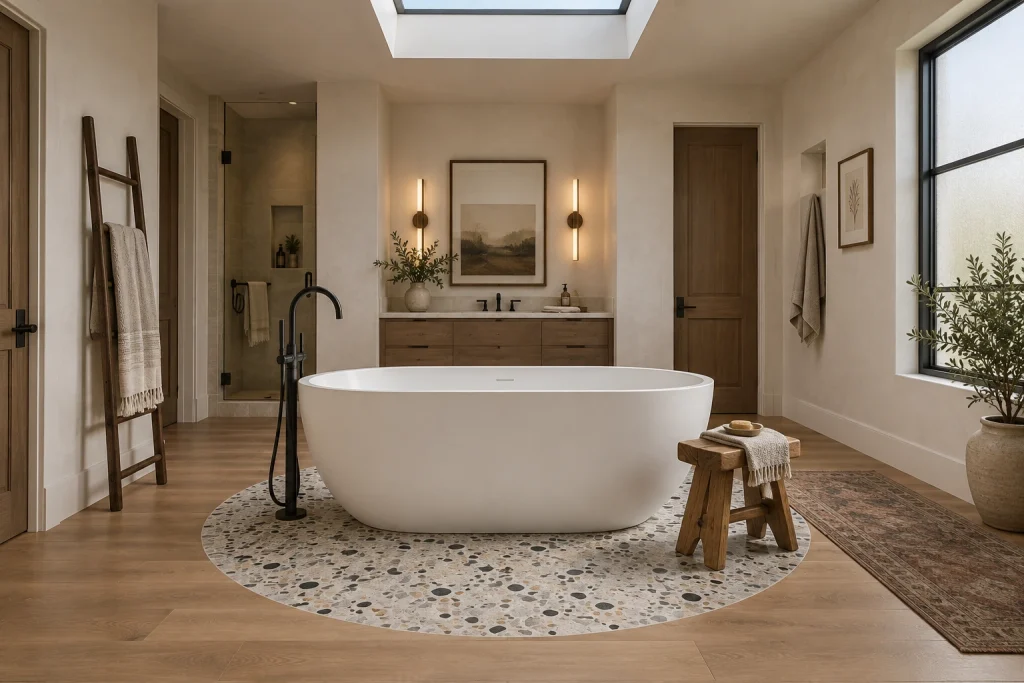
Here, terrazzo works like a built-in area rug: a round inlay frames the freestanding white tub and distinguishes the bathing zone from the surrounding wood floor. The soft gray ground is flecked with black, cream, and warm beige aggregate, giving the floor detail at a comfortable scale beneath the large oval form. Matte black plumbing creates a crisp vertical counterpoint at the tub’s edge. Around it, pale walls, a wood vanity, a simple stool, and a dark wood towel ladder keep the composition grounded. The medallion’s circular outline is especially effective because it is visibly contained; it adds pattern exactly where the eye lands rather than covering every floor surface. Overhead and side daylight sharpen the contrast between its speckled texture and the smooth tub.
Why it works: A bounded terrazzo field establishes a focal zone while allowing the warm wood flooring to remain the dominant background.
- Circular terrazzo floor inlay
- Freestanding oval white tub
- Matte black floor-mounted faucet
- Wood towel ladder
- Small wood stool
Design tip: Center a shaped terrazzo inset on the fixture it is meant to highlight.
3. Make the Backsplash a Full-Height Feature
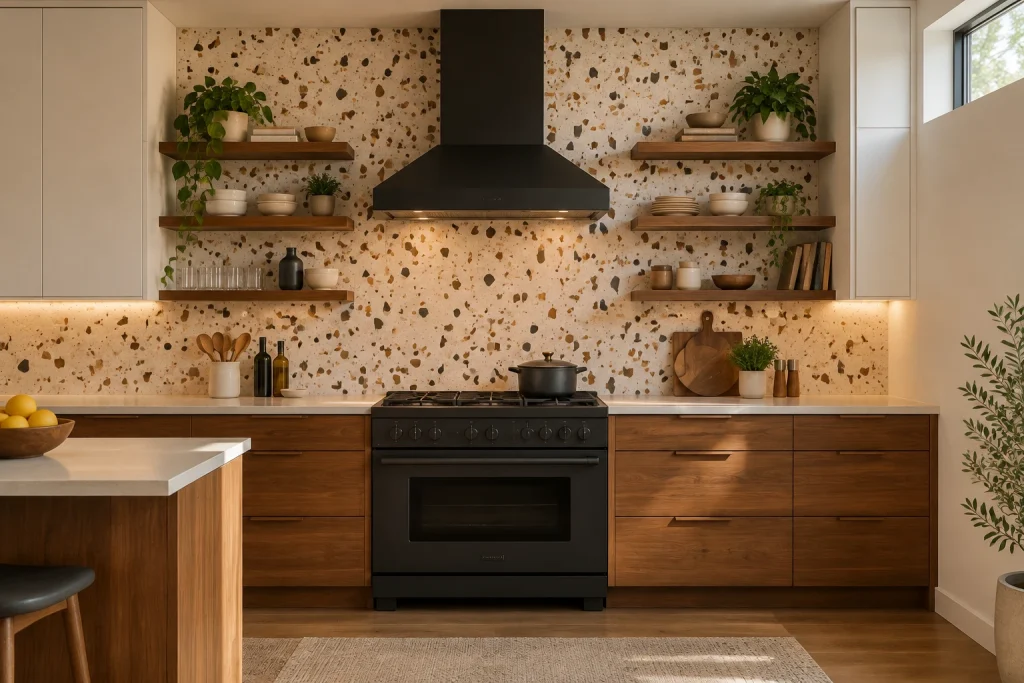
For bold terrazzo-accent-ideas that still feel orderly, take the material from the countertop line to the ceiling on a single cooking wall. This kitchen uses a warm white terrazzo with honey, brown, and charcoal chips behind a matte black range and hood, creating a strong central frame. The same surface continues across both sides of the range, so the pattern reads as one expansive backdrop rather than a narrow strip. Floating walnut shelves sit directly over the terrazzo and carry neatly spaced ceramics, books, and trailing plants. Their deep wood tone picks up the backsplash’s warmer flecks and relates to the lower cabinetry. A pale counter and tall light cabinets at each end provide visual breathing room, while under-shelf lighting brings out the stone’s varied aggregate after daylight fades.
Why it works: The dark range supplies a clear focal point, and the full-height terrazzo gives it a textured but unified surround.
- Full-height warm white terrazzo backsplash
- Matte black range and vent hood
- Floating walnut shelves
- Walnut base cabinetry
- Under-shelf lighting
Design tip: Choose shelf wood that echoes a prominent terrazzo chip color for a more connected cooking wall.
4. Repeat Terrazzo in the Shower Pan and Niche
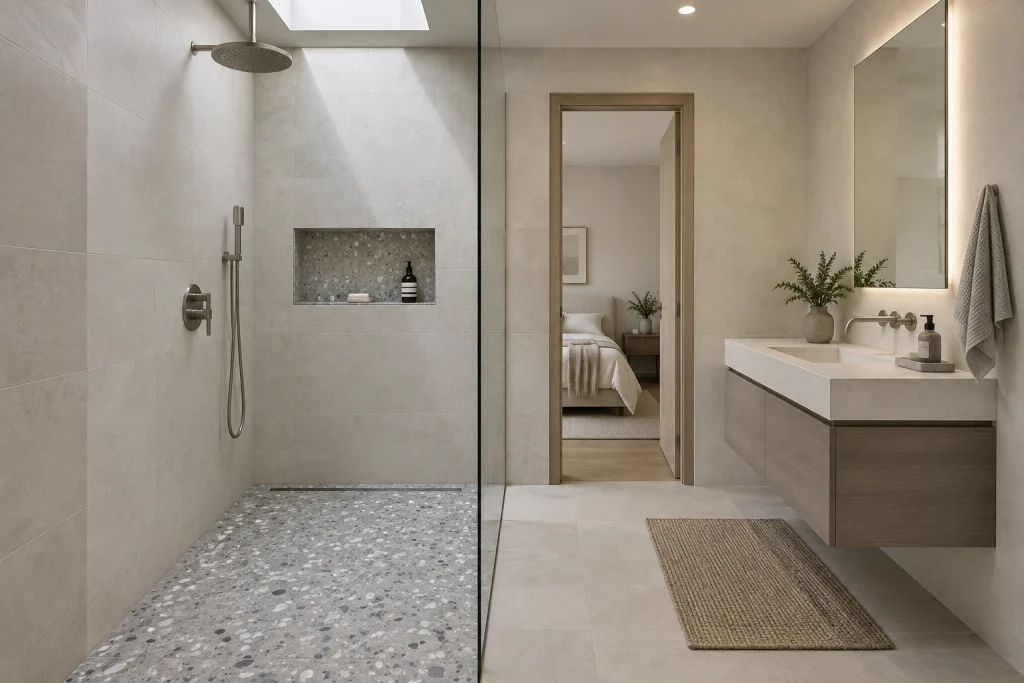
This minimal bathroom concentrates terrazzo inside the glass-lined shower, where a dove gray speckled pan is repeated in the recessed wall niche. The matching surfaces make the niche feel integrated instead of added on, while the pale large-format wall tile stays intentionally quiet around them. White and charcoal chips offer subtle contrast with the smooth gray field and the brushed metal shower fittings. A linear drain sits at the back edge of the shower floor, maintaining the pan’s uninterrupted look. Outside the shower, a floating wood vanity, broad mirror, woven bath mat, and pale floor tile continue the restrained material palette. Daylight from the skylight falls directly into the shower, making the aggregate legible without requiring additional pattern elsewhere.
Why it works: Repeating the same terrazzo in two small shower elements creates continuity while reserving the stronger pattern for a contained wet area.
- Gray terrazzo shower pan
- Matching terrazzo recessed niche
- Clear glass shower panel
- Pale large-format wall tile
- Floating wood vanity
Design tip: Repeat one terrazzo finish in the shower floor and niche, then keep surrounding wall tile low-contrast.
1. Give Stair Risers a Terrazzo Accent
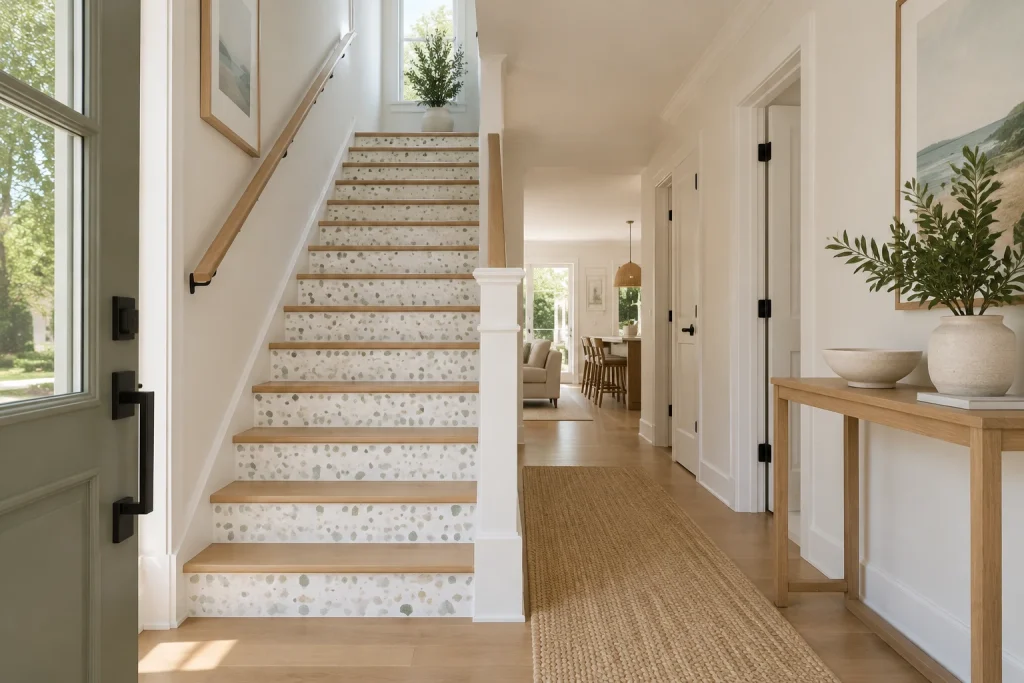
Among terrazzo-accent-ideas, stair risers offer a precise way to introduce pattern without covering an entire floor. Here, white risers are scattered with soft green, gray, and sandy chips, while the natural wood treads stay clean and unpatterned. That division keeps each step easy to read and lets the terrazzo register as a vertical detail rather than a busy surface underfoot. White stringers and walls pull the pale base color outward, and the wood handrail repeats the treads’ warmth. Daylight at the entry and upper window brings out the varied aggregate, while the narrow wood console, pale bowl, and leafy branches reinforce the restrained natural palette.
Why it works: The repeated risers create a rhythmic, built-in display for terrazzo, balanced by the plain oak treads and white-painted trim.
- White terrazzo stair risers
- Natural wood treads and handrail
- White-painted stringers
- Large entry and stair windows
- Slim wood console with a ceramic bowl
Design tip: Match the terrazzo base color to the stair trim, then limit surrounding woods to one warm tone.
2. Turn a Fireplace Into a Terrazzo Focal Point
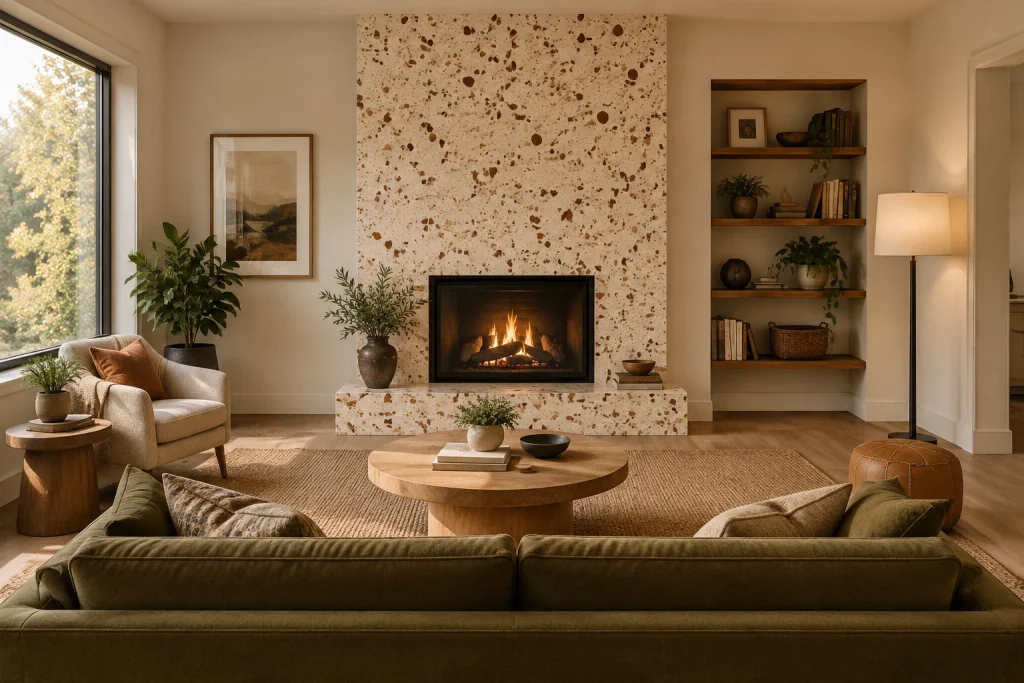
A fireplace surround is a strong setting for terrazzo because it gives the material one uninterrupted field. In this living room, creamy terrazzo climbs from the broad hearth to the ceiling, framing the dark firebox in a pale surface flecked with rust and brown. The oversized scale makes the aggregate feel intentional, not decorative. Its earthy inclusions connect naturally to the olive sofa, round wood coffee table, woven rug, leather-colored ottoman, and wood shelving. The hearth remains visually simple, holding only a vessel and shallow bowl, so the speckled surround can lead. Recessed shelves and a tall floor lamp flank the composition without competing with its central vertical line.
Why it works: A full-height application gives the patterned material architectural presence, while the darker firebox supplies a crisp center point.
- Cream terrazzo surround with rust-brown flecks
- Dark framed firebox
- Low, broad terrazzo hearth
- Olive upholstered sofa
- Round wood coffee table and woven rug
Design tip: When using terrazzo at fireplace scale, repeat one or two chip colors in textiles or wood rather than adding another patterned surface.
3. Ground a Mudroom-Laundry Room With Terrazzo Tile
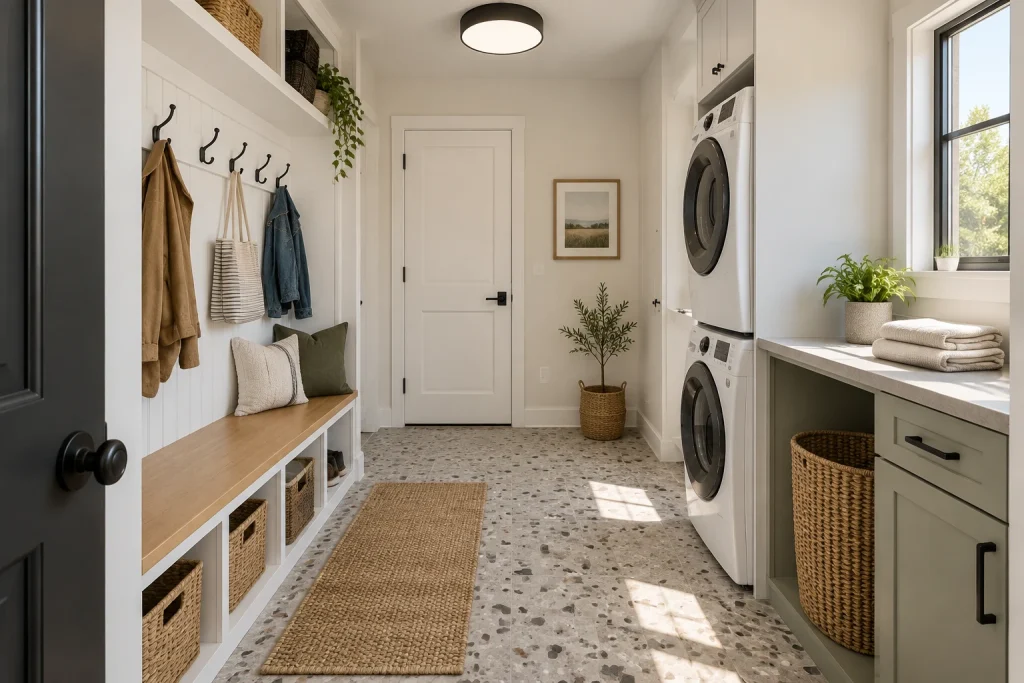
This narrow mudroom-laundry space uses terrazzo across the full floor, creating a practical-looking foundation beneath the bench, stacked laundry appliances, and counter. The pale ground with gray and brown chips brings movement to an otherwise white room, yet its low-contrast palette stays calm alongside beadboard, light cabinetry, and black pulls. Larger, irregular-looking flecks are especially helpful visually here: they soften the room’s many straight lines, from cabinet doors to open cubbies and wall hooks. A jute runner defines the center aisle while leaving terrazzo visible along both sides. Woven baskets in the bench cubbies and beneath the counter add another natural, textured layer that relates to the warmer specks in the floor.
Why it works: The continuous floor visually connects work zones on both sides of the room, and its mottled finish offsets the crisp white storage.
- Pale terrazzo floor with gray and brown chips
- White beadboard wall treatment
- Wood-topped bench with open cubbies
- Stacked white laundry appliances
- Matte black hooks and cabinet pulls
Design tip: Choose a low-contrast terrazzo floor for a utility room, then use a runner only where you want added softness underfoot.
4. Use Terrazzo-Look Backsplash for a Compact Kitchenette
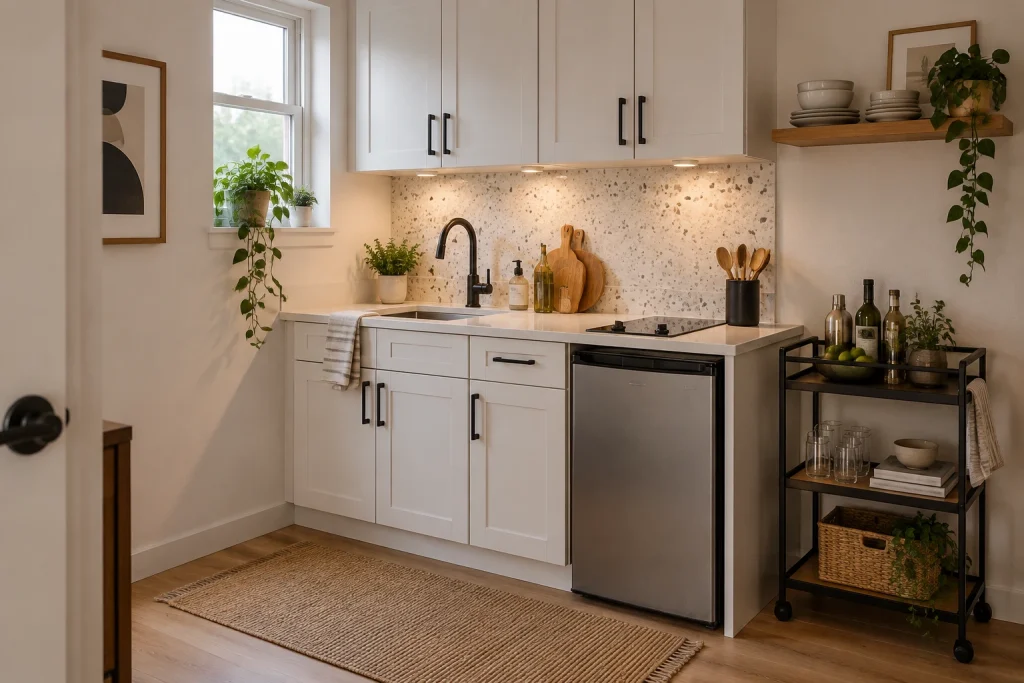
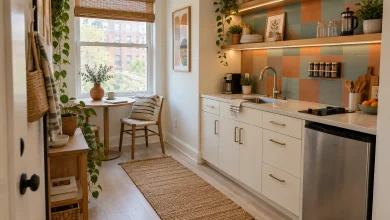
A warm cream terrazzo-look backsplash creates a clear focal band between the countertop and upper cabinets in this compact kitchenette. Gray and taupe flecks add detail behind the sink and cooktop, while matte white cabinet fronts and black pulls keep the composition graphic and orderly. The backsplash stops neatly at the cabinet line and countertop, giving its edges a clean, contained appearance. Under-cabinet lights highlight the pattern after daylight from the nearby window fades, and the black faucet, cooktop, utensil crock, and bar cart echo the hardware’s dark finish. Wood cutting boards, the floating shelf, and woven basket bring in warmth without competing with the small-scale terrazzo pattern. The result is a layered surface treatment that still reads light.
Why it works: Keeping terrazzo-look material to the backsplash concentrates pattern at eye level and lets the white cabinetry preserve visual openness.
- Cream terrazzo-look backsplash with gray flecks
- White upper and lower cabinets
- Black pulls and gooseneck faucet
- Under-cabinet lighting
- Wood floating shelf and black bar cart
Design tip: Run a patterned backsplash only across the main work wall, and pair it with plain counters and cabinet fronts.
1. Turn a Terrazzo Panel Into a Soft Bedroom Focal Point
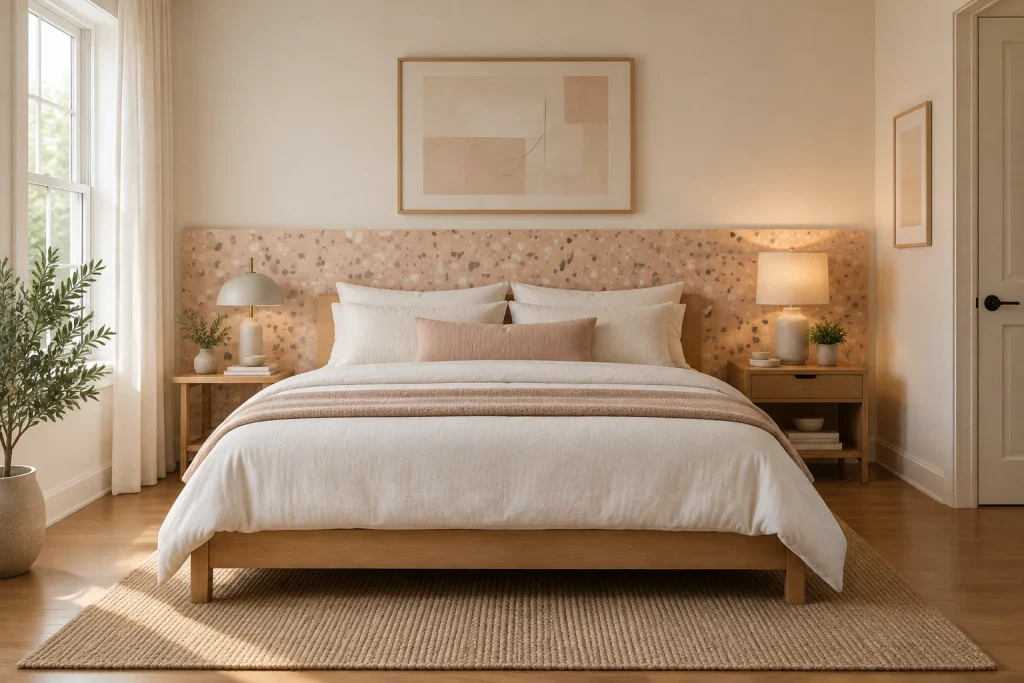
Among terrazzo-accent-ideas, an extended headboard panel is a particularly composed way to bring the material into a bedroom. Here, the blush-toned terrazzo stretches well beyond the bed, creating a low, continuous band behind the pillows. Its gray, cream, and darker flecks give the quiet palette enough variation without competing with the white bedding or pale walls. The ash wood bed frame and bedside tables echo the panel’s warm undertone, while the two lamps intentionally differ in shape: a domed metal shade at left and a rectangular fabric shade at right. Daylight from the window catches the terrazzo surface, and the large, muted artwork above maintains the room’s calm vertical balance.
Why it works: The panel has enough width to read as architecture rather than a small decorative insert, while its restrained color connects the wood, textiles, and art.
- Blush terrazzo headboard panel with multicolor chips
- Low ash wood bed frame
- White layered bedding with a muted blush lumbar pillow
- Mismatched bedside lamps
- Pale framed abstract artwork
Design tip: Choose a terrazzo ground color that repeats one color from the bedding, then keep adjacent textiles largely solid.
2. Define a Narrow Hall With a Graphic Terrazzo Floor Border
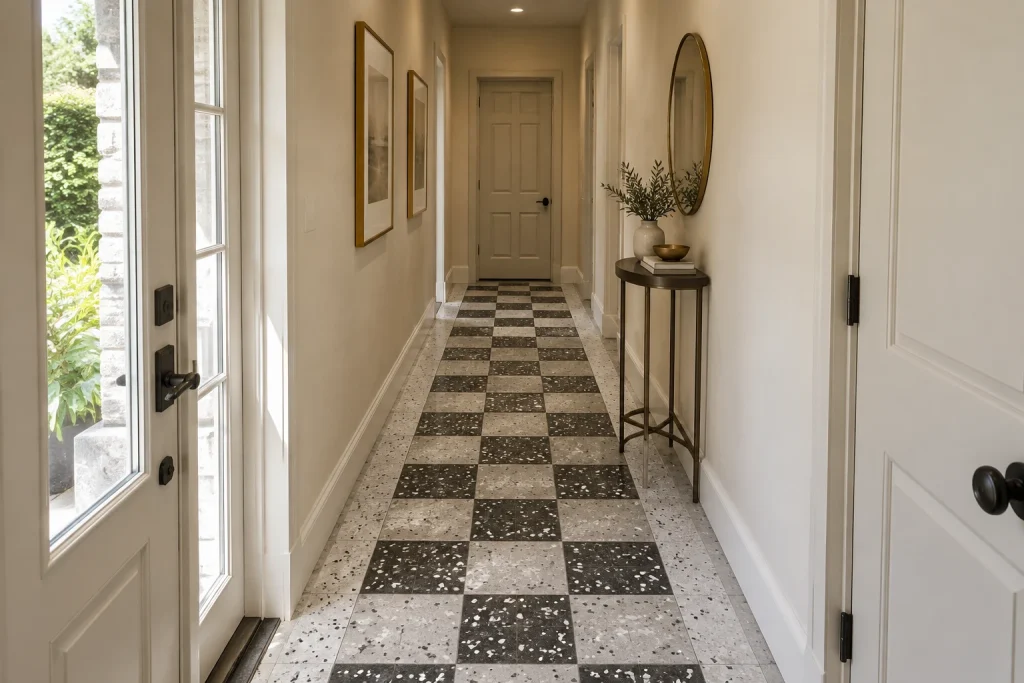
This entry hall uses terrazzo as the dominant visual element underfoot. Alternating charcoal and pale gray square tiles form a checkerboard-like run through the center, while a speckled light terrazzo border frames it on both sides. That edge detail gives the pattern a deliberate finish against the warm off-white walls and white trim. The darker squares carry crisp white flecks, making the floor read as textured rather than flat black. A slender round console sits close to the right wall beneath an oval mirror, leaving the patterned center visually open. At the opposite side, the glazed front door and sidelight bring daylight across the floor, sharpening the contrast between the two tile colors.
Why it works: The border contains the high-contrast checkerboard pattern, so it feels tailored to the hall instead of overwhelming its long, narrow proportions.
- Charcoal terrazzo squares with white flecks
- Pale gray terrazzo squares
- Speckled light terrazzo perimeter border
- Slim dark round console table
- Oval wall mirror with a dark frame
Design tip: Use a lighter terrazzo border around a dark check pattern to give the floor a clear edge at the walls.
Final thoughts
The most successful terrazzo accents feel intentional rather than scattered. Choose one primary application—such as a full-height backsplash, a contained tub medallion, or a patterned floor—and repeat related colors through wood, metal finishes, textiles, or paint. When the surrounding surfaces stay relatively calm, terrazzo has room to show its variation while the overall space remains composed. Whether used as a broad architectural field or a narrow border, it can add lasting character to everyday rooms.