Curved sofas and round furniture bring a softer rhythm to living rooms that might otherwise be dominated by straight walls, rectangular rugs, and boxy upholstery. A sweeping sectional, rounded loveseat, circular ottoman, or pedestal table can redirect the eye, ease circulation, and make a seating group feel more conversational. The key is to give each curve a purpose. In an open plan, a curved sectional can define the lounge without creating a hard visual barrier. In a smaller room, a round ottoman or nesting tables can preserve a clearer path around the seating. Repeating rounded forms—through chairs, rugs, side tables, and poufs—also helps an arrangement feel intentional rather than crowded. These curved-sofa-and-round-furniture-layouts offer practical ways to pair soft silhouettes with fireplace walls, media zones, bay windows, dining nooks, and porch views. Notice how scale, circulation, and a restrained material palette keep the rooms grounded while their rounded pieces make them feel more relaxed.
1. Let a Curved Sectional Soften an Open Living Area
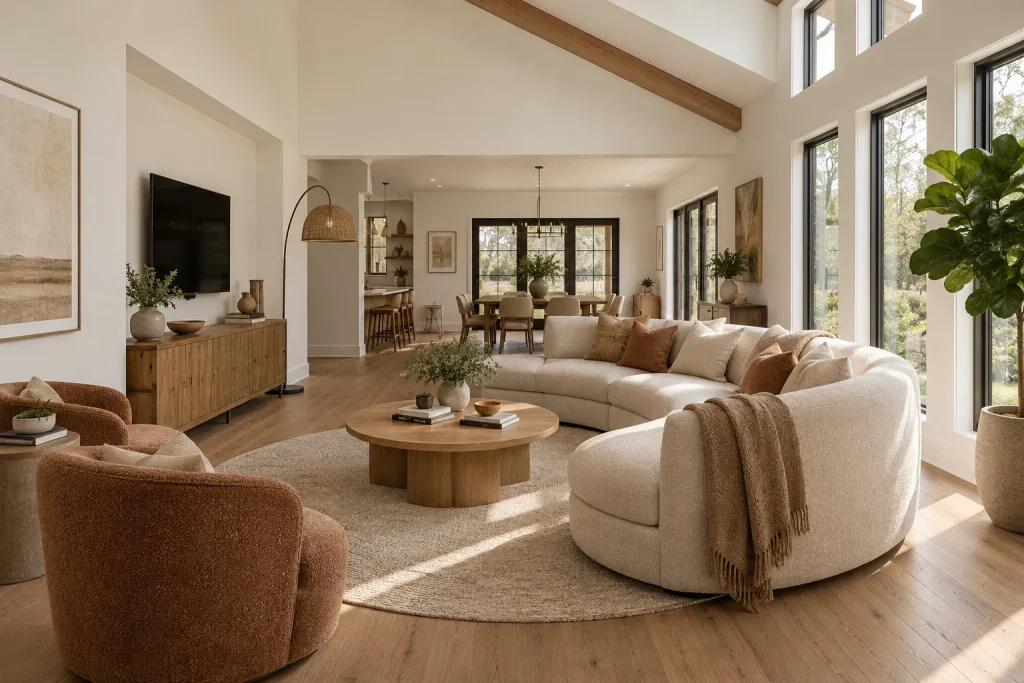
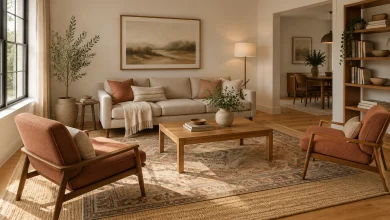
This curved-sofa-and-round-furniture-layouts approach uses a generous cream sectional to create a clear seating zone without interrupting the room’s long sightlines. The sectional faces a wood media console and wall-mounted television, while a low, round wood coffee table holds the center of a large pale rug. Two rust-toned, rounded lounge chairs sit to the left, balancing the sectional’s scale without making the group feel boxy. A swivel-style white chair at the front right continues the rounded silhouette. Warm wood floors, woven lighting, neutral upholstery, and terracotta-toned pillows pull the open living and dining areas into the same relaxed palette. Tall black-framed windows add strong vertical lines, making the low, soft furniture feel especially grounded.
Why it works: Rounded seating gives this expansive, high-ceilinged room a more intimate center, while the circular table keeps the conversation area visually open.
- Cream curved sectional
- Round wood coffee table
- Pair of rust-toned rounded chairs
- Large pale area rug
- Wood media console and woven arc lamp
Design tip: Use one round coffee table to anchor a large curved sofa without adding sharp corners.
2. Make a Compact Room Feel Easier to Navigate
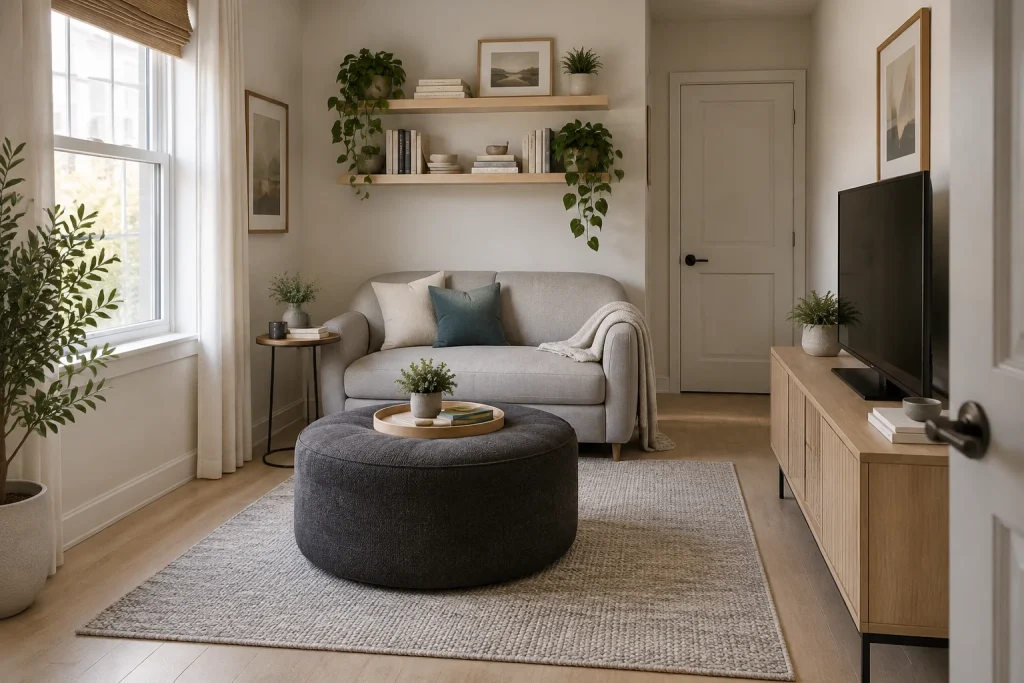
In this compact living room, a small pale upholstered loveseat has softly rolled, curved arms that relax the room’s otherwise straight architectural lines. A substantial charcoal round ottoman sits at the center of the rug, topped with a shallow tray, books, and a small plant. Its low, upholstered profile keeps the middle of the room from feeling visually busy. A slim round side table beside the loveseat offers a more traditional tabletop surface without taking up much visual space. Above, two simple wood wall shelves hold books, framed art, and trailing plants, using the wall plane rather than adding another storage piece at floor level. The light wood media console and neutral rug keep the narrow seating arrangement calm and cohesive.
Why it works: The ottoman, side table, and loveseat introduce useful rounded forms while leaving the walls and floor edges legible, an effective balance in a small room.
- Compact curved-arm loveseat
- Charcoal round ottoman
- Slim round side table
- Floating wood shelves
- Light wood media console
Design tip: Pair a large round ottoman with a slender side table so drinks have a stable landing spot.
3. Build Formal Balance With Repeated Rounded Forms
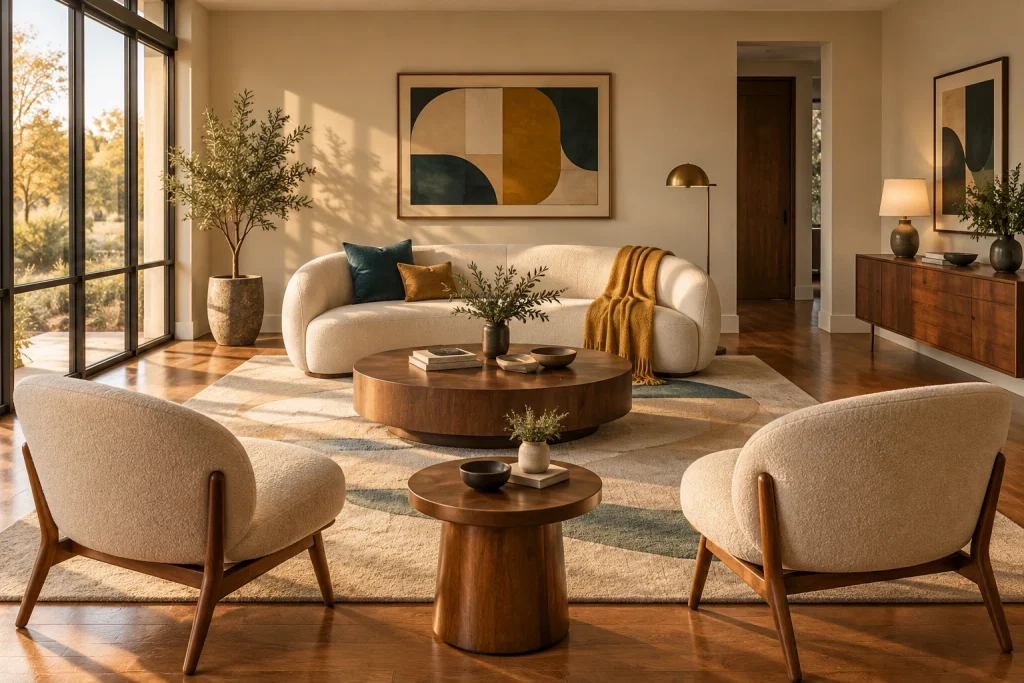
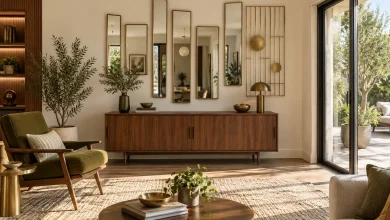
This room layers rounded furniture into a composed, mid-century-inspired arrangement. A low cream sofa curves gently across the back wall beneath a large geometric artwork in cream, mustard, and deep teal. In front, a broad round walnut coffee table echoes the sofa’s arc, while two cream lounge chairs with rounded backs frame the foreground. Their exposed wood bases relate to the coffee table and the long walnut credenza on the right. A smaller pedestal side table sits between the chairs, repeating the circular motif at a lighter scale. The geometric rug introduces curved color blocks beneath the furniture, so the arrangement feels connected rather than assembled from separate pieces. Sunlight from the black-framed windows emphasizes the warm wood and layered cream upholstery.
Why it works: Repeating circles and curves creates unity, but the symmetry of the chairs, artwork, and central table prevents the room from becoming overly soft or informal.
- Curved cream sofa
- Round walnut coffee table
- Two rounded wood-framed lounge chairs
- Pedestal side table
- Walnut credenza and geometric rug
Design tip: Repeat a curved silhouette at three scales—sofa, coffee table, and side table—for a cohesive seating group.
4. Shape a Fireplace Conversation Circle
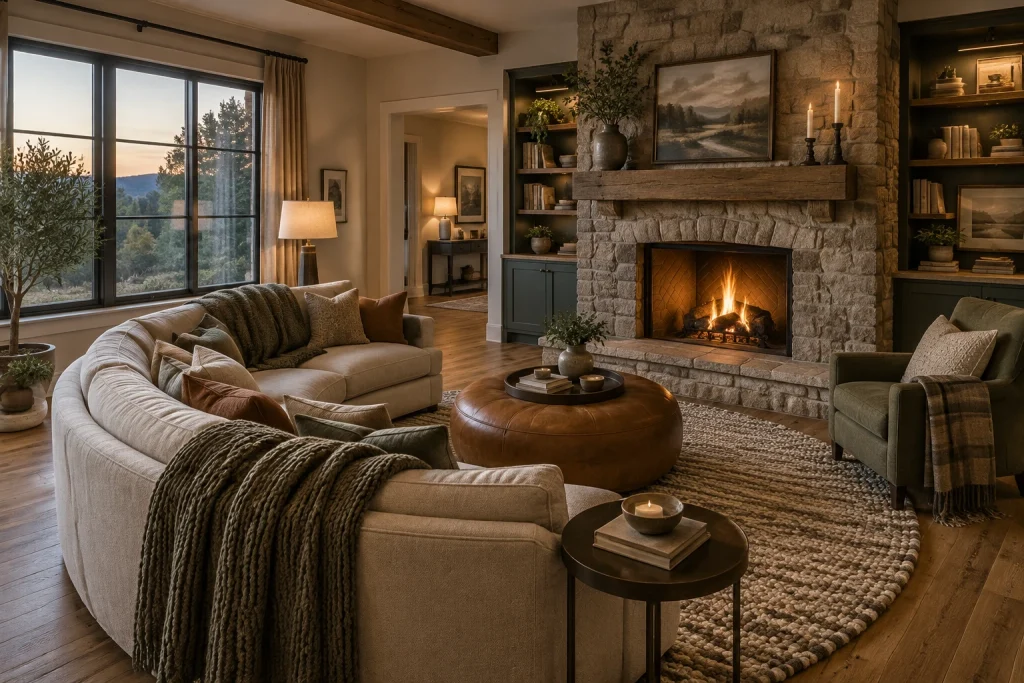
A deep, curved cream sofa forms a broad arc around a round leather ottoman, directing the seating group toward the stone fireplace. The ottoman is topped with a black tray, books, and small vessels, creating a defined center without the hard outline of a rectangular coffee table. A dark round side table at the sofa’s near arm offers another surface, while a green upholstered armchair adds a contrasting, tailored shape at the right. The room’s textures do much of the visual work: rough stone, a thick nubby rug, warm wood flooring, leather, linen-like upholstery, and chunky throws. Built-in dark shelving flanks the fireplace, and a substantial wood mantel grounds the vertical stone surround. The open curve leaves the hearth visible from the surrounding seats.
Why it works: The sofa’s arc turns the fireplace into the natural focal point and makes the ottoman accessible from several sides, while varied tactile materials keep the neutral palette layered.
- Curved cream sofa
- Round brown leather ottoman
- Stone fireplace and wood mantel
- Dark round side table
- Olive-green armchair and textured rug
Design tip: Center a round ottoman inside a curved sofa’s arc, leaving a comfortable visual gap around it.
1. Use a Curved Banquette to Soften an Open Kitchen
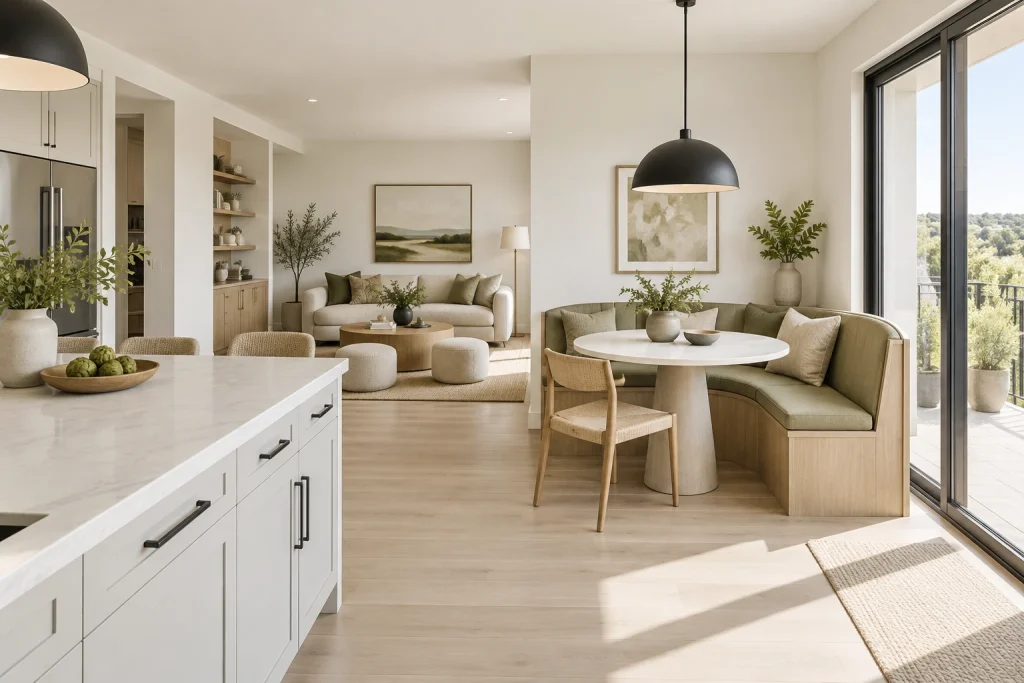
This open-plan room uses rounded forms to distinguish dining and lounging without introducing visual bulk. A pale green, wood-framed banquette wraps the corner beside the large black-framed sliding doors, meeting a white round pedestal table and a single woven dining chair. Nearby, a compact ivory sofa faces a low, round wood coffee table, with two small cylindrical poufs completing the living grouping. The dining nook and lounge share pale wood flooring and a restrained mix of cream, sage, and natural wood, while black pendant lights and door frames add definition. Most importantly, the curved banquette keeps the dining setup contained at the window side, leaving the central floor plane visibly open between the kitchen island, table, and seating area.
Why it works: The repeating circles create cohesion across two functions, while the banquette’s curved edge makes the dining nook feel integrated rather than boxed in.
- Curved sage upholstered banquette
- Round white pedestal dining table
- Low circular wood coffee table
- Two upholstered round poufs
- Black dome pendant lights
Design tip: Pair a curved banquette with a pedestal table to eliminate awkward table legs at the entry side.
2. Ground a Curved Sofa With One Strong Round Table
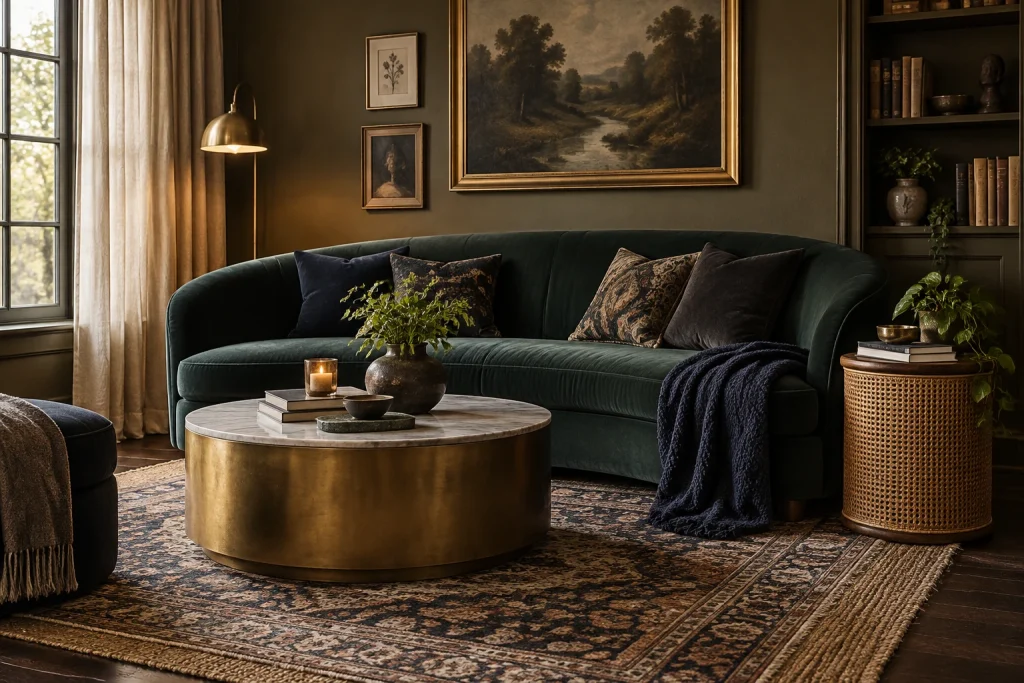
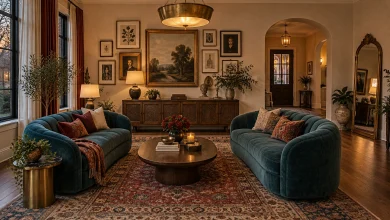
In this dark, layered lounge, the sweeping emerald velvet sofa is balanced by a substantial round coffee table rather than competing with angular pieces. The table’s brass-colored cylindrical base and pale stone top bring a bright, reflective note to the charcoal-green room, while its generous diameter echoes the sofa’s continuous front curve. Patterned pillows, a navy throw, framed art, and an ornate rug build depth without disrupting the seating arrangement. At the sofa’s right arm, a round cane-front side table holds a short stack of books and a small brass bowl. Window light filters through full-length neutral drapery on the left, and a brass floor lamp introduces another warm, rounded silhouette. The result is dense and intimate, with the coffee table serving as the calm center.
Why it works: A single large circular table gives the sofa’s broad curve a clear focal point, while brass, velvet, cane, and patterned textiles provide contrast through material instead of extra furniture shapes.
- Deep green curved velvet sofa
- Round brass and stone coffee table
- Round cane-front side table
- Patterned area rug
- Brass floor lamp
Design tip: With a deep curved sofa, choose one low, wide round coffee table instead of several small tables.
3. Create a Family-Friendly Arc Around a Round Ottoman
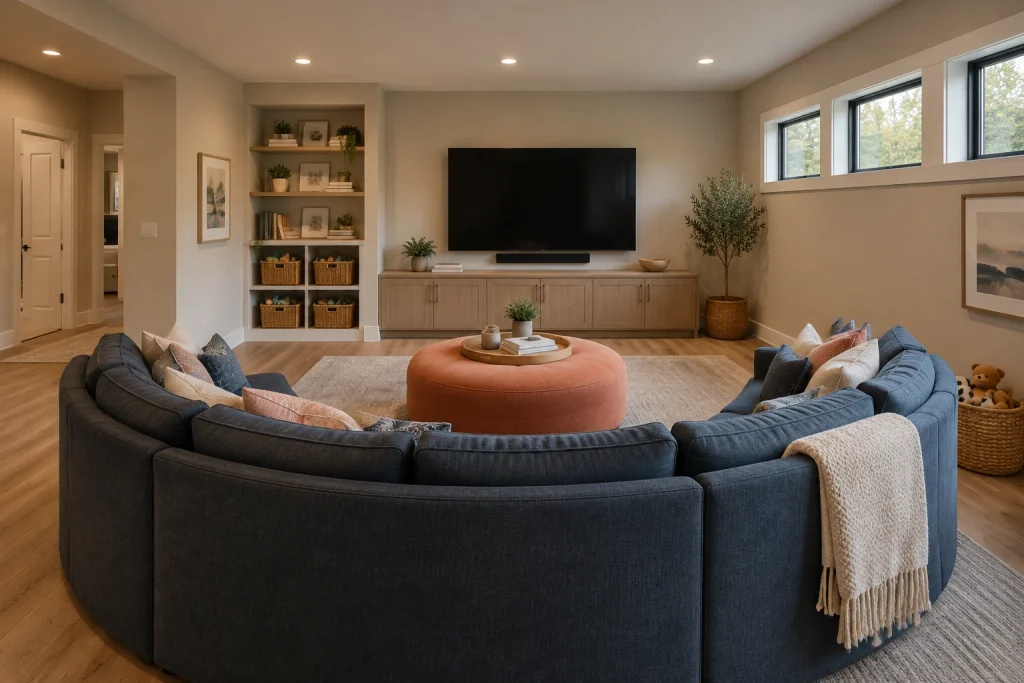
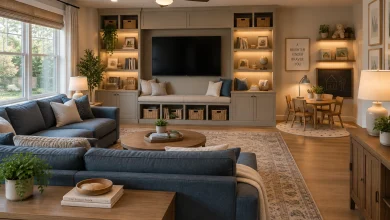
A navy curved sectional forms a broad arc facing the wall-mounted television, making the screen the obvious focal point while enclosing a comfortable central zone. A large coral round ottoman occupies the middle of the seating arrangement, topped with a tray, books, and a small vessel. Its soft profile visually lightens the substantial sectional and introduces a warm color against the room’s greige walls, pale wood floor, and neutral rug. Behind the ottoman, a low wood media cabinet runs beneath the television; open shelves to the left display books, framed artwork, plants, and woven baskets. Two high windows brighten the wall to the right, while a basket of plush toys sits beside the sectional. The sectional’s open curve keeps the center legible rather than dividing it with a rigid coffee table.
Why it works: The circular ottoman matches the sectional’s geometry and leaves the seating arrangement visually open, while built-in-style storage concentrates everyday items along the media wall.
- Curved navy sectional
- Large coral round ottoman
- Wall-mounted television
- Long wood media cabinet
- Open shelves with woven baskets
Design tip: Use a tray on a large upholstered ottoman to create a stable surface without sacrificing its soft edges.
4. Build a Compact Conversation Zone With Modular Curves
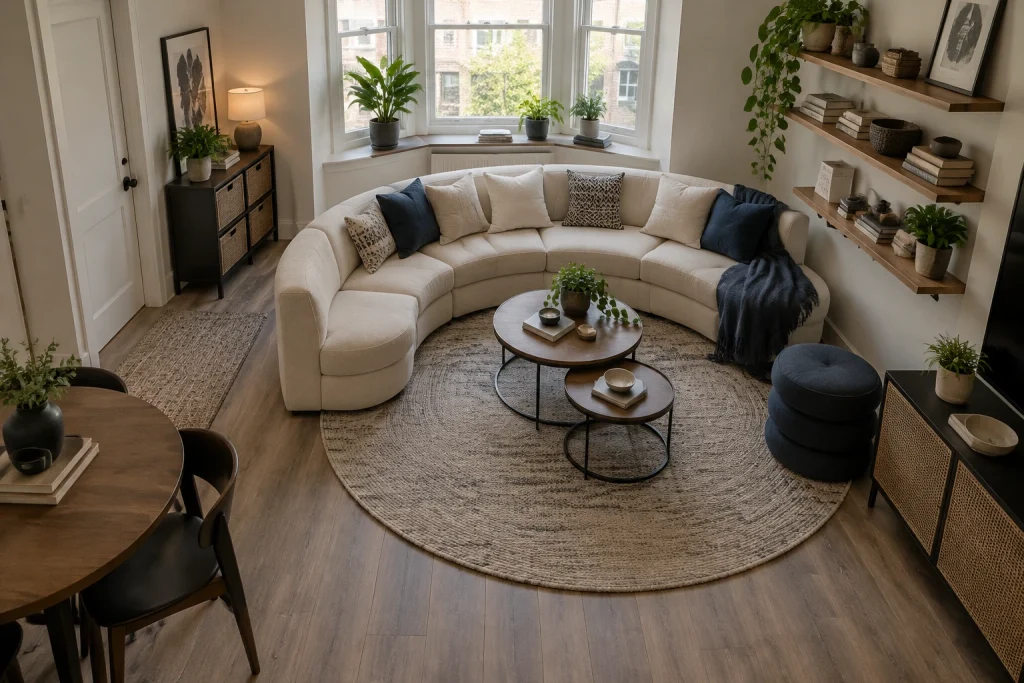
This compact living area shows how curved sofa sections can establish a distinct conversation zone within a larger room. The cream seating forms a near semicircle beneath a projecting bay window, with navy pillows and a dark blue throw sharpening the otherwise quiet palette. Two round nesting coffee tables sit at the center, their slim black bases keeping the middle visually light. A large circular rug extends beneath the sofa and tables, clearly outlining the lounge area against the wood-look floor. At right, three stacked navy poufs offer compact movable seating. Floating wood shelves fill the wall above the sofa’s right side with books, small vessels, framed art, and plants, while a black cabinet with woven-panel doors provides additional storage. A round dining table is partially visible in the foreground, reinforcing the room’s recurring curved language.
Why it works: The round rug, nesting tables, and curved sofa establish a unified center, while the open floor around the rug separates the lounge from the visible dining area.
- Cream curved sectional seating
- Round nesting coffee tables
- Large circular textured rug
- Stacked navy poufs
- Wall-mounted wood shelves
Design tip: Anchor a curved sectional on a round rug large enough to extend beyond its front edge.
1. Soften a Narrow Sitting Room With One Rounded Anchor
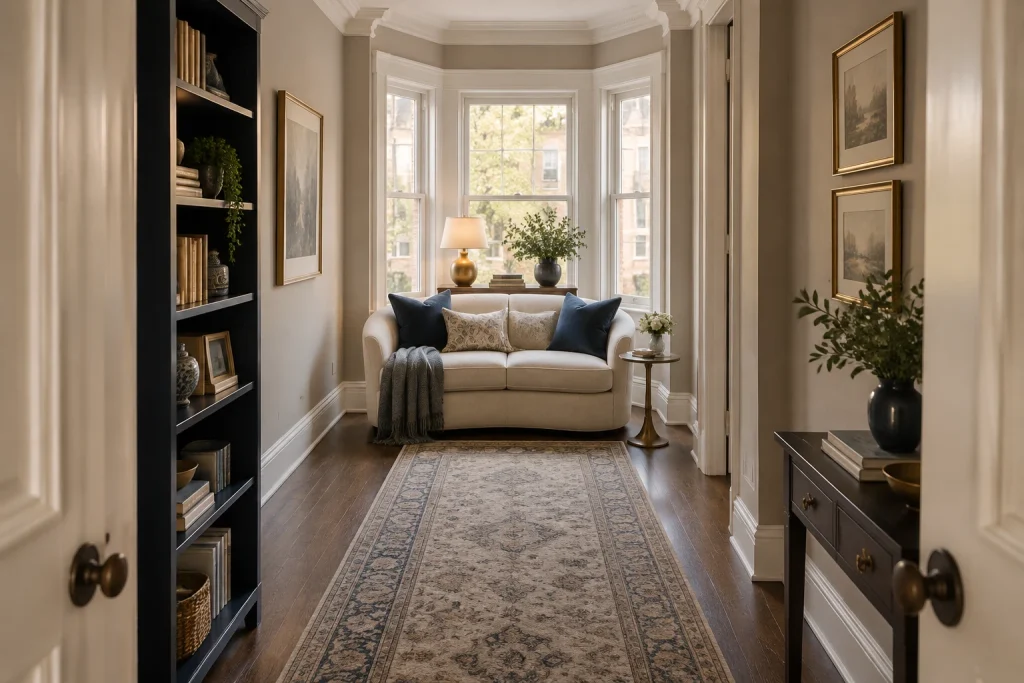
In this slender sitting room, a compact ivory sofa with rounded arms occupies the bay without visually hardening its edges. Its low, gently curved silhouette is balanced by tailored cushions in navy and patterned neutrals, while a small round pedestal table sits at the sofa’s right arm. A narrow black bookcase fills the left wall vertically rather than projecting into the floor area; books, ceramics, framed pieces, and a trailing plant give it depth. The patterned runner establishes a long central axis on the dark wood floor, and the unobstructed strip beside it keeps the approach to the bay legible. White-painted millwork, taupe walls, brass-framed art, and a brass lamp add traditional structure around the softer furniture forms.
Why it works: The sofa’s rounded profile relieves the room’s long, rectilinear geometry, while the pedestal table provides a usable surface with a minimal footprint. Tall storage and wall-mounted art keep visual interest off the walking zone.
- Compact ivory sofa with rounded arms
- Small brass pedestal side table
- Tall black built-in-style bookcase
- Long muted-pattern runner
- Bay windows with white trim
Design tip: Choose a pedestal side table beside a curved sofa to avoid sharp corners in a tight passage.
2. Use Circular Pieces to Create an Easy Porch Conversation Zone
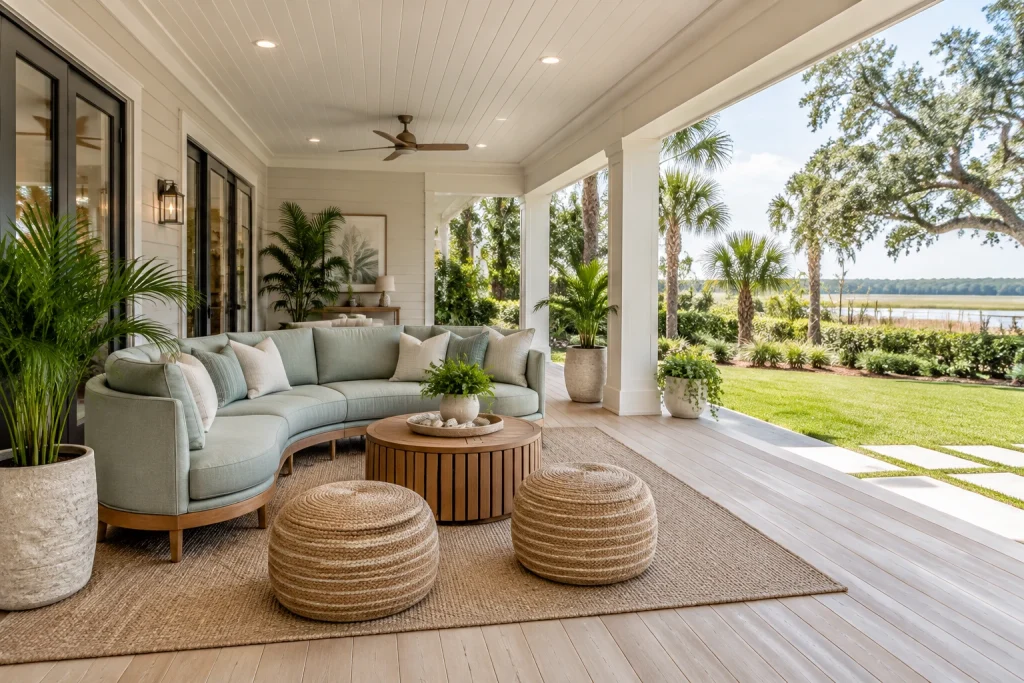
A seafoam curved sectional gathers the seating area at the sheltered side of this covered porch, facing the open lawn and water view. Its arc wraps around a round, slatted wood coffee table, creating a compact center for the arrangement without introducing hard corners. Two low, woven round poufs sit at the rug’s front edge, ready to work as flexible extra seats or footrests. A large natural-fiber rug defines the group against the pale plank floor, while substantial potted palms soften the glass doors, wall, and porch columns. The open side remains clear from the seating arrangement, allowing the eye to travel across the grass, palms, and water. White ceiling boards, recessed lights, a ceiling fan, and black-framed doors provide crisp architectural contrast.
Why it works: Repeating rounded silhouettes—the sectional, coffee table, poufs, planters, and rug-adjacent grouping—makes the conversation area feel cohesive against the porch’s straight boards and columns. Keeping the open perimeter free preserves the view and the porch’s airy edge.
- Seafoam curved sectional
- Round slatted wood coffee table
- Two woven round poufs
- Large natural-fiber area rug
- Potted palms and open garden-facing edge
Design tip: Center a round coffee table inside a curved sectional, then keep the porch’s open edge free of movable pieces.
Final thoughts
Curved furniture works best when it supports the room’s natural focal point and leaves a comfortable route around the seating group. Start with one rounded anchor, such as a curved sofa, banquette, or substantial round ottoman, then repeat the shape at a smaller scale with a coffee table, side table, rug, or pouf. In larger rooms, these forms can organize an expansive floor plan into a clear conversation area. In tighter spaces, they can reduce visual bulk and eliminate sharp corners along major walkways. Balance the softness with grounding elements—wood floors, tailored textiles, a media console, a fireplace surround, or a structured bookcase—so the finished room feels composed rather than overly curvy. Whether the setting is a formal lounge, a family room, a compact sitting area, or an indoor-outdoor space, curved sofas and round furniture create layouts that feel welcoming, connected, and easier to move through.