Layering rugs in a living room is a practical way to give a seating area more definition while bringing texture closer to the furniture. The most successful arrangements begin with a larger, quieter base rug and add a smaller top layer that introduces pattern, softness, shape, or contrast. A natural-fiber foundation can support a patterned rectangle, a plush rug can soften a flatweave, and overlapping circles can echo curved seating. These layered-rugs living-room ideas show how to use visible borders, proportion, and placement to organize everything from compact nooks to open-plan spaces.
1. Start With a Textural Jute Foundation
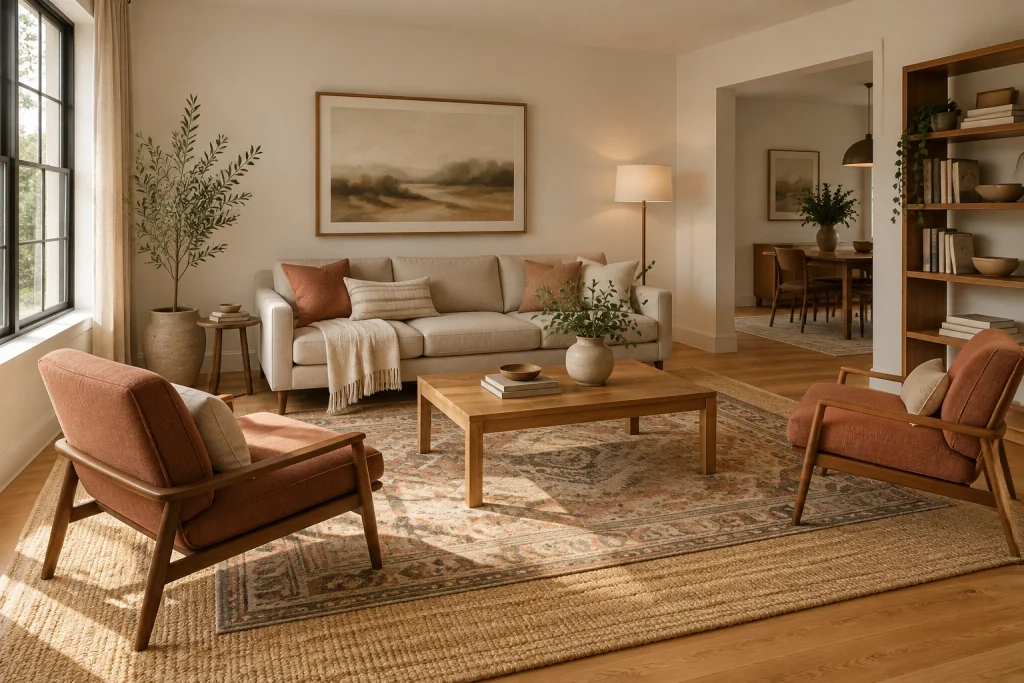
This layered-rugs-living-room arrangement begins with a generously scaled natural-fiber rug that reaches beneath the sofa, both wood-framed lounge chairs, and the coffee table. Its chunky woven surface establishes a quiet sand-colored field over the oak floor. A smaller rectangular rug, detailed with a muted terracotta, charcoal, and cream pattern, is placed squarely on top. The patterned layer sits beneath the coffee table and meets the sofa’s front feet, giving the central conversation area a more defined boundary. Because the outer rug projects well beyond the inner one on every side, the two pieces read as deliberate layers rather than competing rectangles. Warm upholstery, wood frames, and the oak table continue the rugs’ natural, low-contrast palette.
Why it works: The large, tactile base gives the furniture one cohesive footprint, while the lower-contrast patterned rug adds visual detail exactly where the eye lands: beneath the coffee table.
- Chunky natural-fiber base rug
- Smaller muted-pattern accent rug
- Oak coffee table centered on the top layer
- Sofa front feet meeting the patterned rug
- Warm terracotta lounge-chair upholstery
Design tip: Keep at least 12 to 18 inches of the base rug visible around the top rug.
2. Offset a Plush Layer in a Compact Seating Area
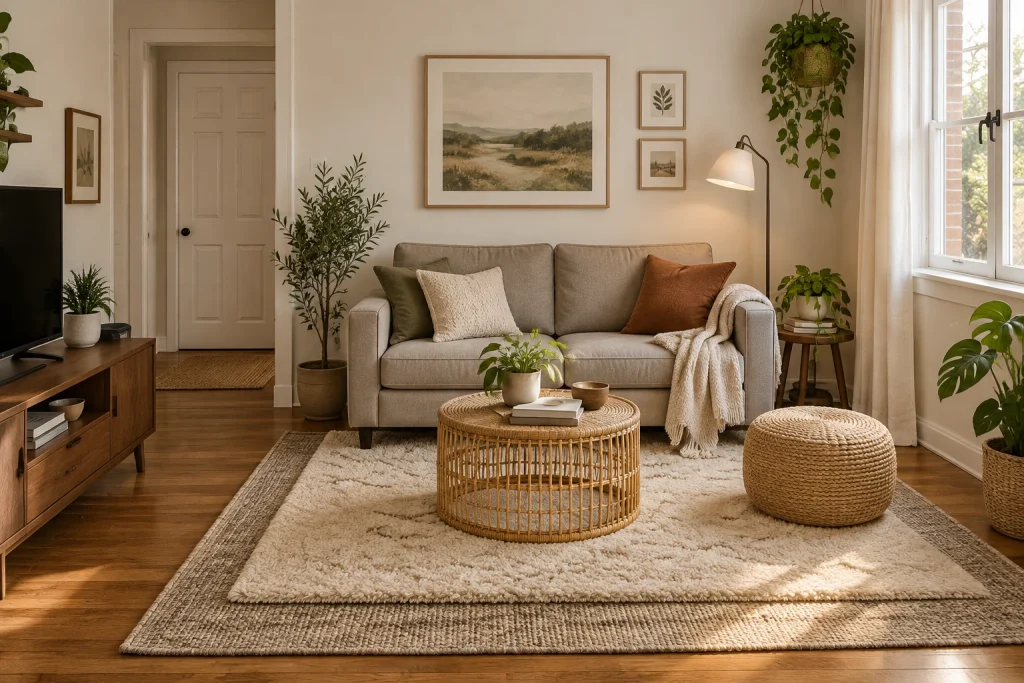
In this small living area, a low-profile woven rug creates a broad, warm-gray perimeter on the hardwood floor, while an ivory shag rug is layered over it with a clear, even reveal. The softer top rug occupies the center of the seating group: it extends under the round woven coffee table, reaches toward the sofa, and leaves the darker, flatter base visible at the sides and front. That contrast in pile height is the primary decorative move, so the palette can stay restrained. A woven pouf, rattan coffee table, neutral sofa, and plants reinforce the casual mix of natural textures without introducing a second strong pattern. The exposed floor remains visible around the rug pair, helping the compact furniture arrangement avoid a crowded look.
Why it works: A flat base prevents the layered composition from becoming visually heavy, and the plush ivory top layer gives the compact seating zone a distinct, comfortable center.
- Warm-gray flatweave base rug
- Ivory high-pile top rug
- Round woven coffee table
- Woven pouf at the rug edge
- Hardwood floor visible around both rugs
Design tip: For a small room, choose one patterned or high-pile rug—not both.
3. Echo Curved Seating With Round Rugs
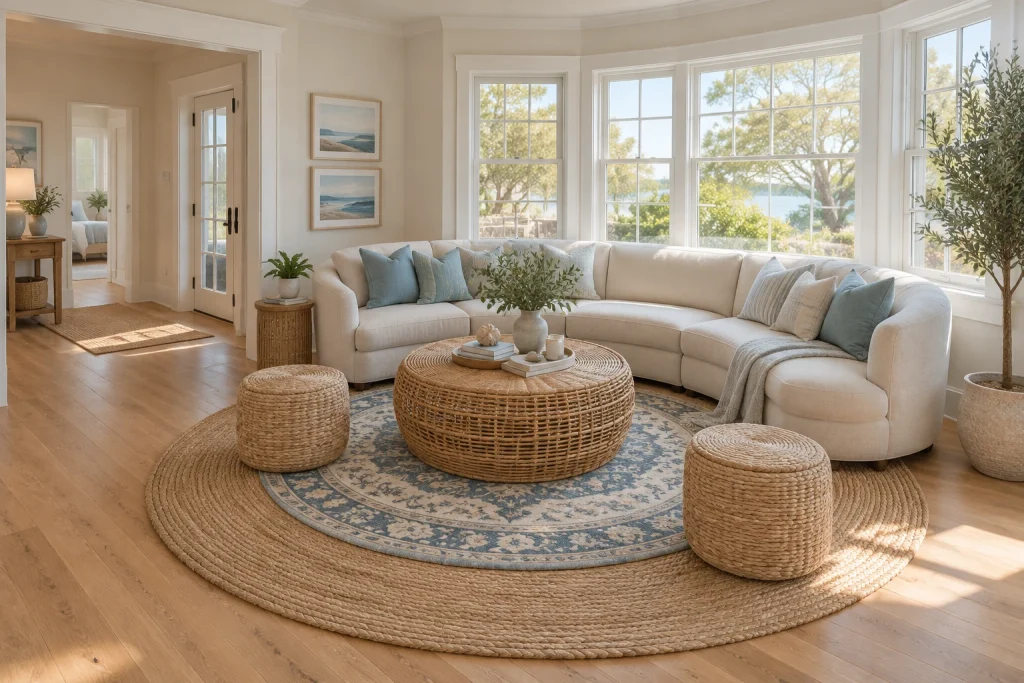
Round-on-round layering suits this bay-window seating area because it repeats the shape of the curved sectional and circular rattan coffee table. The larger rug is a thick, braided natural-fiber circle that sets a sandy, textural foundation on the pale wood floor. Centered above it is a smaller round rug with a blue-and-cream floral pattern. Its defined border creates a second circle beneath the table, while the braided base remains visible as a wide halo around it. Two low woven stools rest near the outer edge of the layered rugs, furthering the room’s rounded rhythm. Blue pillows on the sectional pull the cooler tones of the patterned rug up into the seating, so the top layer feels connected to the broader palette rather than isolated on the floor.
Why it works: Matching the rug geometry to the sectional’s sweeping form softens the seating zone and avoids the awkward corners a rectangular rug could introduce here.
- Large braided round base rug
- Smaller blue-and-cream round patterned rug
- Curved ivory sectional
- Round rattan coffee table
- Two woven round stools
Design tip: Center both circles on the coffee table, then check that the outer ring remains visibly even.
4. Use High Contrast to Define a Moody Room
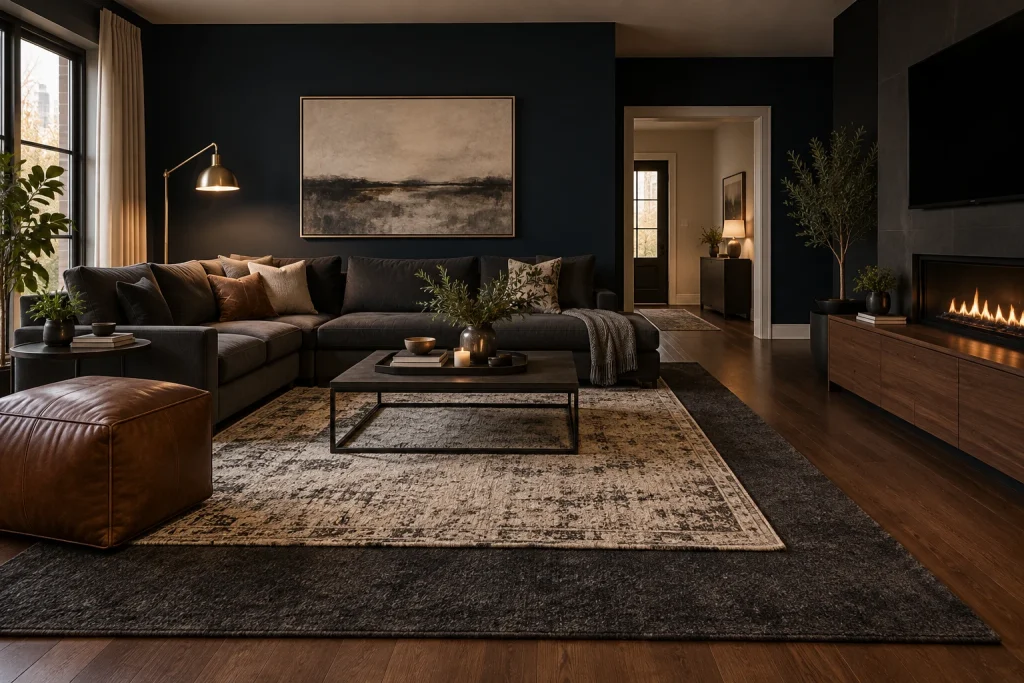
This room takes the opposite approach to tonal layering: a near-black charcoal rug creates a large, dark ground beneath the sectional, leather ottoman, and low coffee table, while a smaller cream-and-charcoal rug sits visibly on top. The inner rug has a distressed, irregular-looking pattern and a pale border, making its rectangular outline easy to read against the dense dark base. The contrast brings the coffee table forward as the center of the composition and introduces lightness at floor level in a room with dark walls, a charcoal sectional, and a black fireplace surround. Walnut cabinetry and the brown leather ottoman keep the palette from feeling stark. The base rug extends substantially beyond the top rug, particularly at the front and right, preserving a strong dark frame around the lighter layer.
Why it works: The pale top rug breaks up a large field of charcoal, while the dark base visually anchors the low furniture and echoes the room’s walls and fireplace surround.
- Large charcoal base rug
- Distressed cream-and-charcoal accent rug
- Low black metal coffee table
- Charcoal sectional
- Brown leather ottoman
Design tip: Use a low-contrast base and a lighter top rug when you want the layered edges to become the focal point.
1. Create a Soft Play Zone Within a Larger Seating Area
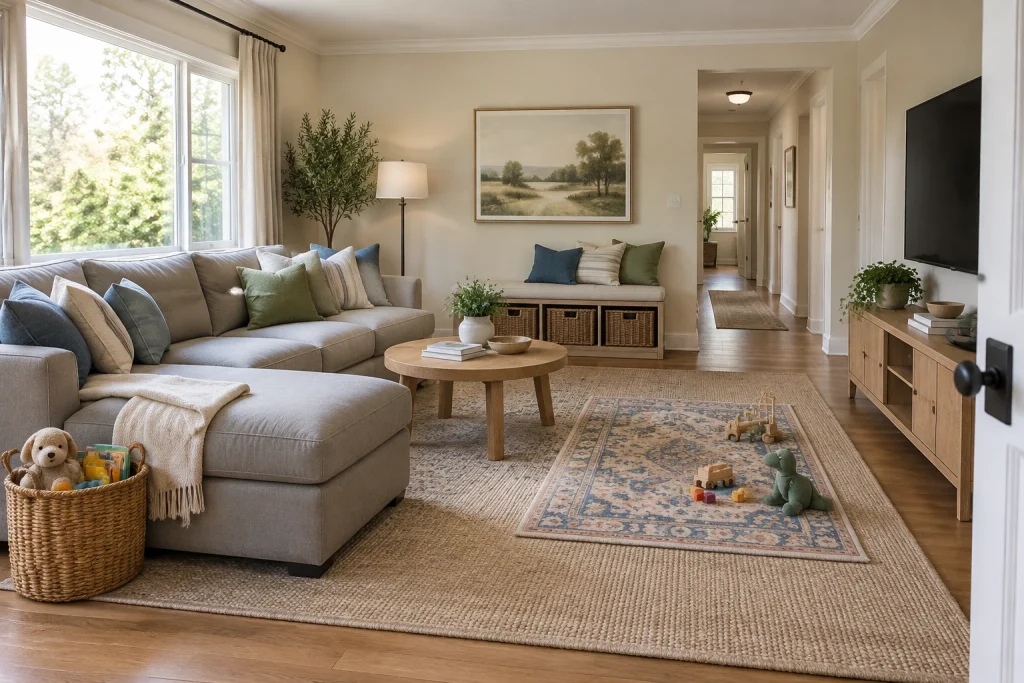
This layered-rugs living room uses scale to make a casual family setup feel organized rather than crowded. A large natural-toned, chunky woven rug stretches beneath the sectional, round wood coffee table, and open floor area, establishing a durable-looking visual ground. On top, a smaller blue, cream, and muted rust patterned rug sits forward of the sofa, where a few toys are gathered. Its crisp rectangular border distinguishes that activity area without interrupting the room’s neutral palette. The gray sectional, blue and olive pillows, woven toy basket, and low storage bench reinforce the relaxed, practical character. Importantly, the layered rugs stop well short of the passage at right, keeping the route toward the hall visually open.
Why it works: The large textured base unifies the furniture, while the smaller patterned rug gives toys and floor play a clear, contained-looking place.
- Oversized natural woven base rug
- Smaller blue-and-cream patterned top rug
- Gray sectional with chaise
- Round wood coffee table
- Woven basket holding toys
Design tip: Place the smaller rug where activity happens, not centered automatically under every piece of furniture.
2. Use Separate Rug Layers to Clarify an Open Plan
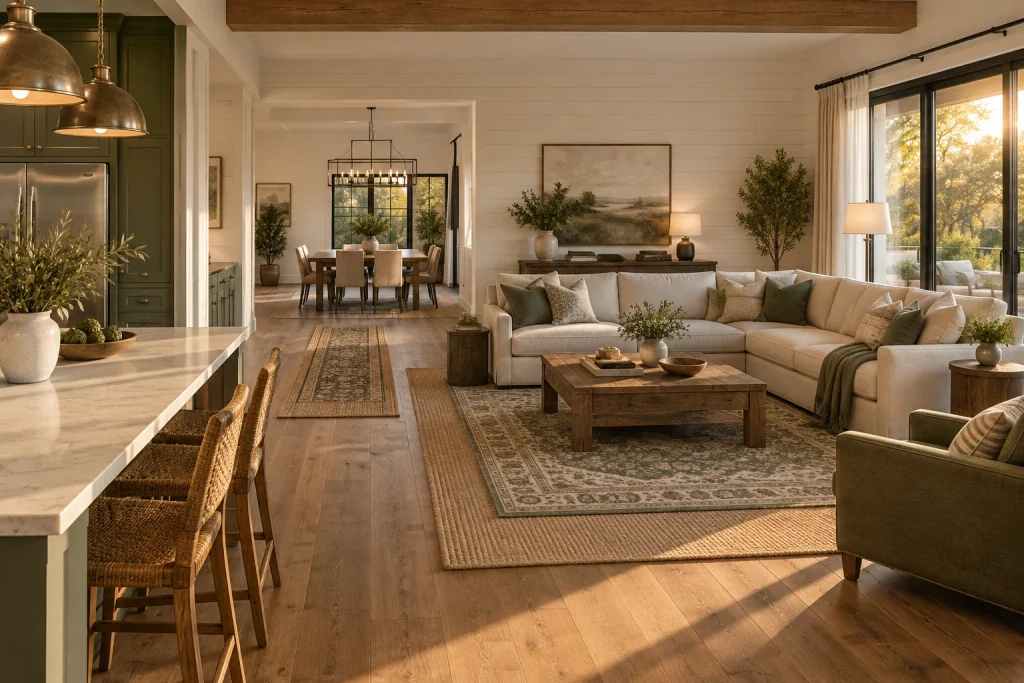
In this open-plan room, layered rugs establish two different kinds of order: a broad living area and a narrow route alongside it. The seating zone begins with a large warm natural-fiber rug beneath the sectional, wood coffee table, and front chair. A smaller, muted botanical-pattern rug is centered over it, giving the coffee table a more defined anchor and adding contrast against the plain woven surface. To the left, a long patterned runner sits on a narrow natural base, extending toward the dining table beyond. The rugs share earthy beige, olive, brown, and gray tones, so the distinct layers read as a connected scheme rather than competing islands across the wood floor.
Why it works: Repeating the base-and-pattern formula at two scales separates lounging from circulation while maintaining a consistent material and color story.
- Large natural-fiber living-room base rug
- Muted patterned rug beneath the coffee table
- Layered runner in the adjacent walkway
- Cream sectional
- Wood coffee table and wood floors
Design tip: In an open plan, reserve a narrow layered runner for a travel path and a larger pair for the seating group.
3. Add One Asymmetrical Soft Layer to a Reading Corner
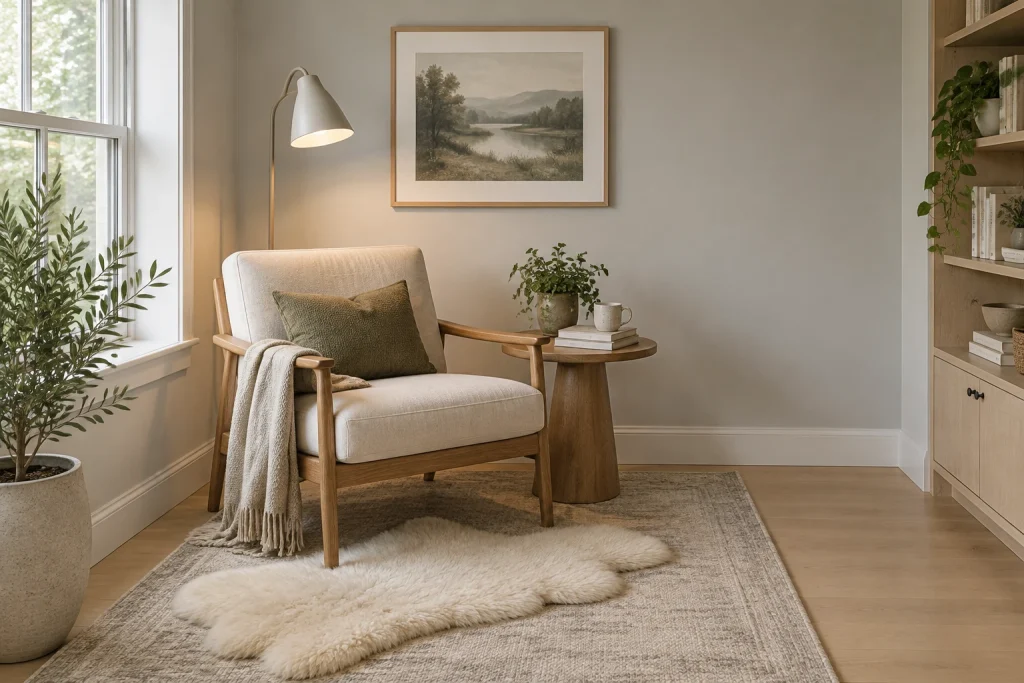
A restrained reading nook shows that layering does not require two full-size rugs. Here, a low-profile gray-beige area rug defines the corner beneath an oak-framed lounge chair and small round pedestal table. An ivory sheepskin is laid diagonally across the front portion of the base rug, extending past the chair rather than matching the rectangle beneath it. That irregular outline is the point: it brings softness and dimension to a composition otherwise shaped by clean lines, pale wood, and quiet neutrals. The cream upholstery, sage pillow, curved floor lamp, and simple landscape print keep attention on material contrast. Open flooring remains visible at right beside the built-in shelving, preventing the compact corner from feeling overfilled.
Why it works: The smooth, structured base rug supplies definition, and the sheepskin provides a tactile accent without visually enlarging the furniture arrangement.
- Low-profile neutral area rug
- Ivory sheepskin layer
- Oak-framed upholstered lounge chair
- Small round wood side table
- Clear floor area beside shelving
Design tip: For a small corner, layer a hide or sheepskin diagonally over a simple rug instead of adding another rectangle.
4. Frame a Formal Conversation Area With Pattern Over Sisal
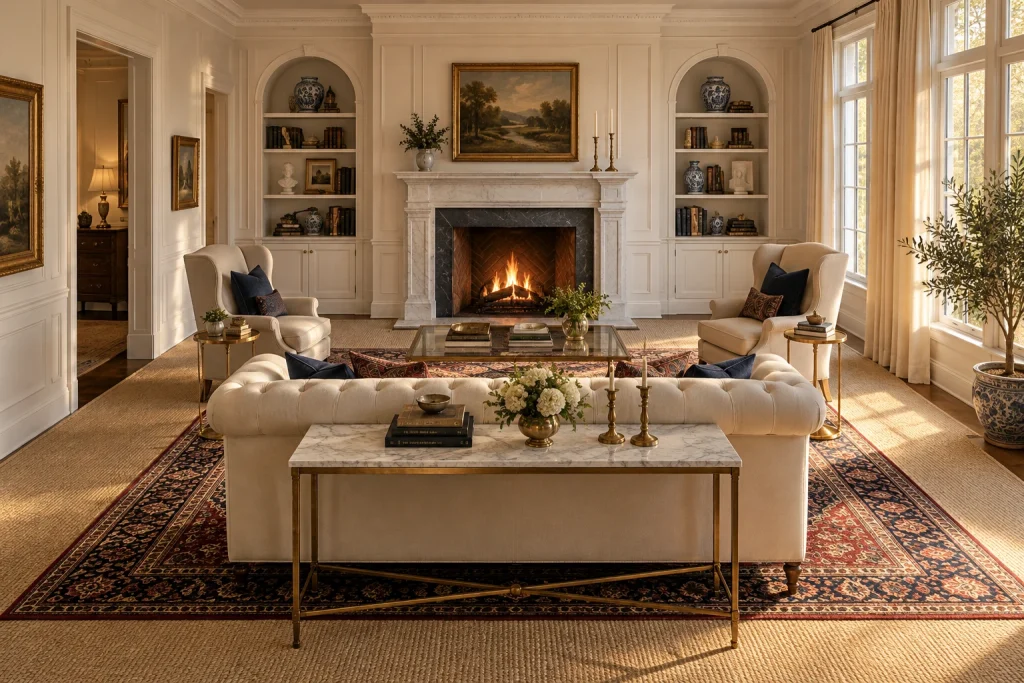
This formal room makes the contrast between a plain woven ground and an ornate accent rug feel intentional. A large tan sisal-style surface spans nearly the entire visible floor, creating a quiet backdrop for the cream tufted sofa, two wing chairs, brass-and-glass coffee table, and marble-topped console. A deep navy, burgundy, cream, and rust Persian-style rug is placed over it beneath the sofa’s front area and central table. Its dark border gives the seating group a strong frame, while its detailed field adds visual weight below the light upholstery. The rug’s long horizontal placement reinforces the room’s symmetrical focus on the fireplace, yet a band of sisal remains visible around it to preserve an airy, tailored edge.
Why it works: The broad neutral weave softens the room’s formality, while the dense traditional pattern concentrates color and detail at the center of the seating arrangement.
- Large tan sisal-style base
- Navy and burgundy Persian-style accent rug
- Cream tufted sofa
- Pair of cream wing chairs
- Brass, glass, and marble finishes
Design tip: Let a patterned top rug sit within a generous visible border of natural fiber for a formal, framed effect.
1. Use a Runner to Stretch a Long, Narrow Sitting Area
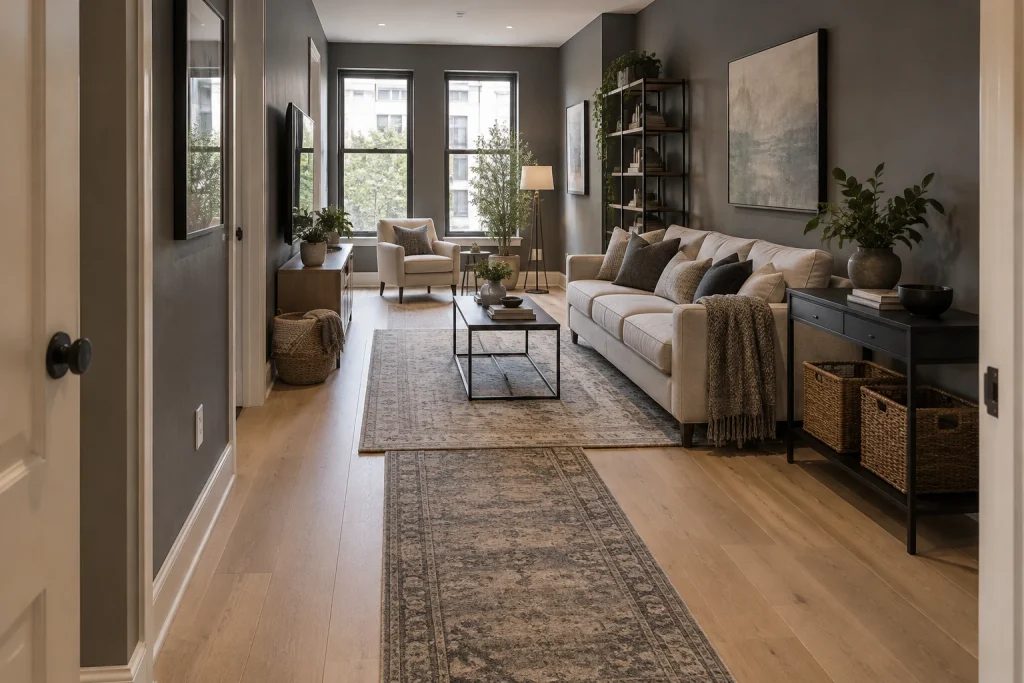
In this layered-rugs-living-room arrangement, a narrow patterned runner begins near the entry and continues beneath the front edge of a larger rectangular rug. The shared muted gray-brown palette makes the overlap feel deliberate rather than busy, while the runner’s long border visually carries the eye toward the three windows at the far end. The larger rug defines the seating zone, holding the black metal coffee table and extending under the front portion of the pale sofa. Crucially, broad strips of light wood floor remain visible along both sides. That exposed flooring preserves a clear central route through the room and lets the rug layers add depth without making the compact footprint feel crowded.
Why it works: The long, linear runner introduces direction, while the wider rug gives the sofa and coffee table a grounded center. Similar tones connect the two patterns, so the visual effect is layered texture rather than competing ornament.
- Narrow vintage-style runner placed lengthwise
- Larger muted patterned area rug
- Partial overlap at the rug edges
- Visible wood flooring along the circulation path
- Slim black metal coffee table
Design tip: Run the narrower rug in the room’s longest direction, then overlap it with a wider rug only where the seating zone begins.
2. Build a Tonal Rug Layer That Pulls Focus to the Fireplace
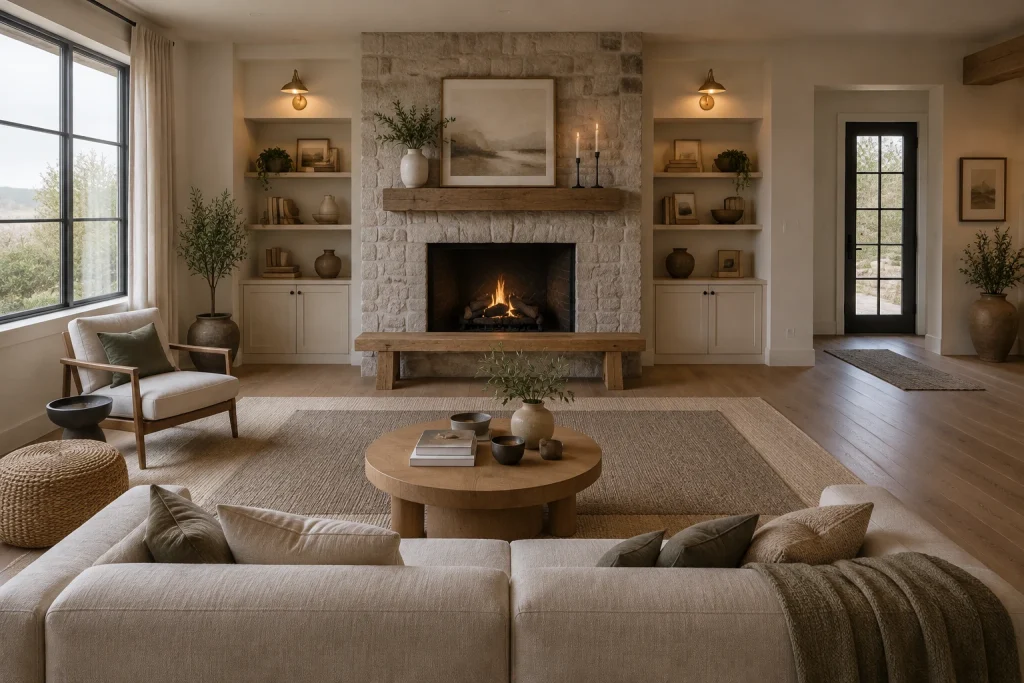
This living room uses close tonal values to make rug layering feel calm and architectural. A large light beige flatwoven rug establishes a broad, low-contrast base beneath the seating area. On top, a smaller, deeper taupe-gray rug is set closer to the stone fireplace, creating a softly defined central rectangle beneath the round wood coffee table. The change is subtle but readable: the darker upper layer gives the furniture visual weight and draws attention forward to the firebox and wood bench. Texture does much of the work here. The fine, linear weave of the larger rug contrasts gently with the denser-looking top rug, while the woven pouf adds another tactile note at the edge of the arrangement.
Why it works: Keeping both rugs within a restrained beige-and-gray range allows the difference in weave, scale, and placement to create dimension. The offset top layer concentrates the seating area without interrupting the open floor leading to the black-framed door.
- Large light neutral flatwoven base rug
- Smaller taupe-gray top rug
- Offset placement toward the fireplace
- Round wood coffee table centered over the layers
- Stone fireplace and low wood bench as focal point
Design tip: For a quieter layered look, choose rugs in neighboring tones and vary the weave before you vary the color.
Final thoughts
A layered-rugs living room works best when each rug has a clear role. Let the larger layer establish the footprint of the seating area, then use the upper rug to frame a coffee table, mark a play zone, soften a reading corner, or add visual focus near a fireplace. Keep a consistent color direction when using several patterns, leave enough of the base rug visible to make the layering intentional, and choose shapes that relate to the furniture layout. Whether the contrast is subtle or dramatic, the overlap should make the room feel more composed and dimensional.