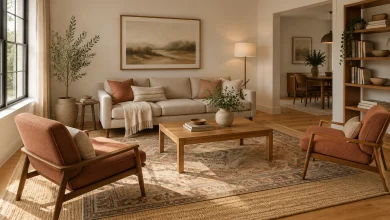
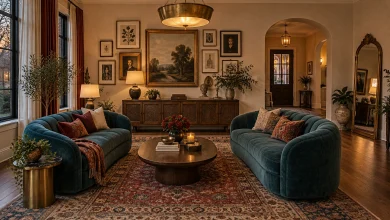
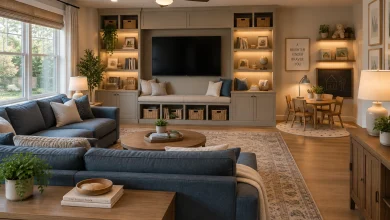
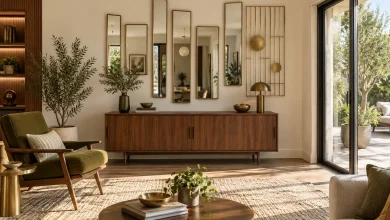
The best vintage-modern-mix-living-room-ideas do not try to make every piece match. Instead, they create a clear contemporary framework—often through a low-profile sofa, clean-lined media console, simple rug, or limited palette—then introduce older forms with texture, patina, and character. A carved sideboard, drop-leaf table, leather club chair, chest-like coffee table, or layered gallery wall can bring history to the room without making it feel period-specific. The key is to control visual weight: let one or two vintage elements take the lead, repeat their warmth through wood, brass, or woven texture, and leave enough open space for the mix to feel intentional.
1. Let a Streamlined Sofa Set the Pace for Ornate Wood
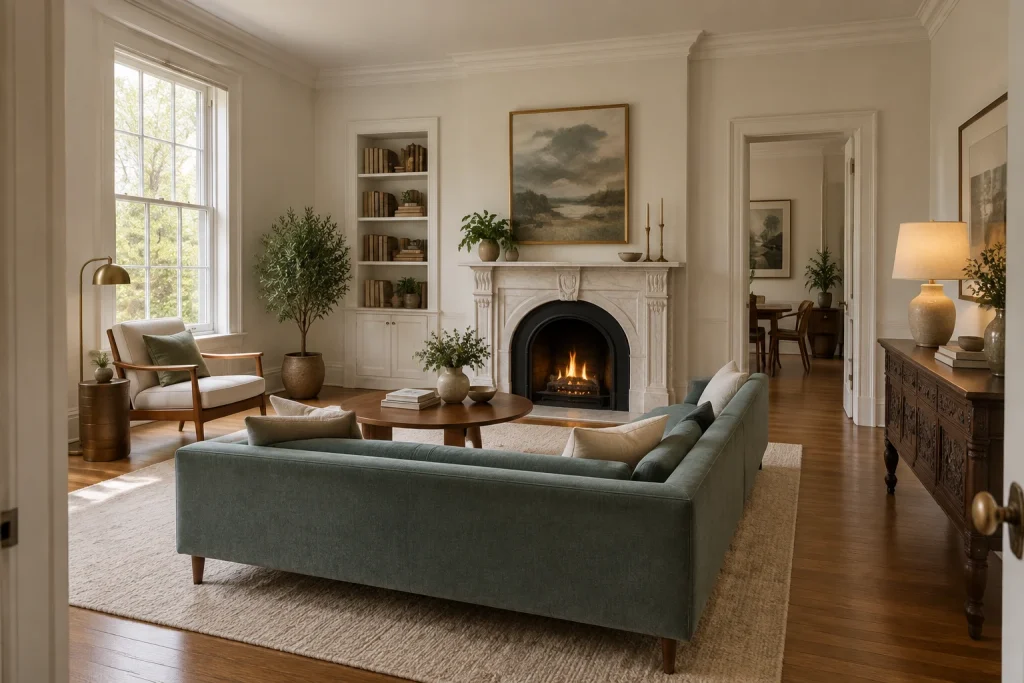
This vintage-modern-mix-living-room-ideas approach starts with contrast in silhouette rather than a crowded collection of eras. A low, boxy blue-green sofa occupies the center of the seating area, its clean profile echoed by the round wood coffee table and the angular wood-framed lounge chair. Across the room, the carved dark-wood sideboard introduces a much more decorative note, but it remains visually separate along the right wall instead of competing with the fireplace. The pale stone fireplace, ivory walls, and large neutral rug create quiet space around both styles. Brass lighting and a pair of tall candlesticks add warm metal accents, while framed landscapes, books, and leafy plants keep the room from feeling overly formal.
Why it works: The room limits ornament to the sideboard and fireplace, allowing the simpler seating to remain the dominant visual language.
- Low blue-green sofa
- Round wood coffee table
- Carved dark-wood sideboard
- Pale stone fireplace
- Neutral area rug
Design tip: Pair one visibly ornate wood piece with upholstery that has a crisp, unembellished shape.
2. Use Soft Texture to Bridge Leather and Modular Seating
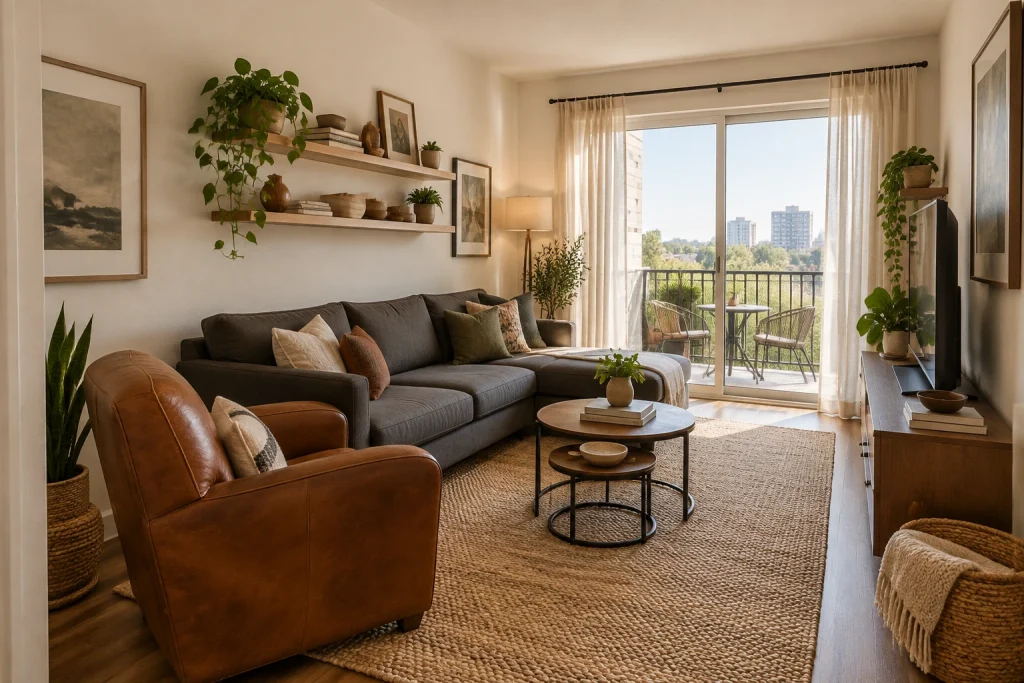
Here, a cognac leather club chair gives a compact gray sectional an immediate sense of age and depth. The two pieces are distinctly different in material and shape—the chair is rounded and substantial, while the sofa is low and segmented—yet a woven natural-fiber rug unites them underfoot. Two small round nesting tables preserve an open feel in front of the seating, rather than introducing a bulky rectangular table. Above the sofa, slim wood shelves hold pottery, books, framed art, and trailing plants; their light profile keeps the wall visually airy. Sheer curtains at the sliding glass door diffuse the daylight, and the warm wood media console repeats the chair’s earthy brown tone on the opposite side of the room.
Why it works: Repeated warm browns and tactile natural fibers make the leather chair and charcoal upholstery read as a considered pairing.
- Cognac leather club chair
- Gray sectional sofa
- Woven natural-fiber rug
- Round nesting tables
- Slim wood wall shelves
Design tip: In a small seating area, choose nesting tables that can tuck together when more floor space is needed.
3. Ground Industrial Architecture With a Patterned Vintage Rug
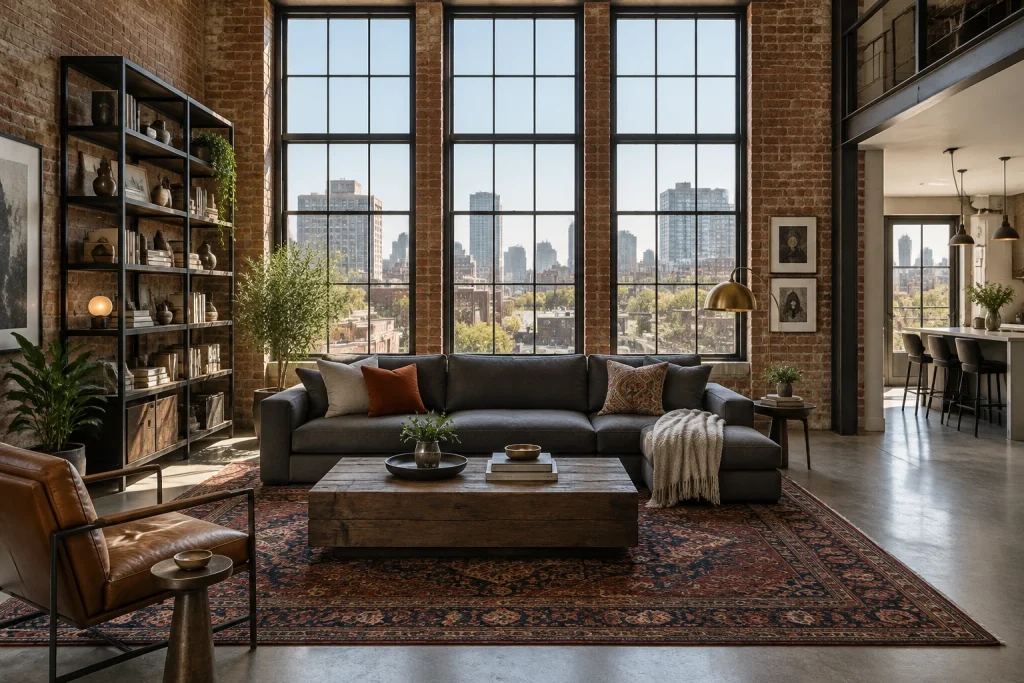
Exposed brick, black steel window frames, and a concrete floor establish a stark industrial envelope, so the richly patterned rug plays an essential softening role. It extends beneath the charcoal sectional and reclaimed-wood coffee table, giving the broad seating zone a clear boundary within the open room. The sofa’s low, tailored form keeps the composition contemporary, while the rug’s dense jewel-toned pattern brings in an older-looking layer without interrupting the clean lines. At left, a tall black metal bookcase relates directly to the window framing; its books, pottery, and plants temper the hard materials. A brass-domed floor lamp and a brown leather chair introduce warmer finishes, balancing the charcoal upholstery and black metal.
Why it works: The rug supplies color, pattern, and softness, while black metal repeats across the windows, shelving, and chair frame for cohesion.
- Exposed brick walls
- Steel-framed windows
- Charcoal sectional
- Patterned rug
- Reclaimed-wood coffee table
Design tip: Use a large patterned rug to define the lounge area before adding smaller vintage accents.
4. Balance a Sleek Media Wall With a Single Tall Antique Form
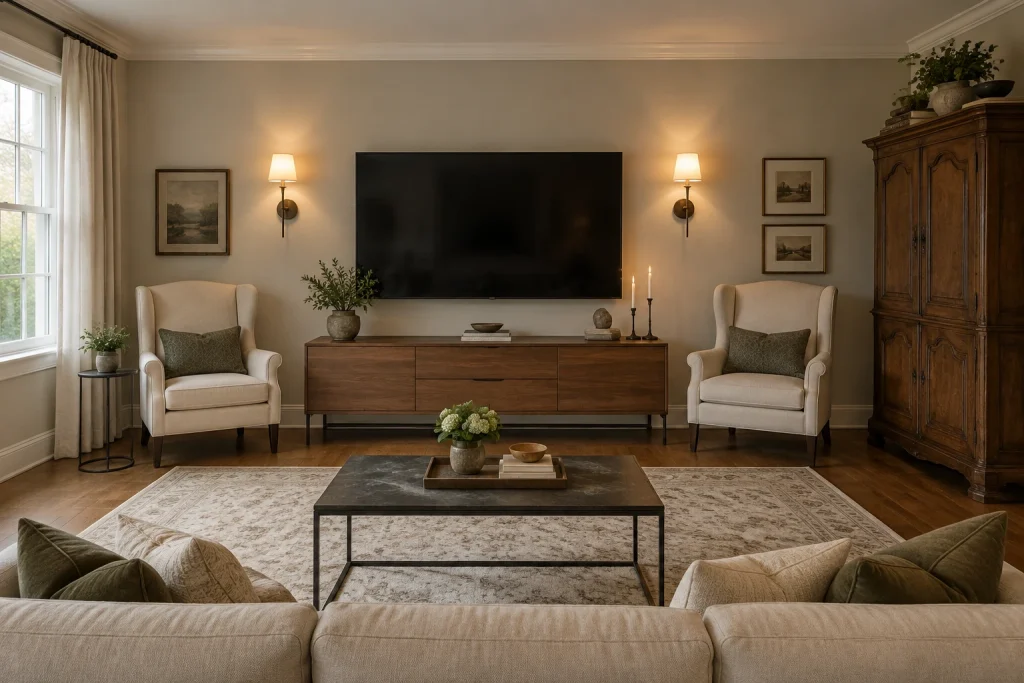
A wall-mounted television and long walnut-toned console create a deliberately clean horizontal line across this living room. The dark, heavily carved armoire at right breaks that line with height, paneling, and a more traditional profile, making it the room’s strongest old-world counterpoint. Matching cream wingback chairs on either side of the console restore visual order through symmetry, even though the armoire sits only on one side. Black-framed coffee-table legs, dark candleholders, and the console’s slim dark base bring a restrained graphic edge to the softer palette of greige walls, cream upholstery, and a pale patterned rug. Wall sconces and small framed artworks keep the television wall layered without surrounding the screen with excessive decoration.
Why it works: A contemporary media setup remains visually calm because the armoire is treated as one substantial accent, not the start of an all-antique scheme.
- Wall-mounted television
- Long wood media console
- Carved dark-wood armoire
- Pair of cream wingback chairs
- Black metal-framed coffee table
Design tip: Offset a streamlined media console with one tall traditional cabinet, then repeat its dark tone in smaller details.
1. Pair a Dark Wood Chest With Airy Natural Textures
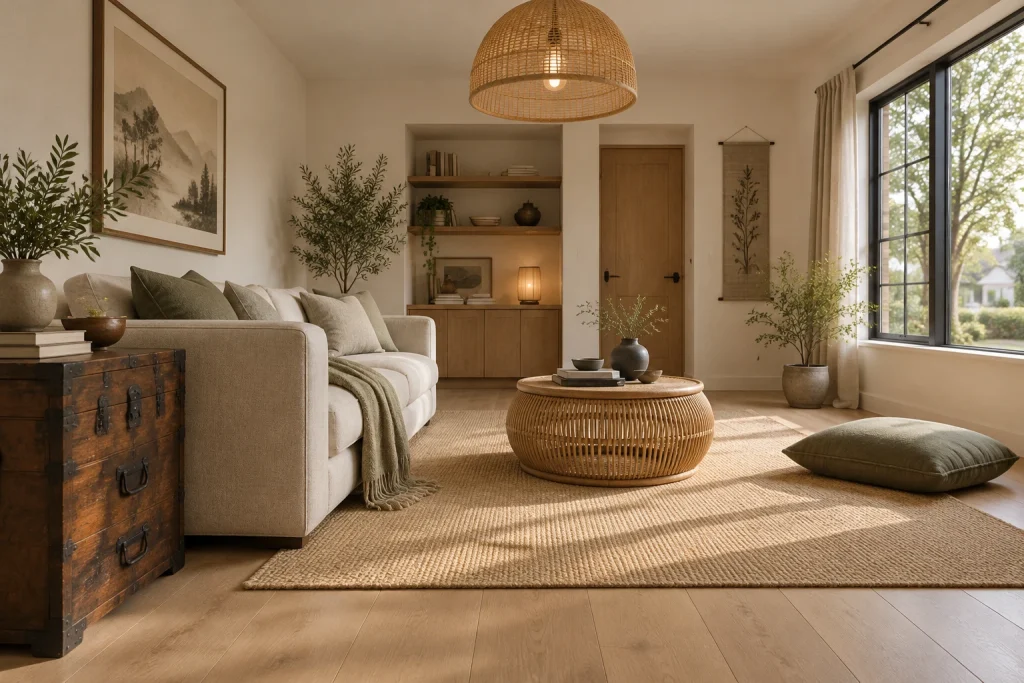
This vintage-modern-mix-living-room-ideas approach begins with contrast in visual weight. At the left edge of the room, a dark, metal-banded wood chest introduces age, patina, and a strong rectilinear silhouette. Beside it, the low upholstered sofa keeps the composition quiet with pale woven fabric, soft cushions, and a fringed throw. A rounded rattan coffee table and woven area rug carry the room’s warm, tactile palette into the center. The large woven pendant echoes the coffee table’s open latticework, while olive-toned pillows, a floor cushion, branches, and leafy plants add restrained color. Sunlight from the black-framed windows emphasizes the room’s generous open floor area rather than filling every surface.
Why it works: The chest supplies the darkest, most historic-looking note, while repeated natural fibers and a limited earth-toned palette make its presence feel integrated rather than abrupt.
- Dark wood storage chest with metal hardware
- Pale tailored sofa
- Round rattan coffee table
- Woven pendant and area rug
- Olive-green textiles and botanical accents
Design tip: Anchor one dark antique-style piece with at least two lighter natural materials nearby.
2. Let a Saturated Sofa Lead a Clean-Lined Scheme
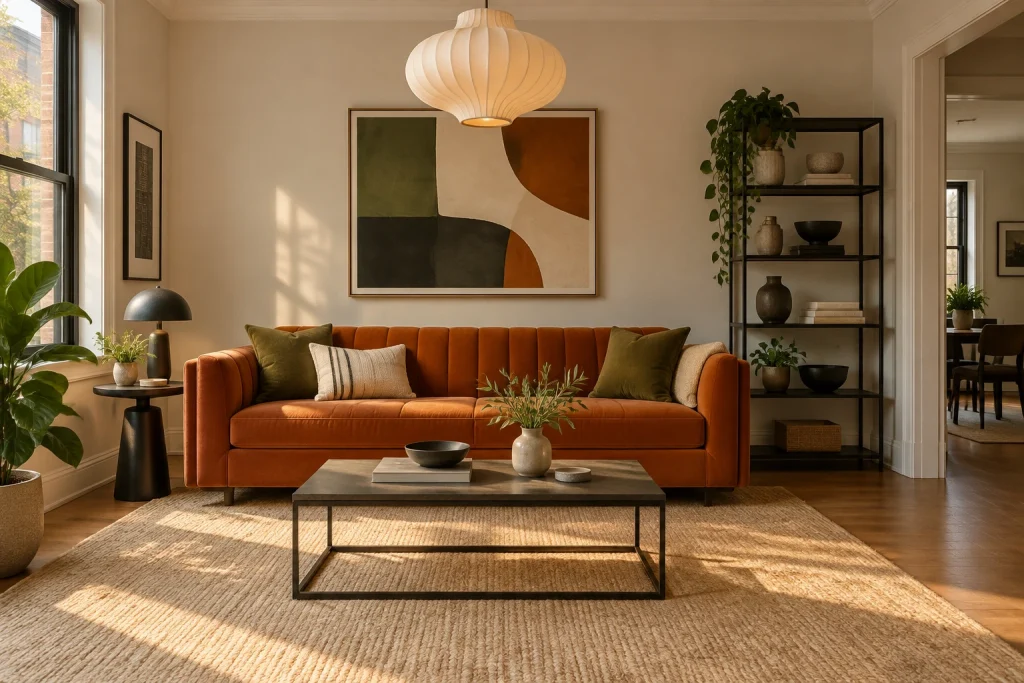
A tufted burnt-orange sofa gives this living room its strongest dose of vintage character, yet the surrounding pieces keep the look sharply current. The sofa’s channel-tufted back and rounded arms bring softness and rhythm to the wall, while the low rectangular coffee table answers with a thin, black metal base and crisp geometry. Above, a large abstract artwork repeats the room’s olive, cream, black, and rust palette in broad blocks of color. A black pedestal side table, dome-shaded lamp, and open black shelving continue the linear accent color without competing for attention. The shelving is styled with a measured mix of books, bowls, vessels, and trailing plants, leaving clear stretches of open space between objects.
Why it works: The sofa is expressive, but its color is echoed in the art and balanced by black-framed furnishings. That repetition connects eras without making every piece similarly decorative.
- Burnt-orange channel-tufted sofa
- Abstract artwork in rust, olive, cream, and black
- Black metal-framed coffee table
- Open black shelving
- Olive velvet pillows
Design tip: When using a statement sofa, repeat its color once in artwork and keep the remaining large furniture visually simple.
3. Make Storage Pieces Part of a Soft Farmhouse Layer
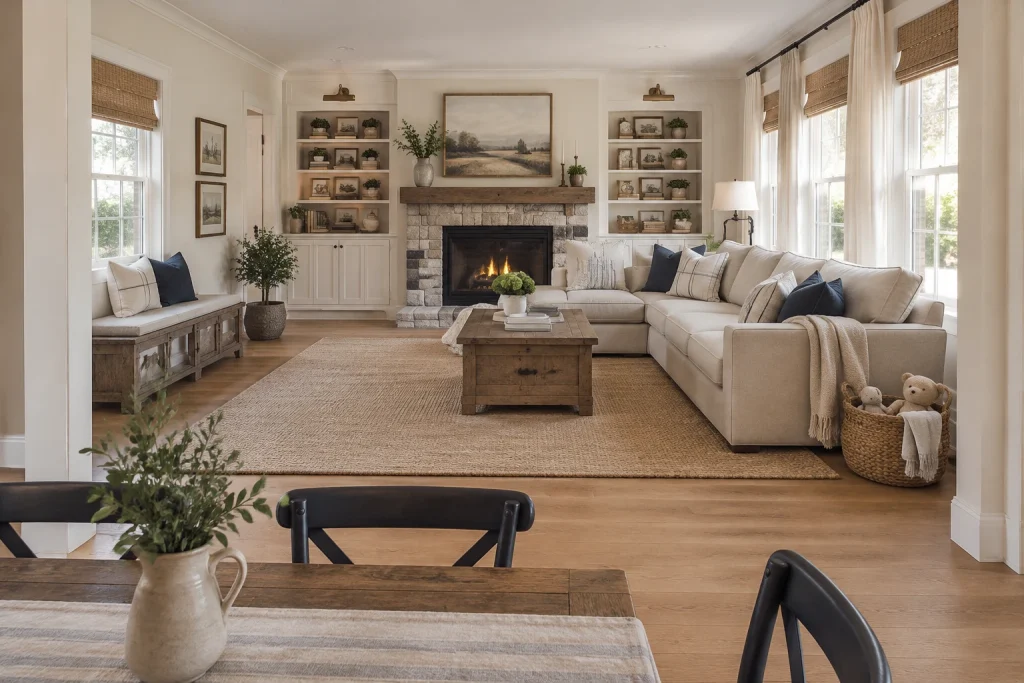
This room uses practical wood pieces to give a pale sectional more history and definition. The large cream sectional forms a relaxed L around a substantial square wood coffee table, both resting on a broad woven rug. A weathered wood bench beneath the left window adds another useful horizontal surface and includes drawer fronts beneath its seat. The coffee table also has a chest-like form, complete with a hinged-looking top, dark hardware, and a sturdy plinth base. Navy pillows and blue-striped cushions punctuate the cream upholstery without disrupting the neutral envelope of white built-ins, warm wood floors, and woven window shades. A basket of soft toys at the sectional’s end makes the room’s everyday use visible while keeping small items contained.
Why it works: The sectional provides a clean, forgiving-looking foundation, and the aged wood bench and coffee table introduce texture, storage-minded forms, and farmhouse character. Repeating woven materials helps bridge the two.
- Cream L-shaped sectional
- Weathered wood bench with drawers
- Chest-like wood coffee table
- Large woven area rug
- Navy and blue-striped pillows
Design tip: Use one repeated wood tone across storage pieces, then let a neutral upholstered sectional keep the room from feeling heavy.
4. Build a Gallery Wall That Relates to the Sofa
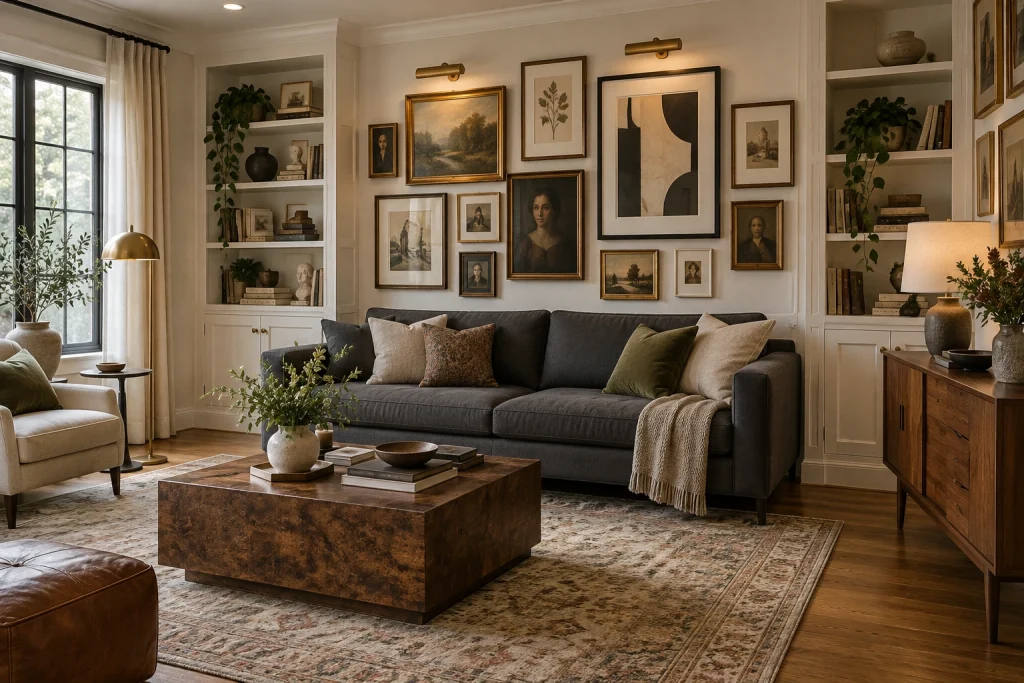
Here, a charcoal sofa becomes the calm base for a densely layered wall of art. Portraits, landscapes, botanical studies, and a large graphic print are arranged in a broad, varied grid above the seating, with frames in black, dark wood, and warm gold tones. The collection has a collected appearance, but the wall feels cohesive because the artwork stays within a muted range of black, cream, brown, green, and tawny gold. Built-in shelving on both sides extends the display with books, pottery, plants, and small framed pieces. On the right, a low wood credenza introduces another warm, grain-rich surface; the substantial square coffee table brings in a darker mottled finish. Textured pillows, a throw, and a patterned rug soften the tailored lines.
Why it works: The sofa’s simple, dark silhouette creates visual breathing room below the active art wall. Shared earthy tones and repeated wood finishes connect the mixed frames, shelves, and furniture.
- Charcoal upholstered sofa
- Mixed-scale framed gallery wall
- Built-in bookcases
- Low wood credenza
- Patterned area rug and square coffee table
Design tip: Start a gallery wall with one large anchor piece, then place smaller frames around it while keeping the overall composition close to the sofa’s width.
1. Put a Drop-Leaf Table to Work Behind Modern Seating
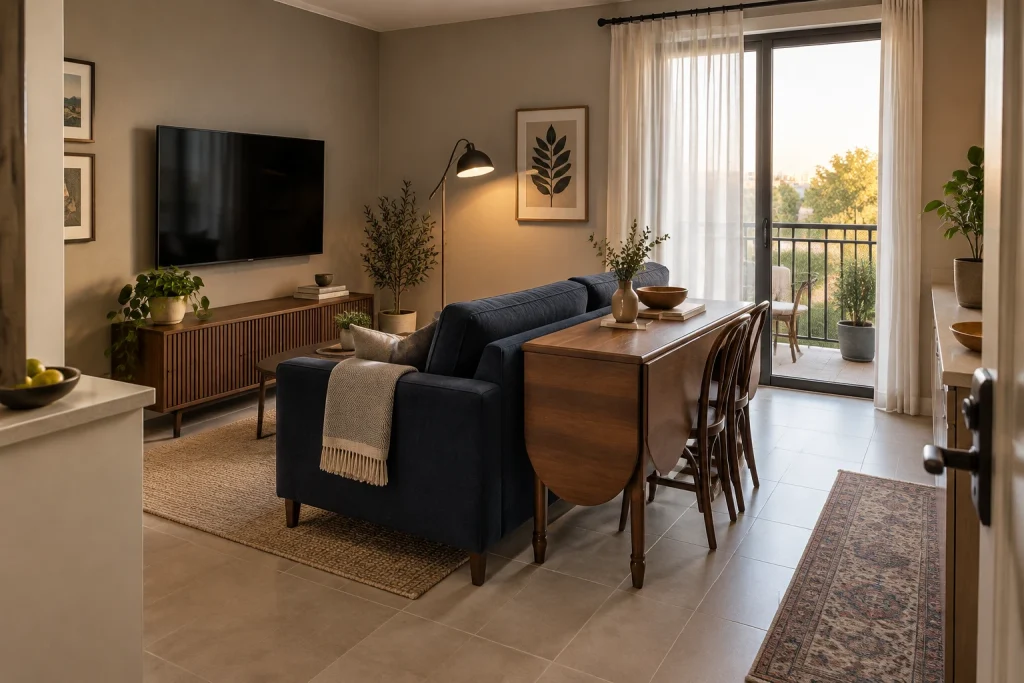
This compact vintage-modern-mix-living-room-ideas approach makes the dining piece part of the room’s visual rhythm. A deep navy upholstered sofa faces a wall-mounted television and a low, slatted wood media cabinet, while a warm walnut drop-leaf table sits directly behind it. With its leaves down, the table has the narrow profile of a console; the rounded leaves and turned legs introduce the older silhouette. Dark wood chairs line its outer edge without interrupting the clear route to the glass balcony door. Soft taupe walls, light tile flooring, a woven area rug, and sheer white curtains keep the combination from becoming heavy. The strong modern upholstery and clean-lined media cabinet give the traditional table a crisp, useful counterpoint.
Why it works: The table creates a clear boundary between seating and dining functions while its folded form stays visually light. Repeating warm wood across the table, chairs, and media cabinet connects old-fashioned curves to more streamlined pieces.
- Walnut drop-leaf table with rounded leaves
- Deep navy upholstered sofa
- Slatted wood media cabinet
- Wall-mounted television
- Sheer curtains at the balcony door
Design tip: Place a folded drop-leaf table behind seating only when the walkway to nearby doors remains comfortably open.
2. Use Symmetry to Let a Statement Sofa Carry the Mix
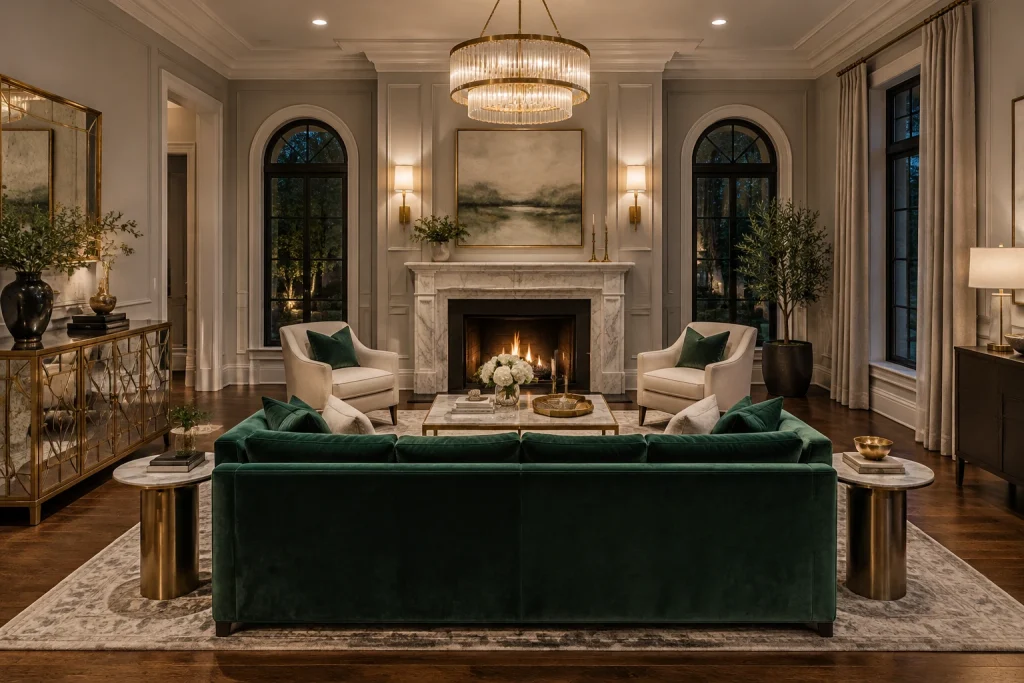
A deep emerald velvet sofa gives this formal room its contemporary color and broad, low profile, set against the pale veining and traditional mantel of a white marble fireplace. The composition is deliberately balanced: two cream upholstered armchairs face the sofa, and two round side tables pair white marble tops with cylindrical brass bases. On the left, a mirrored cabinet with a geometric brass framework supplies a distinct Art Deco note; its reflective finish catches light without adding another heavy wood piece. Paneled gray walls, arched black-framed windows, tailored drapery, and brass wall sconces establish a classic envelope. Above, a tiered chandelier of clear ribbed elements and brass brings a more current, sculptural layer to the centered fireplace arrangement.
Why it works: The room mixes periods through materials rather than visual clutter. Marble, brass, mirror, velvet, and dark wood recur in controlled doses, while the fireplace-centered symmetry gives the varied silhouettes a disciplined framework.
- Emerald velvet sofa
- White marble fireplace surround
- Mirrored geometric cabinet
- Marble-top brass side tables
- Tiered brass and glass chandelier
Design tip: When combining ornate and modern pieces, anchor the room with one centered axis—such as a fireplace—and match the larger supporting furniture across it.
Final thoughts
A layered living room feels cohesive when old and new each have a distinct role. Keep modern pieces streamlined and functional, then use vintage furniture, warm wood, aged leather, patterned textiles, or collected artwork to add depth. Balance heavier antique forms with pale upholstery, airy curtains, open shelving, or a simple furniture layout, and repeat a few finishes across the room. Whether the focal point is an ornate armoire, a saturated tufted sofa, a drop-leaf table, or a vintage rug, one strong historic note can give a contemporary space a more personal, lived-in finish.