Small-entryway-styling works best when every element has a clear job: create a landing spot, contain shoes, hold daily layers, and make the transition into the home feel intentional. Slim consoles, floating drawers, and narrow cabinets can add storage without overwhelming a tight hall, while wall-mounted hooks and pegboards use vertical space that might otherwise go unused. For larger households, built-ins and locker-style zones can assign a place for coats, bags, and footwear. The ideas below balance those practical needs with warm wood, woven texture, mirrors, color, and thoughtfully edited surfaces.
1. Use a Slim Oak Console to Ground a Long, Narrow Entry
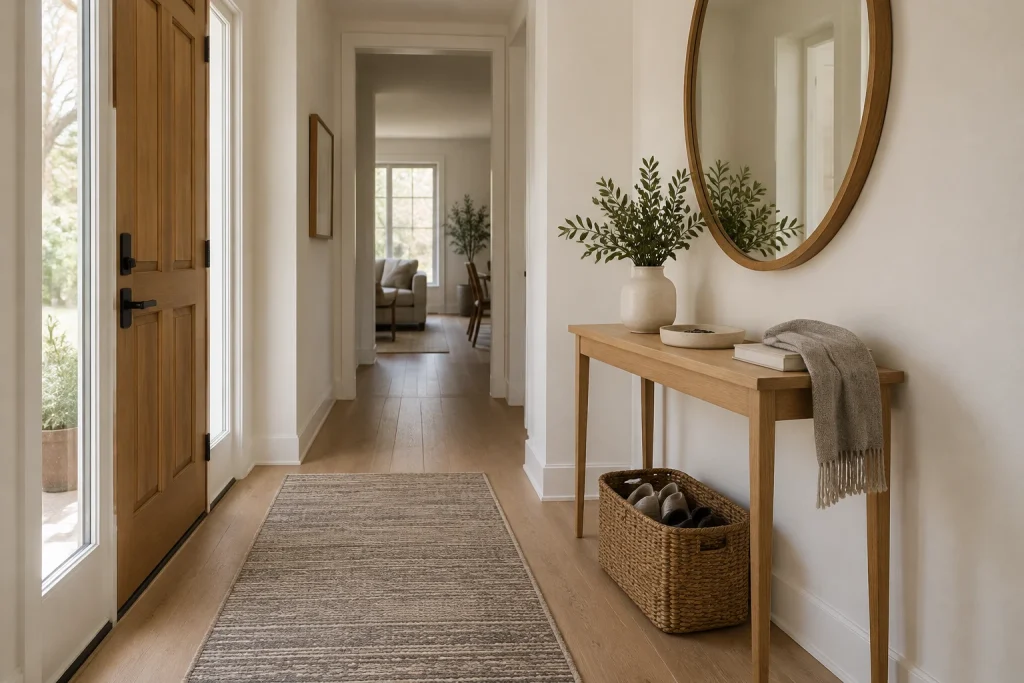
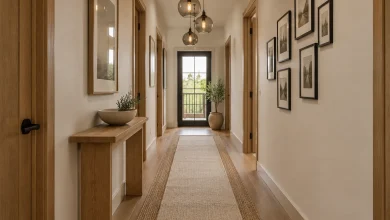
For small-entryway-styling, this natural-oak console shows how a narrow wall can become useful without looking crowded. Its open-legged profile keeps the floor and baseboard visible, while the large round mirror gives the wall a clear focal point. A cream ceramic vase with leafy branches, a shallow dish, two books, and a folded gray throw make the top feel composed rather than overfilled. Below, a woven basket holds several pairs of shoes, turning the unused space beneath the table into discreet drop-zone storage. The gray runner follows the length of the hall, visually connecting the wood door, light wood flooring, and console while leaving the console side of the entry uncluttered.
Why it works: The console, mirror, and basket stack function vertically: reflection above, landing surface at hand height, and shoe storage below.
- Slim natural-oak console
- Oversized round wood-framed mirror
- Woven under-console shoe basket
- Neutral runner rug
- Small ceramic catchall and vase
Design tip: Choose a console with open legs so the floor remains visible beneath it.
2. Turn the Space Below the Stairs Into a Storage Wall
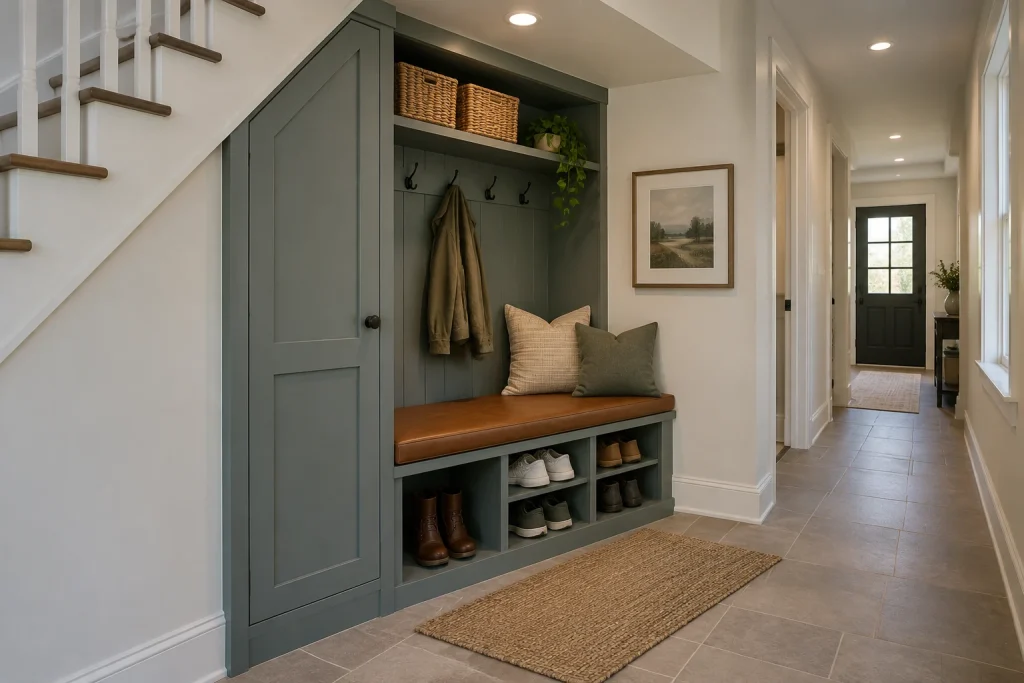
This under-stair built-in uses one tailored unit to handle coats, shoes, bags, and seating. Painted a muted blue-green, the cabinetry follows the diagonal line of the staircase and brings order to an otherwise awkward wall. A tall paneled cabinet sits beside the bench, while black hooks line the back panel above a brown leather cushion. Two throw pillows soften the seat without hiding its usable surface. Open cubbies below hold individual pairs of shoes, including taller boots at the left, and woven baskets sit on the shelf above. The surrounding white trim keeps the built-in defined against the stair, and the long woven rug adds texture across the tiled floor in front of it.
Why it works: Closed, open, and hanging storage are combined in one compact zone, so everyday items can be sorted by use rather than spread through the hall.
- Blue-green under-stair cabinetry
- Tall paneled storage cabinet
- Leather-cushioned bench
- Open shoe cubbies
- Black wall hooks and woven baskets
Design tip: Reserve lower cubbies for the shoes used most often, and use upper baskets for smaller loose items.
3. Make a Hook Wall the Entry’s Main Feature
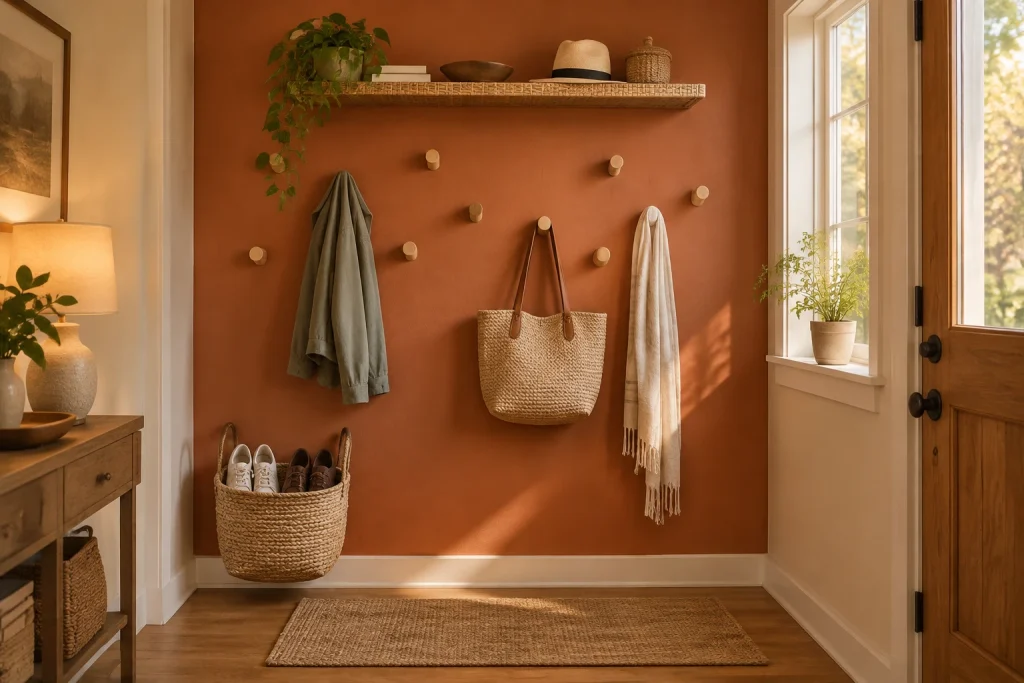
A terracotta accent wall turns simple peg hooks into a graphic, highly visible organizing system. The round wood pegs are arranged at different heights across the wall, creating room for the green jacket, woven tote, and fringed cream scarf without requiring a large freestanding piece. Above, a long woven shelf carries a trailing plant, books, a shallow bowl, a straw hat, and a small lidded basket. At floor level, a substantial woven basket corrals shoes beside a textured natural-fiber rug. The wall’s warm color also brings definition to the small nook between the white-trimmed window and the adjacent wood console, where a lamp, framed artwork, and plants add additional layers without competing with the hooks.
Why it works: The storage is spread from floor to ceiling, while the repeated natural materials make the varied objects read as one intentional composition.
- Terracotta painted wall
- Staggered round wood hooks
- Long woven wall shelf
- Woven floor basket for shoes
- Natural-fiber area rug
Design tip: Install hooks at more than one height to separate coats, bags, and lightweight accessories.
4. Hide Shoes Inside a Floating Walnut Drawer
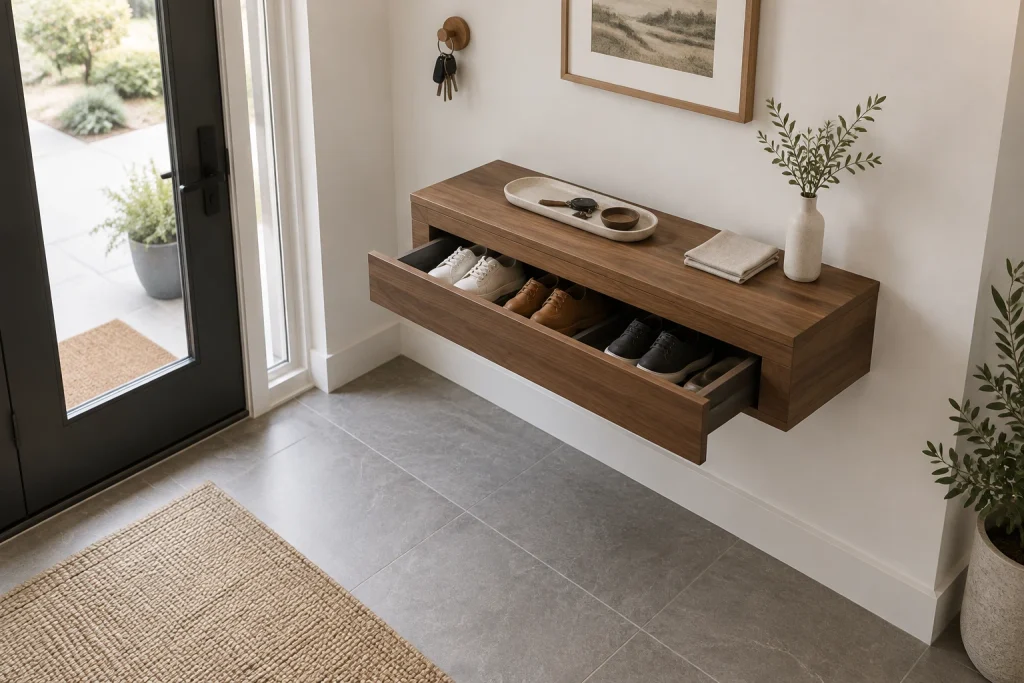
This wall-mounted walnut console delivers the usefulness of a shoe cabinet with a much lighter visual footprint. The deep wood box floats above large-format gray floor tile, leaving a broad stretch of floor exposed beneath it. Its long drawer is open in the image, revealing several pairs of shoes organized side by side in divided sections. On top, an oval tray gathers keys and small objects, while a folded light-colored textile and narrow ceramic vase keep the surface restrained. A single round wood wall peg holds another set of keys beside a framed landscape print. The black-framed glass door brings daylight to the console wall, and the woven rug introduces warmth against the smooth gray tile and clean white walls.
Why it works: Suspending the storage off the floor creates a cleaner edge in a compact entry while concealing shoes behind one continuous drawer front.
- Floating walnut console
- Pull-out divided shoe drawer
- Oval key tray
- Round wood key peg
- Gray tile floor with woven rug
Design tip: Plan the drawer depth around your largest everyday shoes before committing to a built-in or wall-mounted unit.
1. Build a Flexible Hook Wall Above Open Shoe Storage
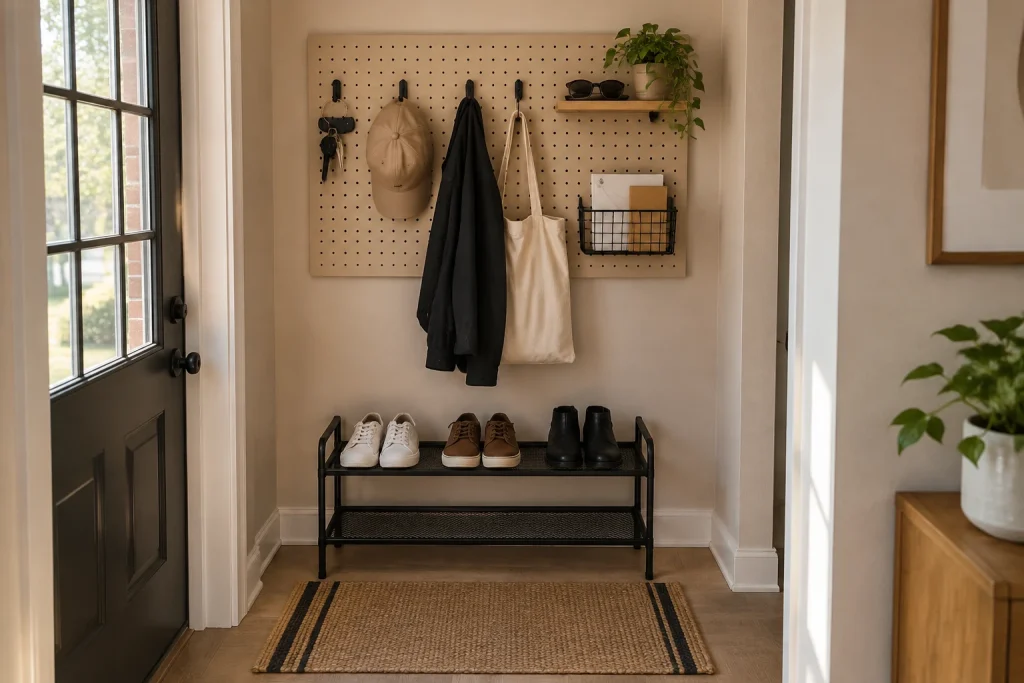
This small-entryway-styling approach puts daily essentials on one compact wall. A pale wood pegboard holds black hooks for keys, a cap, a jacket, and a canvas tote, while a shallow wood shelf corrals sunglasses beside a trailing plant. A black wire basket provides a visible landing spot for envelopes and small paper items. Below, a black metal two-tier shoe rack keeps three pairs of shoes off the floor, with the lower shelf left open. The arrangement feels orderly without looking overly formal because the materials repeat across the wall: warm wood, matte black metal, and soft neutral textiles. A woven tan rug with dark border stripes defines the spot in front of the dark-painted door and adds texture against the wood floor.
Why it works: Vertical storage handles small, frequently used items while the open rack keeps footwear accessible and the floor visually lighter.
- Pale wood pegboard
- Black hooks and wire mail basket
- Small wood display shelf
- Two-tier black metal shoe rack
- Woven striped rug
Design tip: Assign one hook to keys so they always have a consistent drop zone.
2. Use Tall Mirrors to Brighten a Slim Credenza Wall
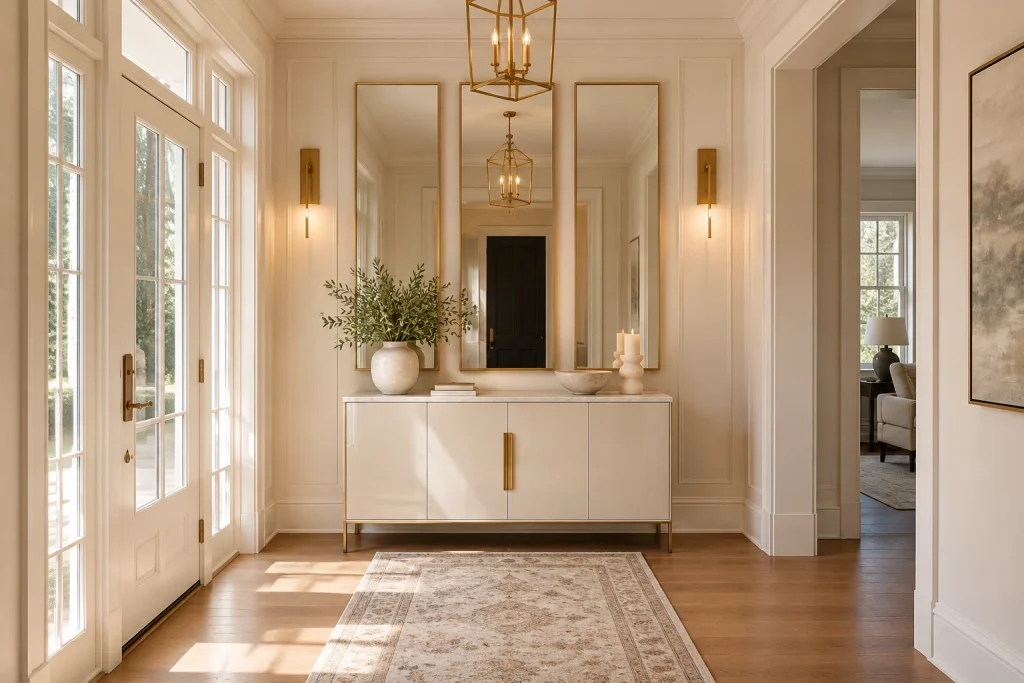
A cream credenza with a pale stone top gives this foyer a polished storage wall without dominating the room. Three tall, brass-framed mirror panels rise above it, reflecting the glass-paneled door, window light, and the brass lantern overhead. The mirror grouping also adds strong vertical structure within the applied wall molding. On the surface, a rounded ceramic vase filled with leafy stems sits beside a short stack of books; a low bowl and sculptural candleholders complete the display. Brass pulls and slender brass legs link the cabinet to the sconces and pendant, creating a tightly edited warm-metal thread. A muted patterned runner extends in front of the credenza, softening the wood floor and establishing a clear, centered approach to the door.
Why it works: The repeated vertical mirrors amplify visible light and make one low storage piece feel more substantial without adding bulk at floor level.
- Cream four-door credenza
- Pale stone top
- Three brass-framed mirrors
- Brass lantern and wall sconces
- Muted patterned runner
Design tip: Keep a mirrored wall effective by limiting the credenza top to a few low, intentional groupings.
3. Give Each Family Member a Defined Locker Zone
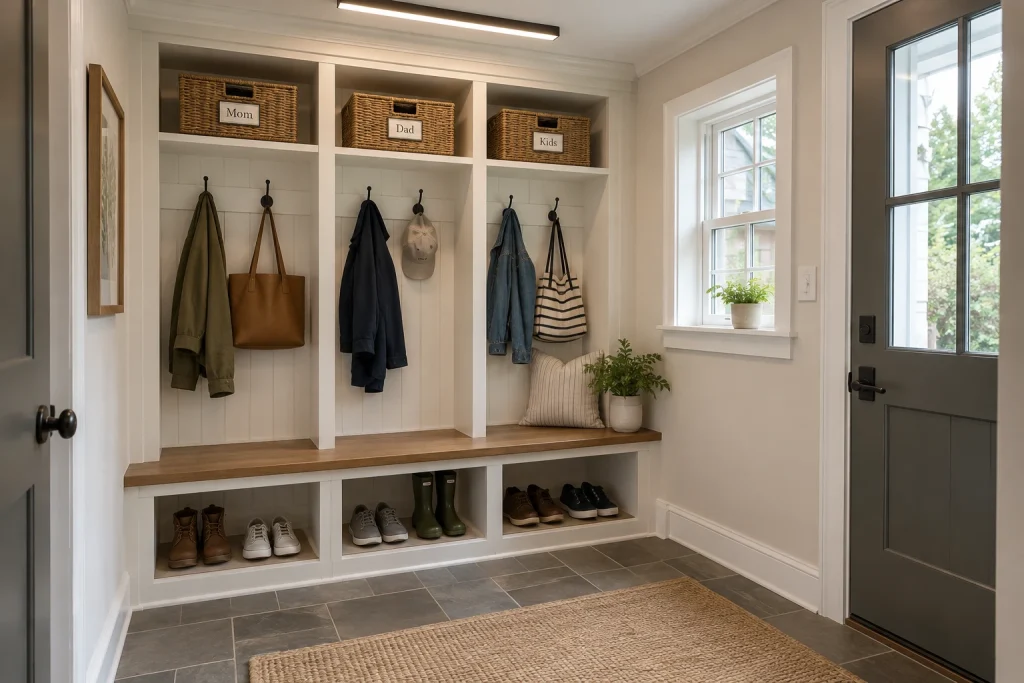
This entry turns one wall into a clear three-part organization system. Each white Shaker-style locker bay has an upper open cubby, black hooks, and a vertical paneled back; woven baskets labeled “Mom,” “Dad,” and “Kids” distinguish the top storage. Coats, bags, a cap, and a striped tote hang within the individual sections rather than accumulating on the bench. The warm wood seat provides a comfortable-looking pause point and is styled simply with a striped pillow and two small potted plants. Underneath, three open shoe compartments separate boots, sneakers, and rain boots. The slate-look tile floor and woven rug suit the practical function, while the dark glass-paneled door, right-side window, and linear ceiling light keep the compact room bright and sharply defined.
Why it works: Dedicated vertical bays make shared storage legible at a glance, and the bench plus lower cubbies concentrate seating and shoes in one built-in-looking unit.
- Three white locker bays
- Labeled woven baskets
- Black double hooks
- Warm wood bench
- Open lower shoe cubbies
Design tip: Use matching labeled baskets at the top of each bay to contain small seasonal items.
4. Follow a Curved Hall with a Rounded Console
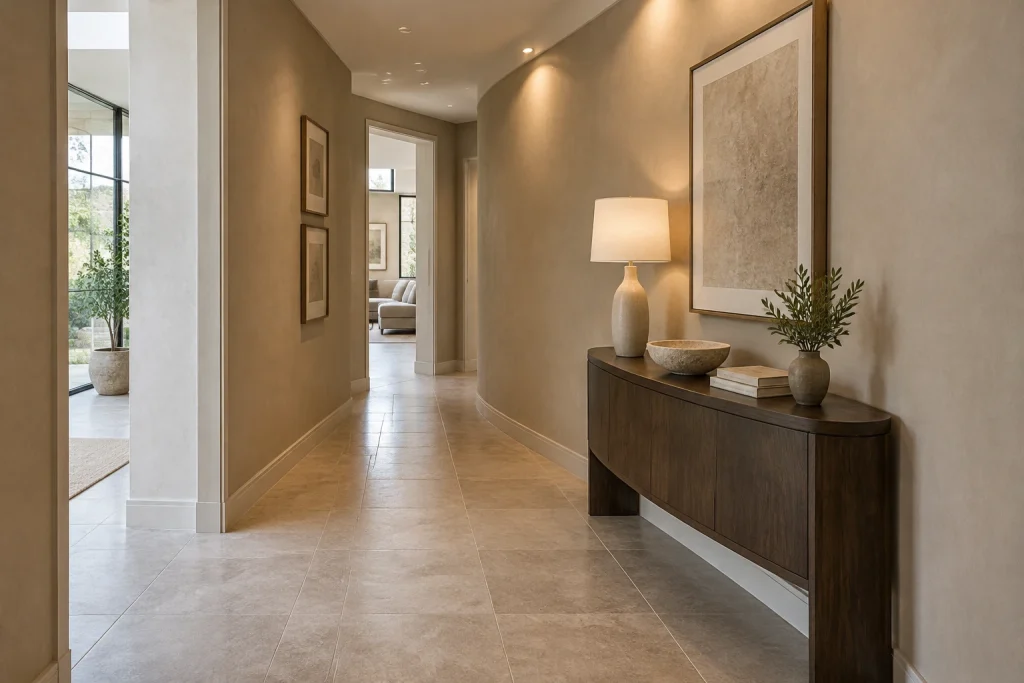
In this narrow taupe corridor, a dark wood console with rounded ends follows the gentle sweep of the wall instead of interrupting it with a sharp rectangular profile. Its substantial wood grain and softly curved front establish a sculptural focal point beneath a large, lightly textured framed artwork. The styling stays spare: a single ceramic lamp, a stone bowl, a small stack of books, and a dark vase of leafy branches occupy the top. Recessed ceiling lights and the lamp add warm pools of light along the hall, while daylight arrives through the glass opening to the left. The console’s raised base reveals a pale inset beneath the cabinetry, giving the long piece a lighter visual finish against the large-format tile floor and leaving the corridor’s center visibly open.
Why it works: A rounded console echoes the architecture and concentrates decoration along one edge, preserving the hall’s clear central route.
- Dark wood curved console
- Large neutral framed artwork
- Ceramic table lamp
- Stone bowl and books
- Large-format tile floor
Design tip: In a curved passage, choose furniture with softened corners and keep tabletop objects low.
1. Let a Tall Armoire Hide the Entryway’s Hardest-Working Storage
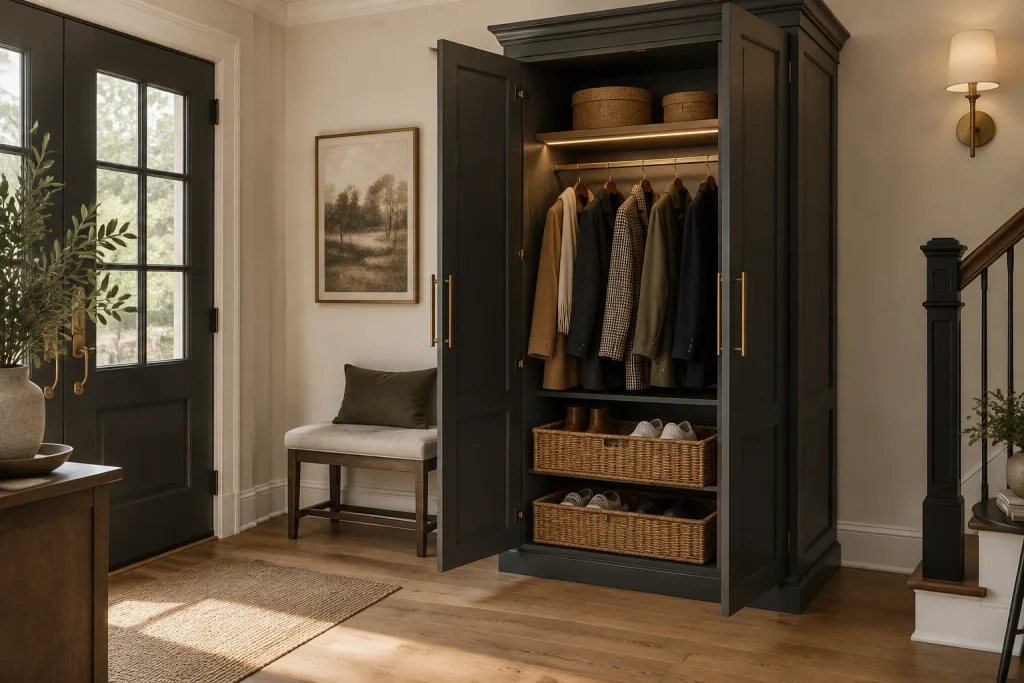
For small-entryway-styling that prefers visual calm to open storage, a tall charcoal armoire creates a strong, furniture-like solution. With its paneled doors opened, this piece reveals a clearly ordered interior: woven lidded baskets sit on the top shelf, a rail holds a concise row of coats and jackets, and two large woven baskets collect shoes below. A slim light integrated beneath the upper shelf brightens the hanging area, making the dark finish feel intentional rather than heavy. Long brass pulls sharpen the cabinet’s tailored profile and echo the brass door hardware and wall sconce nearby. When closed, the armoire can return the foyer to a composed backdrop, while its substantial height gives the storage real presence.
Why it works: The cabinet concentrates coats, footwear, and small accessories in one vertical volume, while its closed fronts reduce the visual noise that often builds up by a front door.
- Tall charcoal paneled armoire
- Brass vertical pulls
- Lighted upper shelf
- Interior hanging rail
- Woven shoe baskets
Design tip: Use matching baskets on the upper and lower shelves to make an open cabinet interior read as one system.
2. Turn a Narrow Shoe Tower Into a Fold-Down Perch
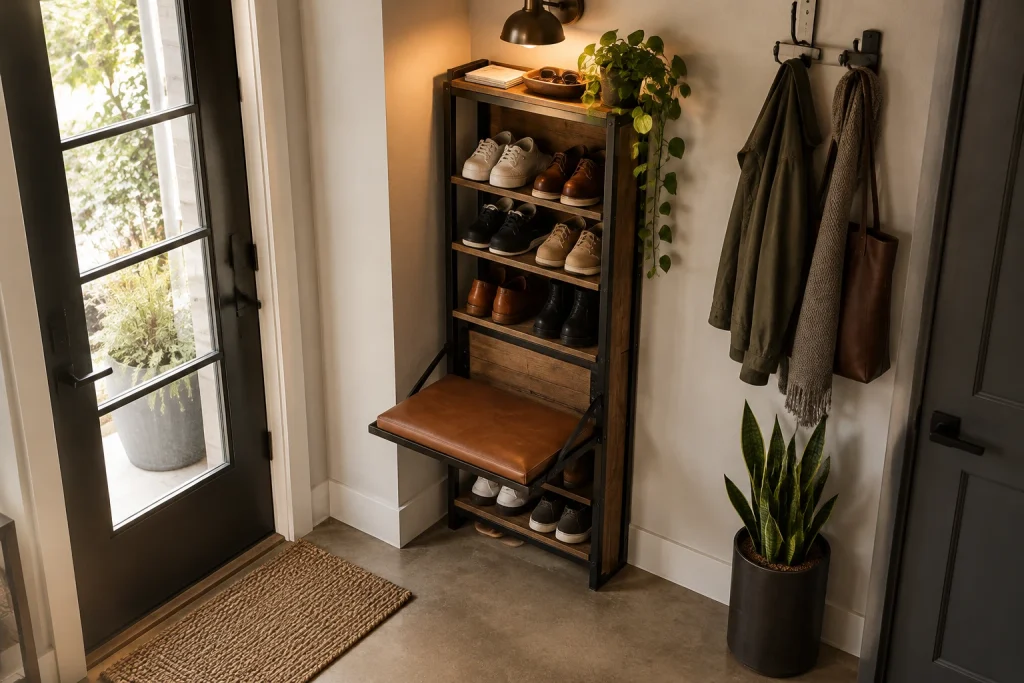
This compact entry setup uses height efficiently with a narrow wood shoe tower framed in matte black metal. Open shelves keep several pairs visible and easy to sort, while the central leather-look padded seat folds down from the unit on black metal supports. That single move adds a place to sit without dedicating floor space to a permanent bench. The top surface also handles a small stack of mail, a shallow dish, and a trailing plant, all lit by a black wall sconce above. To the right, a short rail of black hooks keeps a jacket, scarf, and tote off the floor. Dark framing, wood grain, and warm light connect the storage components without making the small wall feel crowded.
Why it works: The arrangement layers footwear, a temporary seat, and everyday drop-zone items upward along one wall. Open shelving makes the tower feel lighter than a solid bank of cabinetry.
- Black metal-framed shoe tower
- Open wood shoe shelves
- Fold-down padded bench
- Wall-mounted black sconce
- Hook rail for outerwear and tote
Design tip: Reserve the top shelf for only daily essentials so the shoe tower remains functional and visually spare.
Final thoughts
A small entry does not need many pieces to feel complete. Start with the storage need that causes the most clutter—shoes, outerwear, keys, or bags—then choose a compact solution that suits the wall and circulation space. A slim console or rounded cabinet can establish a focal point, hooks can keep essentials within reach, and baskets or closed drawers can soften the visual noise of everyday items. Finish with one mirror, artwork, greenery, or a restrained tabletop arrangement to give the space a welcoming point of view.