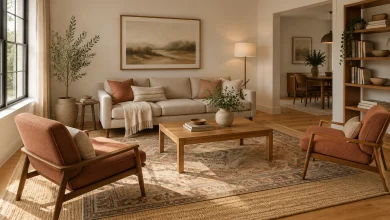
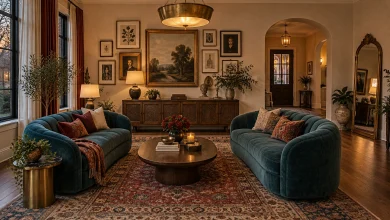
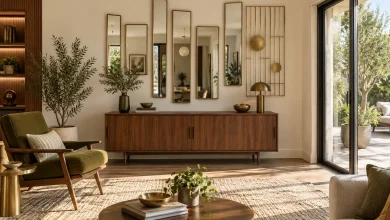
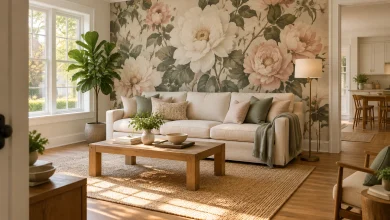
A successful layered-lighting-living-room plan does more than make a space brighter. It gives the room structure: daylight defines the overall mood, ambient lighting keeps circulation comfortable, and lower-level lamps or directed fixtures make seating areas feel warm and usable. Accent lighting then adds depth by drawing attention to artwork, shelving, fireplaces, plants, and textured walls. The strongest schemes balance these layers instead of relying on one central fixture. A pendant can establish a focal point, recessed lights can support the room’s envelope, and table or floor lamps can soften the places where people actually sit. Whether the room is compact, open-plan, dark and dramatic, or filled with daylight, the examples below show how each light source can have a clear role in a photo-ready composition.
1. Use Soft Layers to Warm a Classic Seating Area
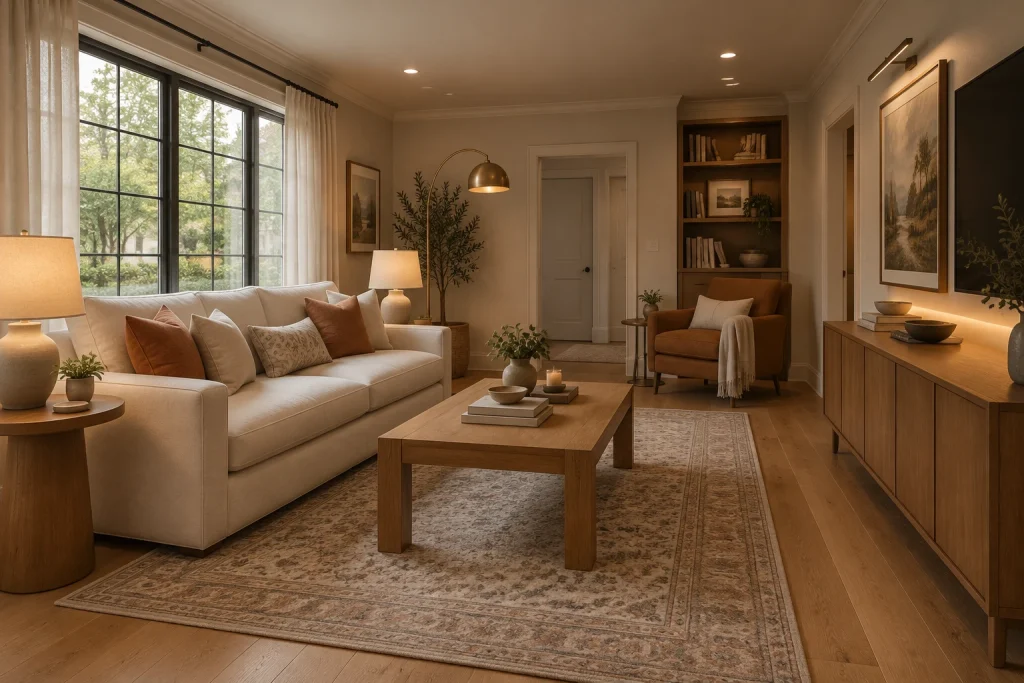
This layered-lighting-living-room approach begins with a bright, evenly lit envelope and lets warmer sources shape the seating zone. Daylight enters through the large black-framed window, softened by sheer ivory curtains. Overhead recessed lights wash the ceiling and walls without becoming the room’s focal point. At sofa level, a ceramic table lamp and a second lamp behind the sofa create an inviting pool of light around the cream upholstery and rust-toned pillows. An arched brass floor lamp reaches over the reading chair, while a slim picture light defines the large framed artwork above the oak credenza. A narrow glow beneath the artwork adds another horizontal layer, giving the media wall more depth than ceiling light alone could provide.
Why it works: The lighting is distributed at ceiling, eye, and furniture height, so the room reads as dimensional rather than flat. Warm lamp shades and brass finishes also connect with the oak furniture and clay-colored textiles.
- Recessed ceiling lights
- Sheer curtains at a large window
- Table lamps with warm shades
- Arched brass floor lamp
- Picture light and low wall glow above the credenza
Design tip: Put artwork lights on a separate dimmer from recessed fixtures.
2. Make One Sculptural Pendant Carry the Center
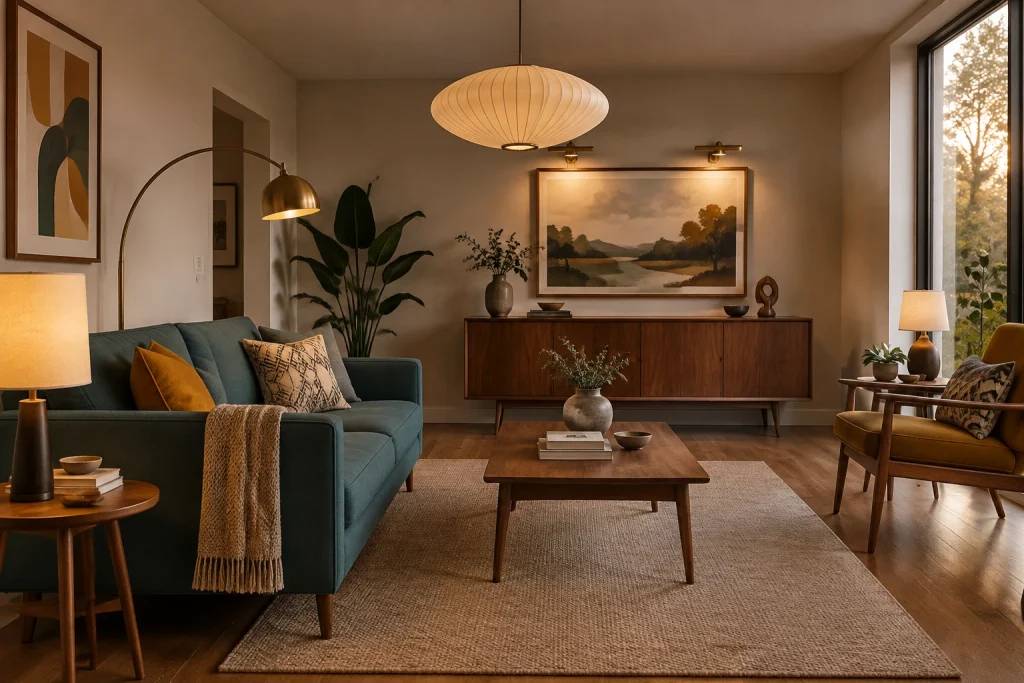
A large ribbed pendant is the visual anchor here, suspended above the walnut coffee table and pale woven rug. Its broad, softly glowing shade gives the compact room a clear center without interrupting the low profile of the teal sofa and tapered-leg credenza. The lighting then moves outward in measured layers: directional picture lights illuminate the landscape artwork above the credenza, an arc floor lamp brings focused light over the sofa, and table lamps brighten both seating edges. The tall window introduces daylight beside the mustard lounge chair, creating a cooler counterpoint to the room’s amber evening lighting. Walnut furniture, brass-toned lamp details, mustard upholstery, and teal fabric stay distinct because each receives light from more than one direction.
Why it works: The pendant establishes a strong overhead gesture, while smaller sources prevent the corners and wall art from disappearing. This mix keeps the room’s low-slung mid-century silhouettes legible.
- Oversized ribbed pendant
- Paired directional art lights
- Arc floor lamp
- Table lamps at both seating areas
- Tall black-framed window
Design tip: Center a large pendant over the coffee table, not over the sofa.
3. Build a Flexible Lighting Grid in a Compact Room
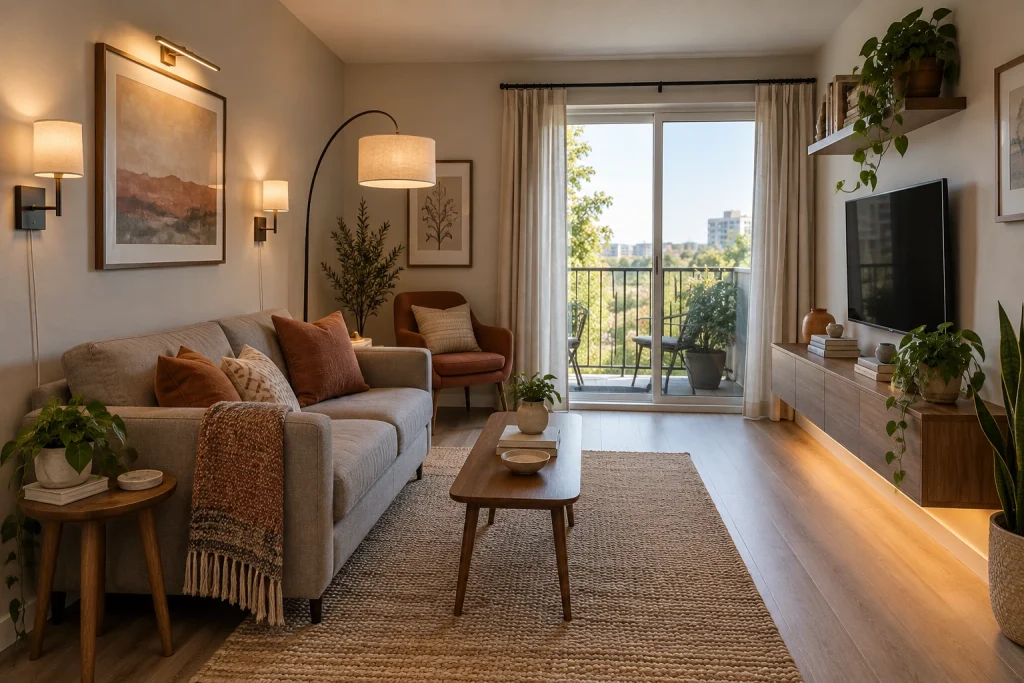
This compact room shows how wall, floor, and furniture-level illumination can do the work of a single ceiling fixture. A pair of slim wall sconces, each with a visible cord running downward, frames the large artwork above the gray sofa; a picture light adds a concentrated wash across the frame. Beside the sofa, an arc floor lamp places a fabric shade over the seating area, while daylight arrives through the sliding glass door and filtered curtains. Across the room, the wood media console has a continuous warm glow at its base, visually lifting it above the floor. Open wood shelves above the television hold books and trailing plants, making the lit console feel like part of a composed vertical wall rather than an isolated screen zone.
Why it works: The light sources are placed along the room’s perimeter and at several heights, leaving the central rug and coffee table visually open. The under-console glow is especially effective at adding depth to the long media wall.
- Corded wall sconces
- Picture light above framed art
- Arc floor lamp
- Sliding glass door with sheer curtains
- Warm under-console lighting
Design tip: Add a concealed light strip beneath a media console to create a floating effect.
4. Frame a Fireplace Wall With Symmetry and Glow
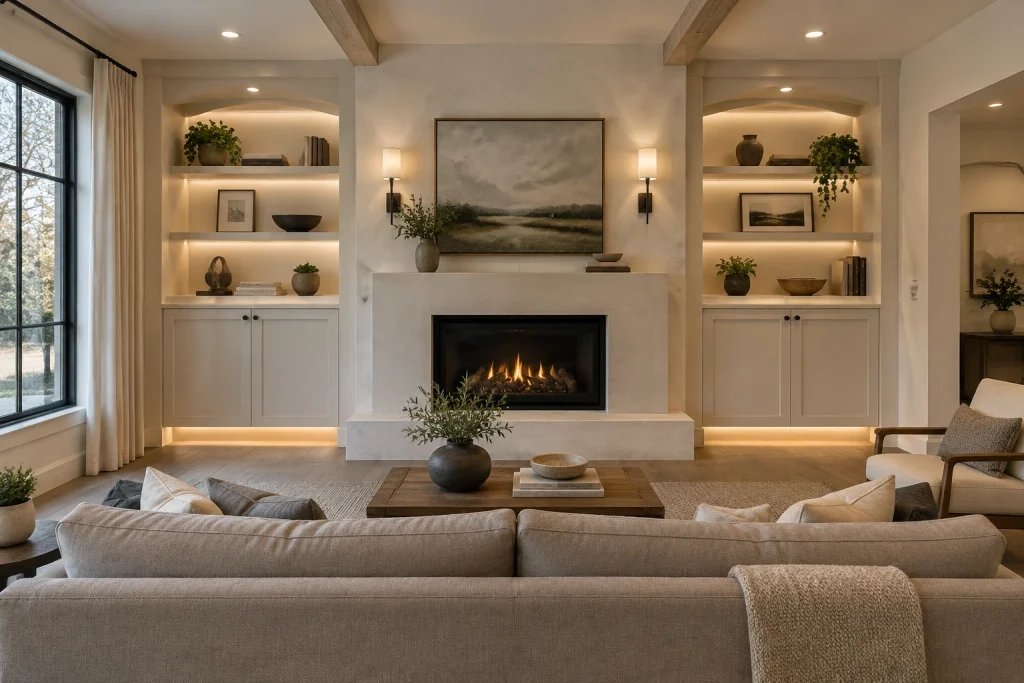
The fireplace wall is organized around a plaster surround, a wide hearth, and a large landscape painting. Two matching wall sconces flank the artwork, giving the center composition gentle side illumination while the recessed ceiling lights supply an even overall layer. On both sides, built-in shelving is lit beneath each shelf, outlining books, framed pieces, pottery, and plants against the soft white cabinetry. A further band of light runs along the base of the closed lower cabinets, echoing the shelf lighting and making the built-ins appear lighter at floor level. Daylight enters through the tall window at left, where full-length curtains soften the bright opening. Exposed wood ceiling beams add a darker line overhead, balancing the charcoal firebox and black window frame.
Why it works: Symmetrical sconces and mirrored built-in lighting reinforce the fireplace as the focal point. The shelf and toe-kick illumination give the broad wall layers of brightness without competing with the fire itself.
- Plaster fireplace surround and hearth
- Matching fireplace sconces
- Recessed ceiling lights
- Illuminated open shelves
- Base lighting beneath built-in cabinets
Design tip: Light shelves from below each tier to highlight objects without visible fixtures.
1. Use Light to Give Each Open-Plan Zone Its Own Identity
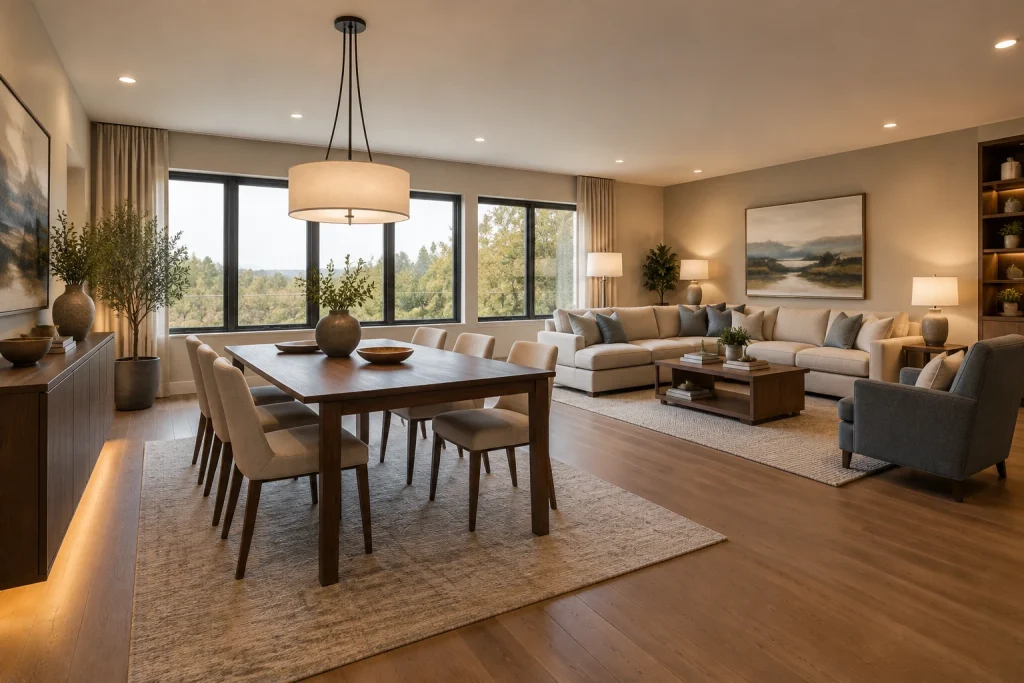
This layered-lighting-living-room approach makes an open living-dining space read as two connected destinations rather than one broad, evenly lit field. A large drum pendant centers the wood dining table, creating a clear pool of focus above the chairs and tabletop. In the adjoining sitting area, a pair of table lamps and a taller floor lamp bring a lower, more intimate glow around the pale sectional. Small recessed ceiling lights distribute a restrained ambient layer across both areas, while warm lighting under the long wood sideboard gives the floor line a soft edge. Daylight enters through the bank of black-framed windows, where sheer drapery tempers the bright exterior view without visually blocking it.
Why it works: The lighting shifts in height and purpose: ceiling fixtures establish overall visibility, the pendant identifies the dining setting, and lamps collect the seating arrangement into a comfortable evening zone. That hierarchy is especially helpful in photographs because the eye can quickly locate the dining table, sofa, artwork, and windows. Warm illumination beneath the sideboard also adds dimension to a long, low plane that could otherwise disappear against the wood floor. The open floor between the rug edges and furniture remains visually quiet, allowing the two rug-defined zones to stay distinct without feeling cut off from each other.
- Large linen-shaded drum pendant positioned directly over the rectangular dining table
- Small recessed ceiling lights spaced across the white ceiling
- Table lamps flanking the sectional, plus a taller floor lamp near the windows
- Warm under-cabinet-style glow beneath the walnut-toned sideboard
- Black-framed window wall softened by full-height neutral drapery
Design tip: Put dining, seating, and under-cabinet lighting on separate controls so each zone can hold its own visual weight.
2. Build Drama by Lighting Texture, Not Every Corner
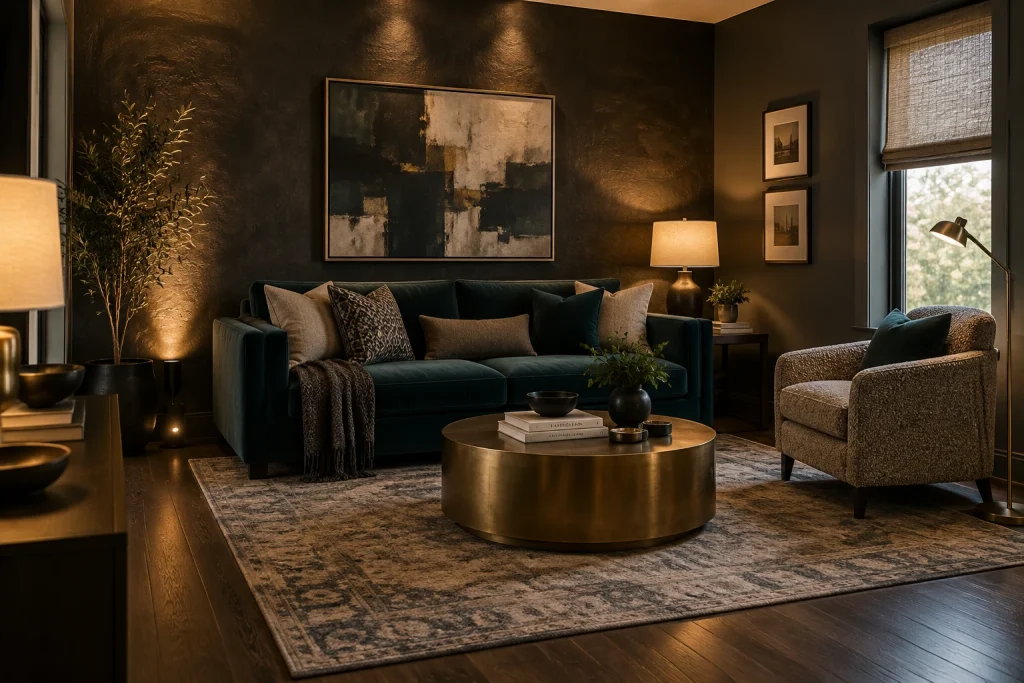
A dark living room benefits from deliberate pockets of warm light, and this composition uses them to reveal material contrast. The deep teal sofa sits against a charcoal, visibly textured wall, while a large abstract artwork creates a centered focal point above it. At the sofa’s left, a low uplight sends a narrow wash up the wall and through the leaves of a tall plant. A shaded table lamp brightens the side table and the sofa’s right arm; another lamp glows at the far left foreground. A slim black floor lamp angles toward the textured armchair beside the window. The brass coffee table catches these warm reflections, giving its rounded form definition against the patterned rug and dark wood floor.
Why it works: Rather than flattening the room with bright overhead illumination, the visible sources create graduated brightness: strongest at the lampshades and plant, softer across the wall, then darker at the room’s perimeter. This makes the wall texture, velvet upholstery, brass table, and nubby armchair read as distinct surfaces. The window’s woven shade contributes a muted daylight note without overpowering the evening-oriented scheme. The small lit gap to the left of the sofa is important: it keeps the uplighted plant separate from the seating silhouette, creating depth in both the room and the image.
- Low uplight placed at the base of the dark textured wall
- Warm shaded table lamp on the sofa-side table
- Adjustable black floor lamp beside the textured armchair
- Brass round coffee table reflecting the surrounding warm light
- Woven Roman shade filtering the narrow window
Design tip: In a dark room, aim one low uplight at a textured wall or plant and keep its beam out of direct sightlines.
3. Make Tall Ceilings Part of the Lighting Plan
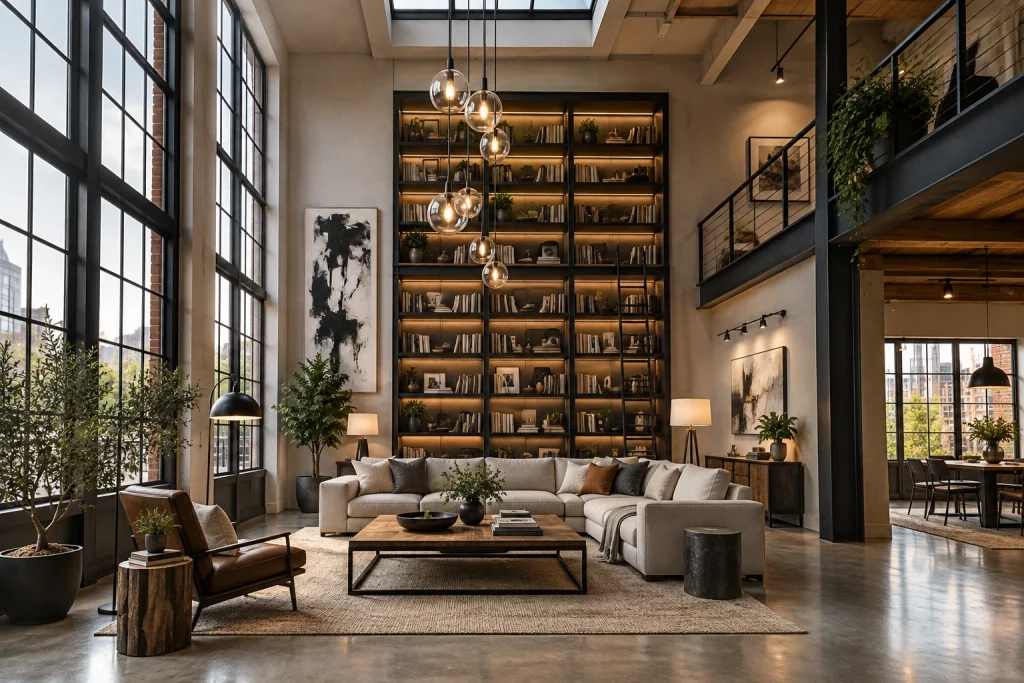
Here, lighting is organized vertically to match the loft’s exceptional height. A cluster of clear globe pendants drops through the center of the room, filling the open volume between the skylight and the seating area without blocking the tall bookcase. Each shelf of the bookcase is traced with warm integrated light, turning books, vessels, and greenery into a luminous grid behind the sectional. Tall factory-style windows along the left wall and the skylight introduce generous daylight, while a black arched floor lamp and two shaded floor lamps bring illumination back down to chair and sofa height. Track heads on the right wall direct light toward artwork, adding another precise layer against the warm concrete-toned surfaces.
Why it works: The room does not rely on a single fixture to solve a very tall ceiling. Instead, the pendant cluster acts as a visual bridge overhead, while the bookcase lighting supplies a broad, vertical plane of warmth at the far wall. The floor and table-height lamps prevent the seating area from feeling dwarfed by the architecture. In a photo, these layers lead the eye from the concrete floor and low coffee table up the sectional, past the illuminated shelves, and toward the skylight. Black metal window frames, railings, and shelving give the warm sources a crisp graphic outline.
- Multi-drop clear-globe pendant cluster suspended through the double-height volume
- Shelf-by-shelf warm lighting within the full-height black bookcase
- Large factory-style windows and a rectangular skylight providing daylight
- Black arched floor lamp placed beside the leather reading chair
- Wall-mounted track lights aimed across the artwork on the right wall
Design tip: For a high-ceiling room, combine an overhead statement fixture with a lit vertical surface and lamps at seating height.
4. Pair Bright Daylight With Gentle Warm Accents
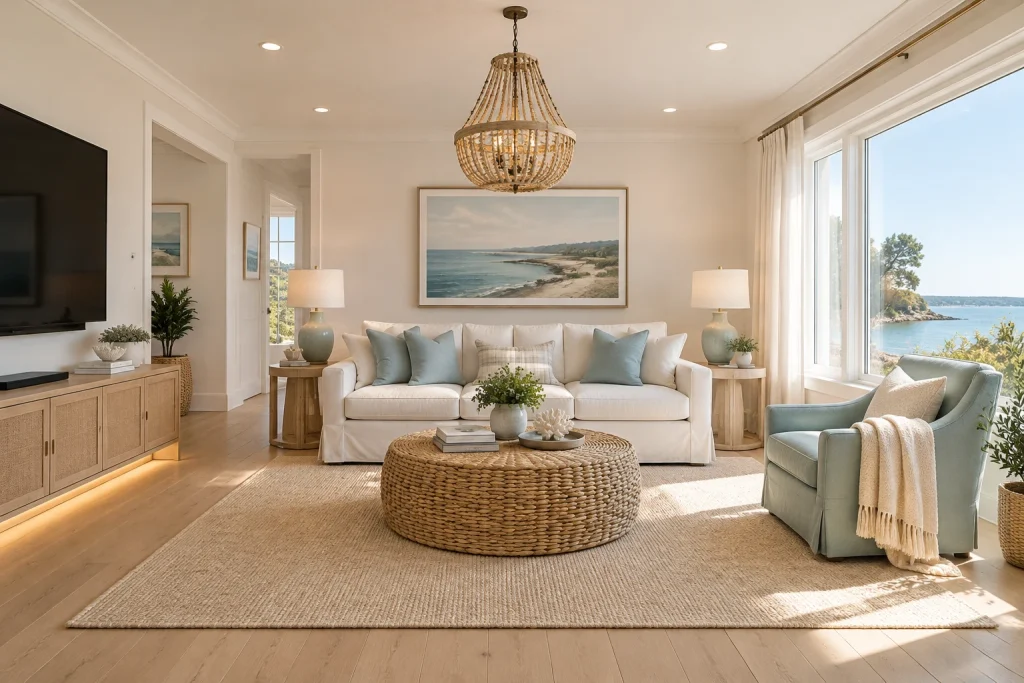
This sunny room maintains a light, photo-friendly feel by letting the large right-side windows do most of the daytime work, then supporting them with soft artificial layers. Recessed ceiling lights provide even illumination across the pale ceiling and white walls. A beaded lantern-style pendant introduces texture and a warm focal glow over the woven round coffee table and cream rug. On either side of the white slipcovered sofa, matching sea-glass-toned table lamps create symmetry and bring the eye back to the seating wall beneath the coastal landscape artwork. At the left, a concealed warm strip beneath the woven-front media console lifts the cabinet slightly from the pale wood floor. The result is bright but not visually sterile.
Why it works: The visible lighting reinforces the room’s most photogenic elements without competing with the blue-water view. Daylight defines the armchair, rug texture, and light wood floor; recessed lights keep the opposite side of the room from falling into shadow. The pendant adds a central layer at midair, while the paired lamps make the sofa composition feel balanced from left to right. Crucially, the warm under-console glow is low and contained, so it adds depth along the media wall rather than introducing a harsh competing highlight. Pale surfaces reflect the available light, making every layer feel soft instead of heavy.
- Large picture windows with sheer white curtains admitting strong daylight
- Evenly spaced recessed ceiling lights across the main ceiling plane
- Beaded lantern pendant centered over the woven coffee table
- Matching pale blue-green ceramic table lamps beside the sofa
- Warm concealed lighting below the woven-front media console
Design tip: When daylight is abundant, use warm lamps and low cabinet lighting for depth rather than adding more bright overhead light.
1. Make Daylight the Lead Layer, Then Light the Greenery
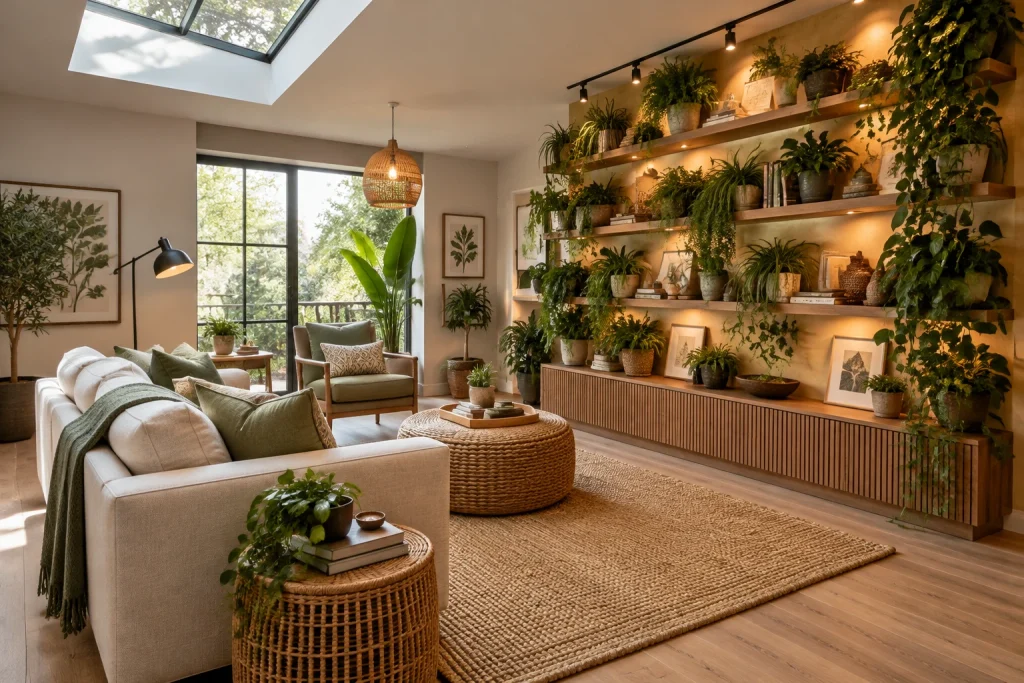
This layered-lighting-living-room scheme begins with what the room already has: a large skylight and a tall, black-framed window that fill the seating area with daylight. That natural brightness keeps the pale sofa, woven rug, and rattan tables clear and softly defined. After dark, the lighting shifts focus to the plant-filled shelving wall. Small track fixtures overhead and warm integrated shelf lights create pools of illumination behind and among the foliage, giving the long wall depth rather than a flat, dark outline. A woven pendant adds a warm central glow, while the black floor lamp directs useful light toward the sofa. The mix is especially effective because each fixture has a visibly different job.
Why it works: Daylight establishes an even base, while directional and concealed warm lights pick out foliage, wood shelves, and seating without competing with the room’s natural palette.
- Skylight above the seating area
- Tall black-framed window
- Warm shelf lighting
- Adjustable black floor lamp
- Woven rattan pendant
Design tip: Put plant-wall lighting on a separate dimmer so the shelves can glow softly after sunset.
2. Give Every Family Zone Its Own Softly Lit Purpose
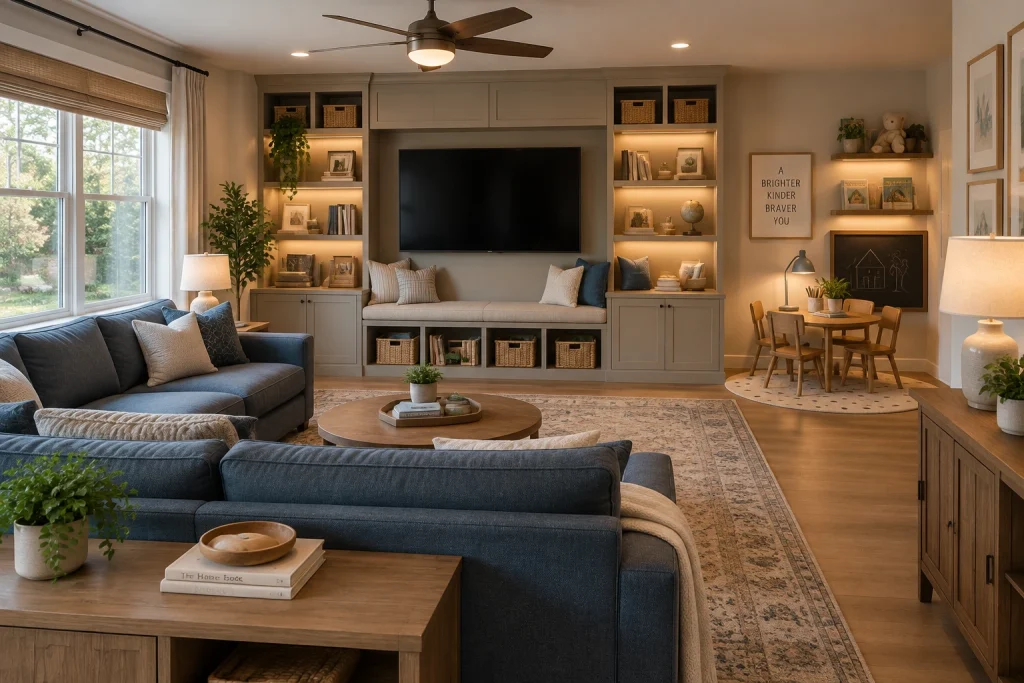
A ceiling fan with a central light and recessed ceiling fixtures provide broad ambient coverage in this casual living room, but the more persuasive layers happen at eye level. Warm under-shelf lighting brings the built-ins forward, revealing books, framed pieces, baskets, and the storage bench beneath the television. At the left, a table lamp adds a gentle pool of light beside the blue sectional and window. On the right, the small children’s table gets its own focused illumination from a black task lamp, while shelf lighting above keeps that corner visually connected to the storage wall. A second table lamp on the wood cabinet brightens the foreground. Together, these layers make the room feel organized, practical, and camera-ready without relying on one bright overhead source.
Why it works: The lighting follows the visible activities—lounging, storage, and table work—while the built-in illumination creates depth across a large wall of cabinetry.
- Ceiling-fan light
- Recessed ceiling lights
- Illuminated built-in shelves
- Table lamps at opposite sides
- Focused task lamp at the children’s table
Design tip: Use warm shelf lighting to define built-ins, then add a task lamp wherever a table needs brighter, directed light.
Final thoughts
Layered lighting works best when every source contributes something distinct. Start with the room’s natural light, add an ambient layer for broad visibility, then use table lamps, floor lamps, sconces, and pendants to define how the room is used. Finish with selective accent lighting for details worth noticing, such as a fireplace wall, built-ins, art, greenery, or a textured surface. For a warmer result, keep the most intimate light near seating height and avoid making every corner equally bright. The goal is not uniform illumination; it is a living room with a clear focal point, comfortable zones, and enough depth to feel inviting in daylight or after dark.