The best home-office-video-backdrop-styling balances personality with visual order. Rather than filling every wall and shelf, start with one defining element—such as a bookcase, art grid, textile, mirror, fireplace, or exposed brick wall—then support it with a few materials and colors that repeat across the room. Keep the area directly behind your chair readable at a glance, vary heights with plants or shelving, and leave enough blank wall or open shelf space for the composition to breathe. These approaches show how storage, artwork, greenery, and architectural details can create a background that feels polished, useful, and natural on video calls.
1. Create a Collected Bookcase Backdrop With a Quiet Center
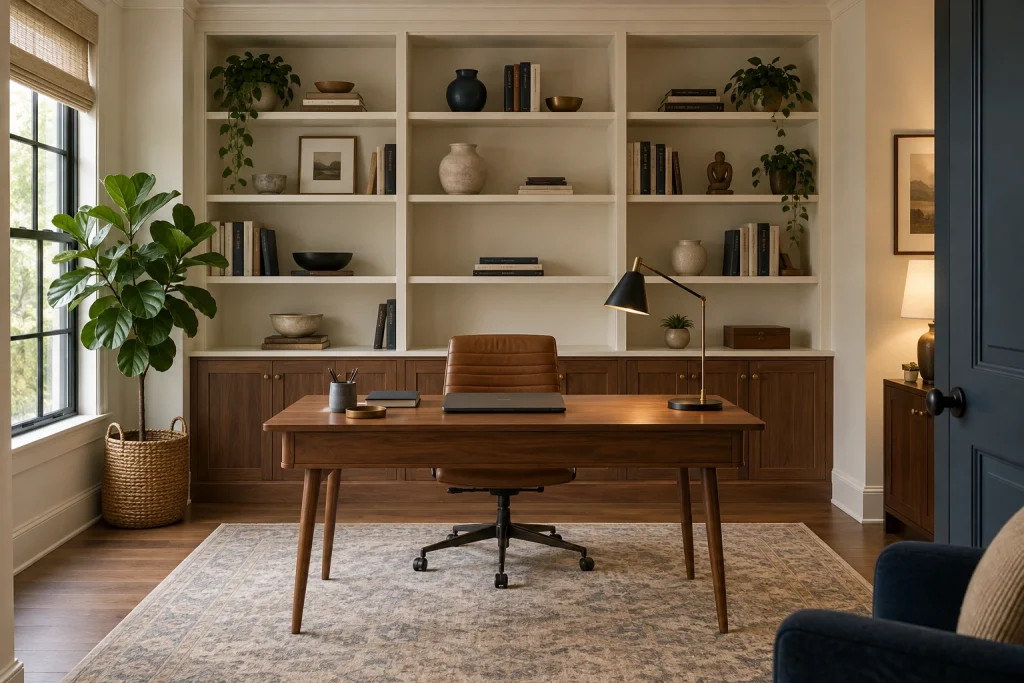
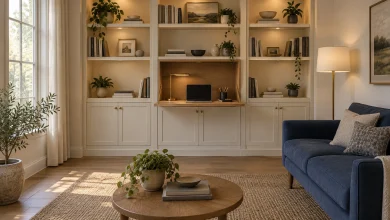
A wall of warm white built-ins gives this office a composed, professional video-call backdrop without feeling overly formal. The shelves mix upright and stacked books with matte black and pale ceramic vessels, small framed art, bowls, and trailing plants. Just as important, the large open middle shelf remains lightly furnished, creating a visual pause among the more detailed cubbies. Walnut lower cabinets and the substantial wood desk ground the arrangement, while the dark task lamp and chair add crisp contrast. A tall leafy plant beside the window introduces a softer vertical line, and the left-side daylight brightens the room’s layered neutrals. The result is a backdrop with depth, but not a competing focal point.
Why it works: Repetition in the shelf grid brings order, while restrained objects and one calm central zone prevent the background from reading as cluttered on camera.
- Floor-to-ceiling ivory built-ins
- Walnut cabinetry and desk
- Restrained black, cream, and brass accents
- Books styled both vertically and horizontally
- Trailing shelf plants and a large floor plant
Design tip: Leave at least one shelf bay noticeably sparse before adding another decorative object.
2. Use a Precise Art Grid to Define a Work Zone
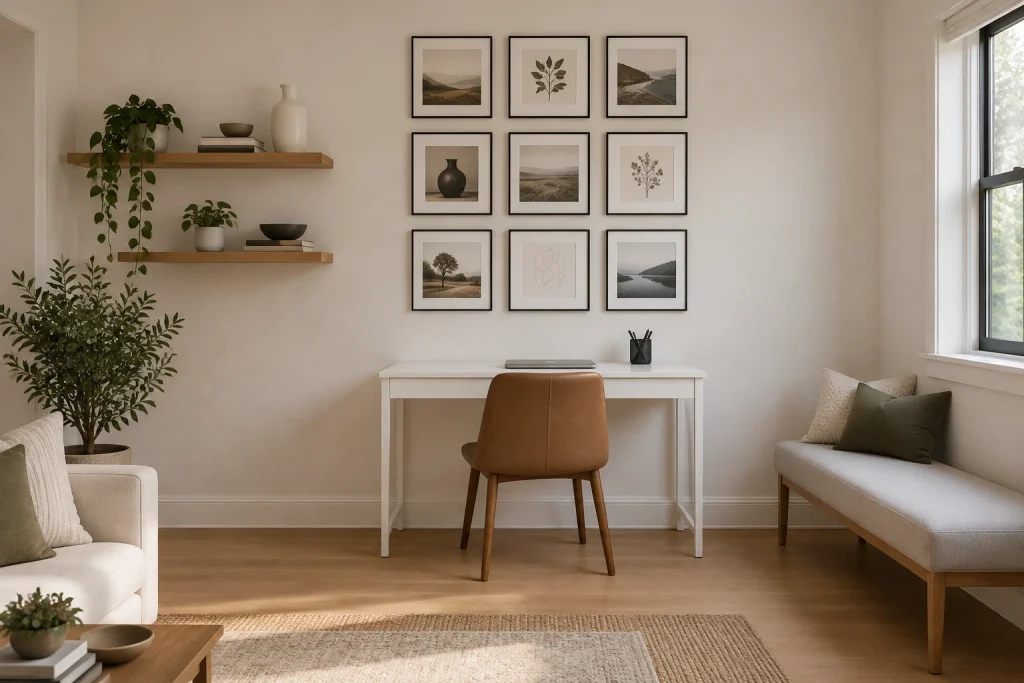
This pared-back setup turns a light wall into a clear home-office-video-backdrop-styling moment through a nine-piece gallery grid. Matching thin black frames, white mats, and muted botanical and landscape prints establish rhythm above the compact white desk. The art is centered over the work surface, while the open wall between the desktop and the lowest row keeps the composition from feeling compressed. To the left, two warm oak floating shelves carry only a few items: pottery, books, and small plants, including one that trails down from the upper shelf. A caramel-toned chair ties into the oak, and the nearby upholstered seating stays quiet in cream and olive. Daylight from the window at right keeps the neutral palette from appearing flat.
Why it works: A uniform frame treatment lets varied images read as one intentional field, making the desk area easy to recognize in a wider call view.
- Nine matching black-framed prints
- White desk with minimal desktop items
- Two staggered oak shelves
- Limited ceramic and plant display
- Warm wood chair against soft neutral walls
Design tip: Keep every frame identical in color and size for a gallery grid that looks clean on screen.
3. Bring Warmth With One Large Textile Statement
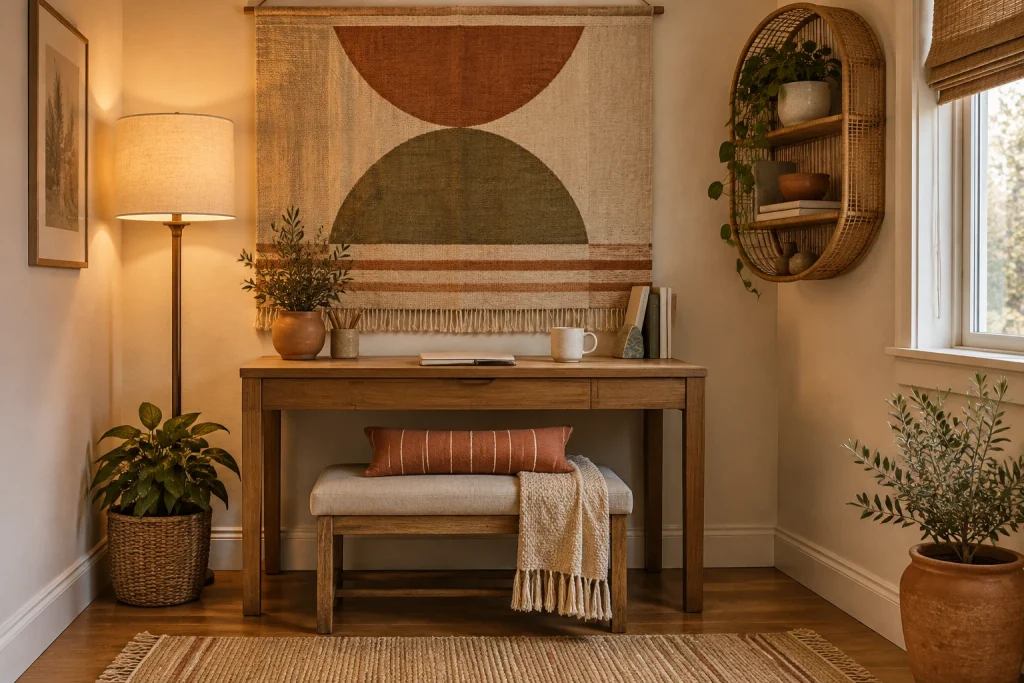
A large woven wall hanging gives this compact desk wall its entire visual identity. Its terracotta and olive half-circle motif stands out against creamy walls, while the fringe along the lower edge adds texture without requiring a gallery of smaller decor. Beneath it, a wood desk is kept relatively simple with a small vessel of foliage, a closed notebook, a mug, and a short row of books. The warm floor lamp at left reinforces the textile’s earthy palette and softens the corner. On the opposite wall, an arched rattan shelf holds plants, books, and pottery; its open weave echoes the basket planter and woven window shade. A narrow upholstered bench tucked under the desk brings in another layer of natural fabric.
Why it works: The oversized textile is legible from a distance, so the wall has character without the fragmented look of many small accessories.
- Graphic terracotta, olive, and cream wall textile
- Wood desk with edited accessories
- Warm linen-shaded floor lamp
- Arched rattan wall shelf
- Textured bench cushion and tasseled throw
Design tip: Choose one oversized textile with a simple graphic pattern, then keep the desk directly below it lightly styled.
4. Frame the Desk With Plant Shelves, Not More Desk Decor
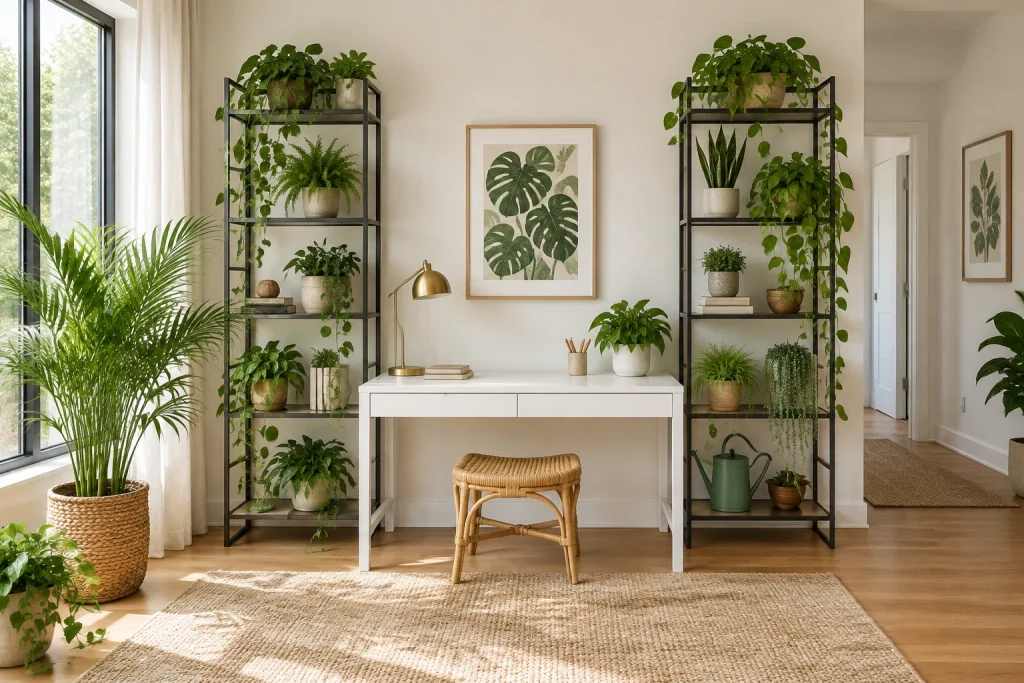
Here, a simple white desk is framed by two tall black metal shelving units filled with plants, creating an architectural green backdrop. The matching shelf forms establish symmetry, but the mix of upright, mounding, and trailing foliage keeps the display from looking rigid. A botanical print centered above the desk extends the plant theme across the blank wall. The desktop remains spare: a brass lamp, a small stack of books, a pencil cup, and one potted plant. Larger floor plants add scale near the window, including a palm in a woven basket, while a low shelf holds a visible green watering can. Pale curtains, light wood flooring, and a woven stool balance the dark shelf frames and abundant greenery.
Why it works: The open shelving contains the visual density at the sides, leaving a clear central area around the speaker and desk.
- Two matching black open plant shelves
- Centered botanical wall print
- White desk with minimal accessories
- Trailing, upright, and bushy plants
- Woven basket planter and rattan stool
Design tip: Place the fullest plants on the outer shelves and keep the space directly above the desk comparatively open.
1. Ground a Calm Call Background With a Low Credenza and Round Mirror
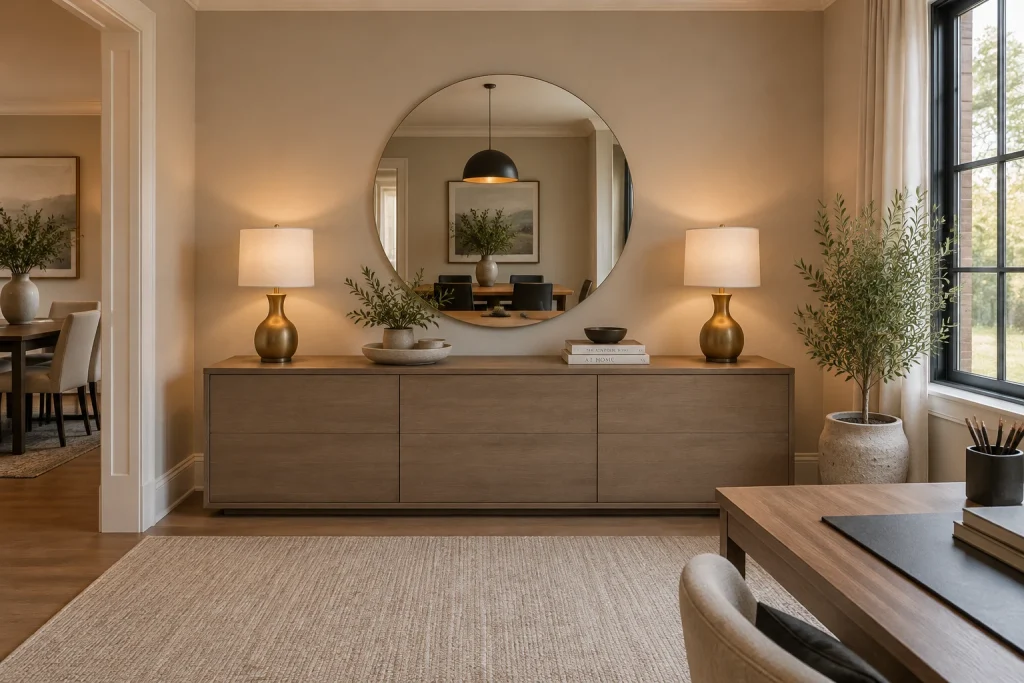
For home-office-video-backdrop-styling, this composition proves that closed storage can carry the visual weight without looking busy. A long wood credenza runs beneath a large round mirror, creating one strong horizontal-and-circular focal point on a warm taupe wall. Matching brass-toned lamps at each end bring measured symmetry, while a low tray with a leafy arrangement and a short stack of books add detail at a smaller scale. The mirror reflects a dining table, chairs, framed art, and a dark pendant, so its placement introduces depth as well as light. At right, a tall potted tree softens the edge near the black-framed window and pale curtain. The broad rug and open floor in front keep the composition from feeling crowded.
Why it works: The background has a clear center, quiet surrounding wall space, and a limited mix of warm wood, brass, black, and green.
- Long closed-drawer wood credenza
- Large centered round mirror
- Matching brass-toned table lamps
- Small tray, books, and leafy arrangement
- Tall plant beside the window
Design tip: Keep the credenza top to a few low, evenly spaced objects so the mirror remains the focal point.
2. Let Exposed Brick Do the Heavy Lifting
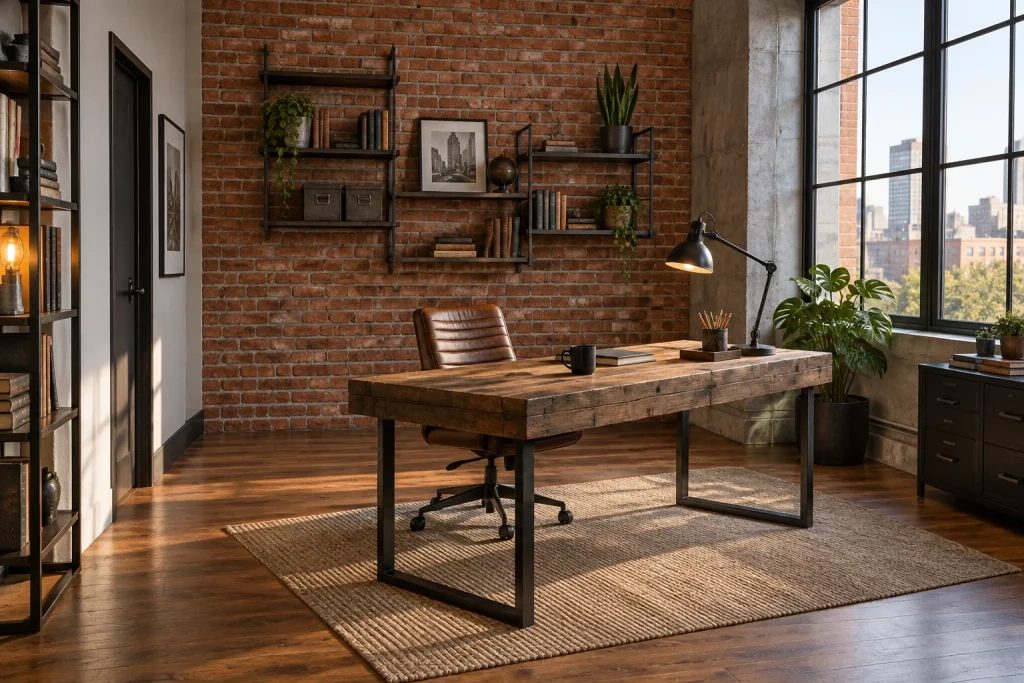
An exposed red-brick wall gives this office a textured video-call background before a single accessory is added. Three black metal-and-wood wall shelves break up the surface without covering it completely, leaving large areas of brick visible between and around them. The shelf styling is restrained but layered: dark-bound books, small storage boxes, trailing plants, a framed black-and-white building image, a globe, and a tall snake plant repeat the room’s charcoal and earthy tones. In front, the thick reclaimed-wood desk and brown ribbed office chair echo the wall’s warmth, while black steel desk legs and an adjustable black task lamp connect to the shelving. Daylight enters from the large gridded window on the right, with leafy plants creating a softer transition at that side of the frame.
Why it works: Brick supplies depth and character, while the open shelves create a deliberate grid of small-scale detail rather than a solid wall of storage.
- Exposed red-brick feature wall
- Black metal-and-wood open shelves
- Dark books and compact storage boxes
- Reclaimed-wood desk with black steel legs
- Large black-framed industrial window
Design tip: Style open shelves in compact clusters, leaving visible wall between each grouping.
3. Build a Vertical Backdrop Above a Floating Desk
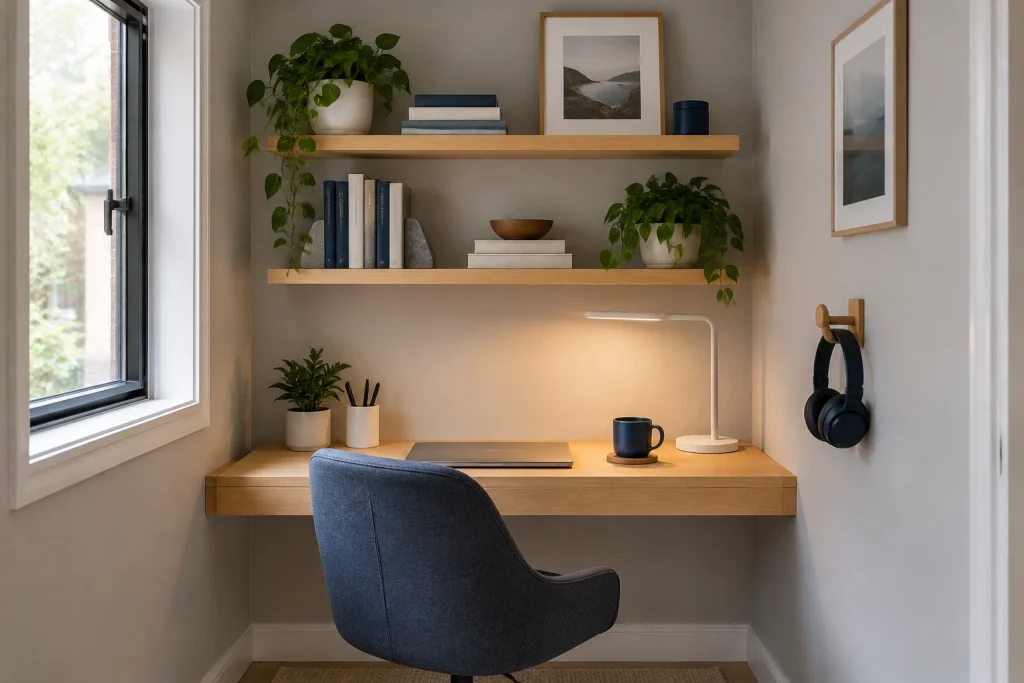
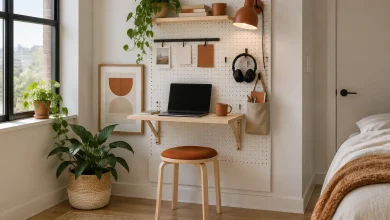
This compact work zone uses the wall above a floating maple desk as the main visual field, leaving the floor almost entirely open. Two slim floating shelves stack vertically over the desk, giving the backdrop height without the bulk of a bookcase. Their contents are organized in balanced, breathable groups: trailing plants in pale pots, short horizontal book stacks, upright books, a small bowl, and a framed landscape print. A second framed print hangs to the right, where a wood peg holds black headphones. Below, the desktop is equally edited, with a closed laptop, a small plant, a pencil cup, a dark mug, and a white task lamp. The dark blue-gray chair and dark blue shelf accent add contrast against the soft gray walls and warm wood.
Why it works: The eye moves upward through a narrow, well-defined arrangement, while the clear floor and slim desk preserve a light visual footprint.
- Wall-mounted maple desk
- Two vertically stacked floating shelves
- Potted trailing and leafy plants
- Framed landscape prints
- Wall peg with black headphones
Design tip: Use two shelves instead of one tall bookcase when you need visual height without filling the floor.
4. Use Fireplace Symmetry for a Polished, Centered Frame
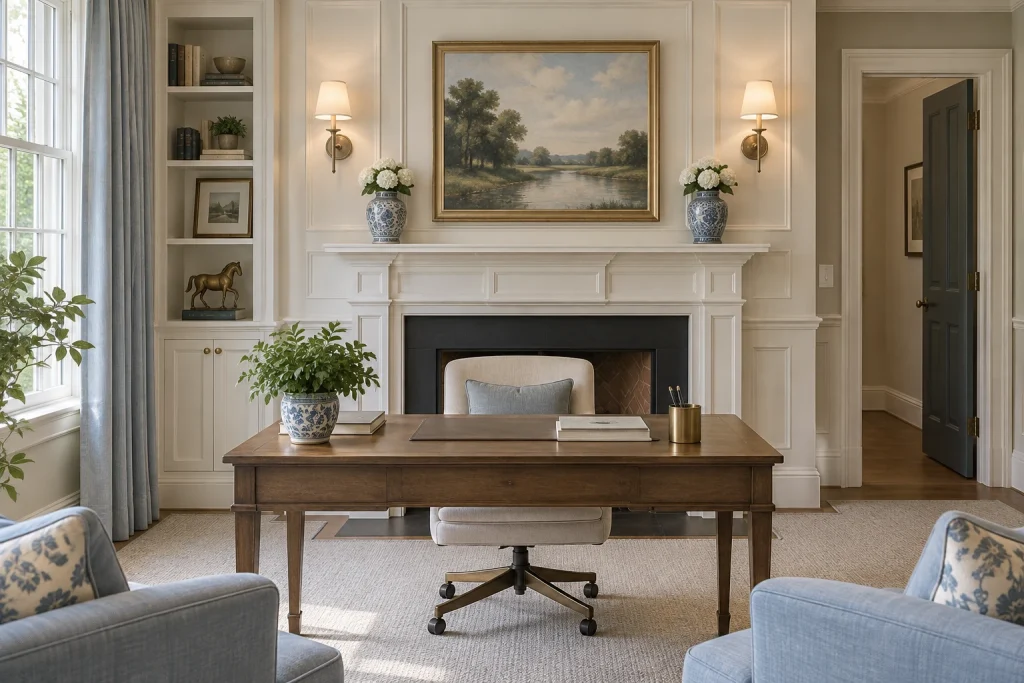
A decorative fireplace creates a naturally centered setting for a home office, especially when the mantel is styled with near-perfect symmetry. Here, a gold-framed landscape painting sits above the mantel between two brass wall sconces with cream shades. Blue-and-white ceramic vases filled with white flowers anchor both mantel ends, repeating the soft blue seen in the drapery and nearby upholstered seating. The white paneled surround and dark firebox provide crisp contrast, allowing the art and vases to read clearly. A traditional wood desk stands in front with only a desk pad, a few papers, a pencil cup, a small plant, and a book. Built-in shelves at left add contained detail, while the open doorway at right stays visually uncluttered.
Why it works: The repeated sconces and matching vases establish an easy-to-read centerline, while the restrained desk surface keeps attention on the architectural backdrop.
- White paneled fireplace surround
- Centered gold-framed landscape painting
- Matching brass wall sconces
- Pair of blue-and-white floral vases
- Simple wood desk with edited accessories
Design tip: For a symmetrical backdrop, center the artwork first, then match the objects placed to its left and right.
1. Make a Pegboard Read as a Composed Creative Backdrop
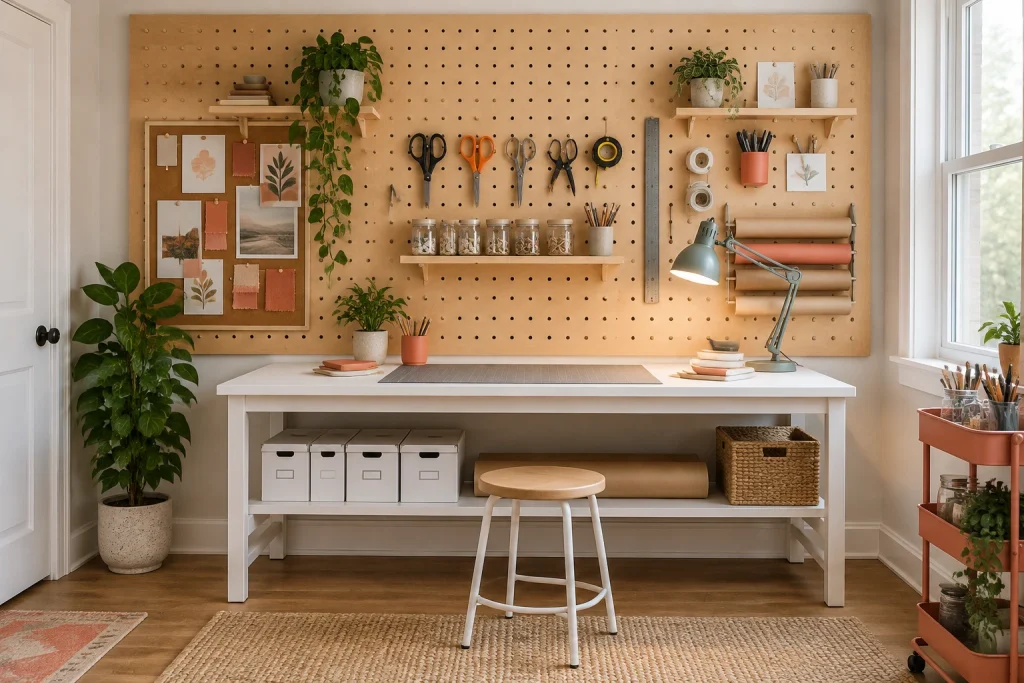
For home-office-video-backdrop-styling with practical character, this wall-sized birch pegboard turns supplies into an orderly composition. The busiest tools sit across the middle in a measured horizontal run: black, coral, and metal scissors, a tape measure, a ruler, and small jars. Open shelves break up the grid with stacked books, potted trailing plants, drawing tools, and a small framed botanical image. At left, a corkboard gathers paper swatches and nature imagery into a separate, contained zone. Below, the white worktable stays comparatively clear, while matching white storage boxes, a woven basket, and rolls of kraft paper occupy the lower shelf. Coral accents on the tool cup, paper, and rolling cart give the pale wood and white furniture a restrained thread of color.
Why it works: The pegboard’s repeating holes provide structure, while shelves and grouped tools create clear visual zones rather than an undifferentiated wall of supplies. A mostly open tabletop gives the backdrop breathing room, and the coral details are repeated sparingly enough to feel intentional.
- Light birch pegboard wall
- Neatly grouped scissors, ruler, tape measure, and jars
- Cork inspiration board with paper swatches
- White worktable with lower-shelf storage boxes
- Coral rolling cart and small coral accents
Design tip: Arrange tools in short horizontal groups, then leave blank pegboard between them.
2. Build a Calm Gallery Wall With Symmetry and Soft Light
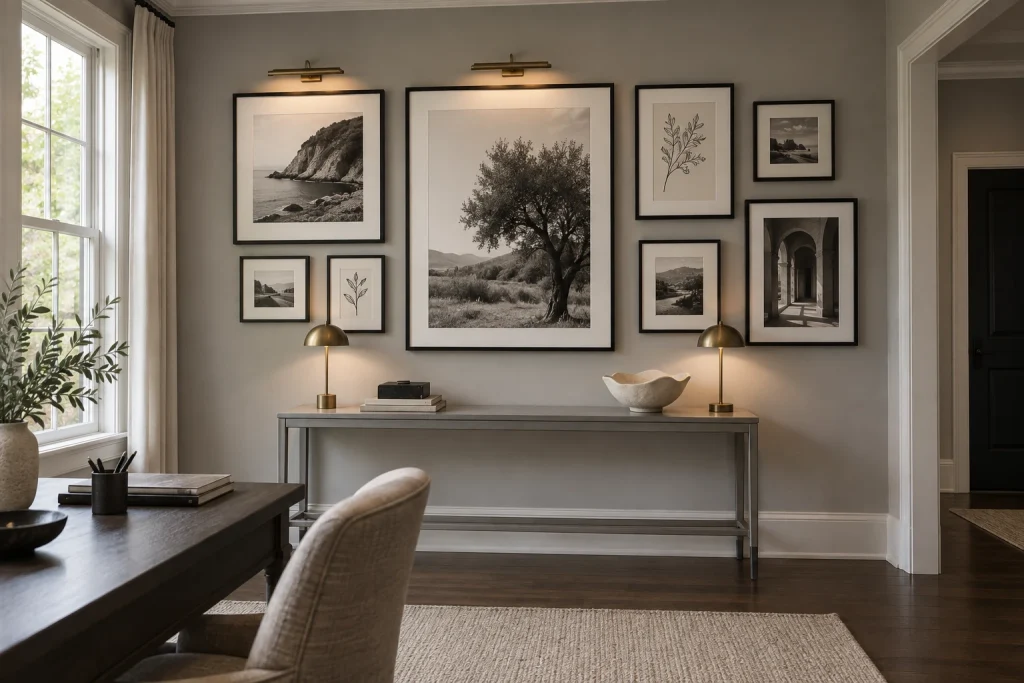
This monochrome backdrop relies on a strong central anchor: a large black-framed landscape print positioned above a slim gray console. Smaller black-framed photographs and botanical studies surround it in an asymmetrical but balanced arrangement, with a larger coastal image at upper left countered by two vertically stacked pieces at right. Generous wall space between the frames keeps each image legible from a distance. Brass picture lights above the two largest works add a warm line near the top of the composition, while matching brass-domed table lamps define each end of the console. The surface remains edited—just a short stack of books, a dark box, and a sculptural pale bowl—so the artwork remains the focal point. A tall window with light curtains brightens the left side, and the open doorway at right is unobstructed.
Why it works: A limited black, gray, white, and brass palette prevents the mixed-scale gallery from feeling scattered. The central print establishes order, and the repeated lamps and picture lights supply visual symmetry beneath and above the art.
- Large central black-framed landscape print
- Mixed monochrome photographs and botanical studies
- Two brass picture lights
- Slim gray console table
- Matching brass-domed table lamps and sculptural bowl
Design tip: Start with one oversized center frame, then maintain consistent gaps as you add smaller pieces around it.
Final thoughts
A strong home office backdrop is less about adding more decor than making deliberate edits. Give the wall behind you a clear focal point, limit smaller accessories to a cohesive palette, and use symmetry or balanced asymmetry to create structure. Closed storage, a lightly styled desk, and pockets of negative space help the setting stay calm on camera, while plants, art, and warm wood add character. Whether your office has built-ins, a bare wall, brick, or a compact floating desk, a focused arrangement can make the space look considered without distracting from the conversation.