Boutique-entryway-vignettes make the first few feet of a home feel considered without asking the space to do only one job. A slim console can hold keys while supporting a sculptural vase; a bench can offer a seat, conceal baskets below, and anchor a seasonal display. Across narrow halls, mudroom walls, niches, and under-stair recesses, the strongest arrangements balance a clear focal point with the everyday essentials that need a place to land. Use warm wood, woven texture, dark metal, soft upholstery, and a restrained mix of decorative objects to create an entry that feels polished yet usable.
1. Frame a Narrow Hall With a Round Mirror
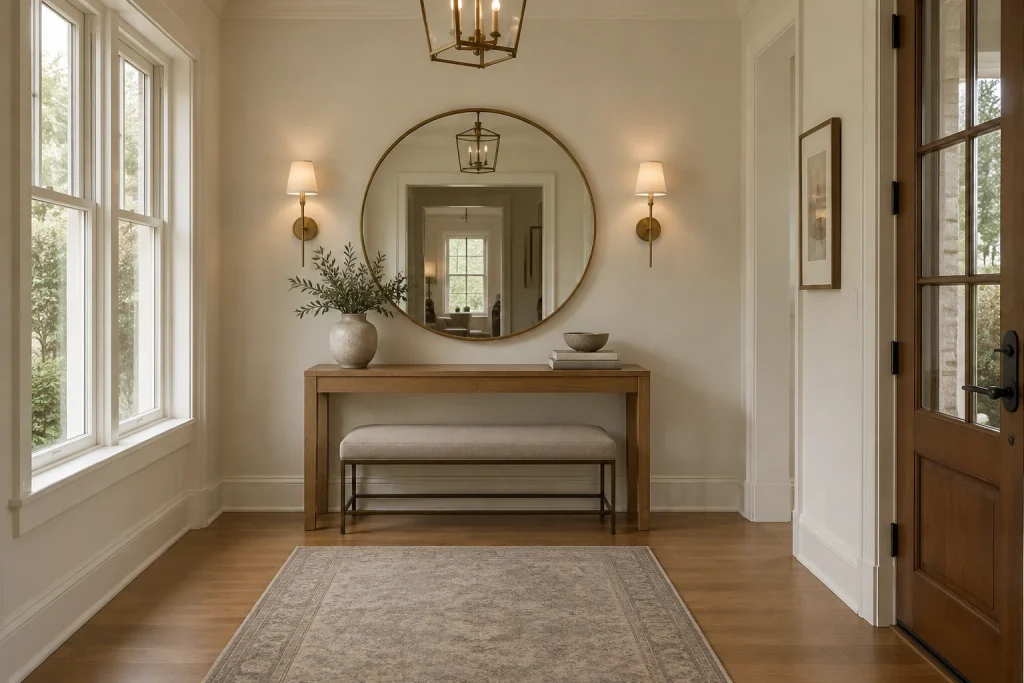
A centered wood console gives this entry a crisp, composed focal point without visually crowding the wall. Above it, the oversized round mirror repeats the warm brass of the two slender sconces and reflects the hall beyond, adding depth to the pale, paneled setting. The styling is intentionally spare: a textured stone-colored vase with leafy branches anchors one side, while a small stack of books and shallow bowl balance the other. A neutral upholstered bench with a dark open base tucks completely beneath the console, keeping the floor line light. Tall windows, a glass-paneled wood door, a muted patterned rug, and the lantern-style ceiling fixture reinforce the transitional mix of warmth, symmetry, and soft contrast.
Why it works: The mirror, sconces, and console create a strong vertical axis, while the low bench and minimal tabletop grouping preserve visual breathing room.
- Honey-toned wood console
- Oversized round brass-framed mirror
- Matching brass wall sconces
- Upholstered bench with dark metal base
- Stone-colored vase, books, and bowl
Design tip: Keep the console top to two balanced groupings rather than filling its full length.
2. Turn a Wall Niche Into a Compact Drop Zone
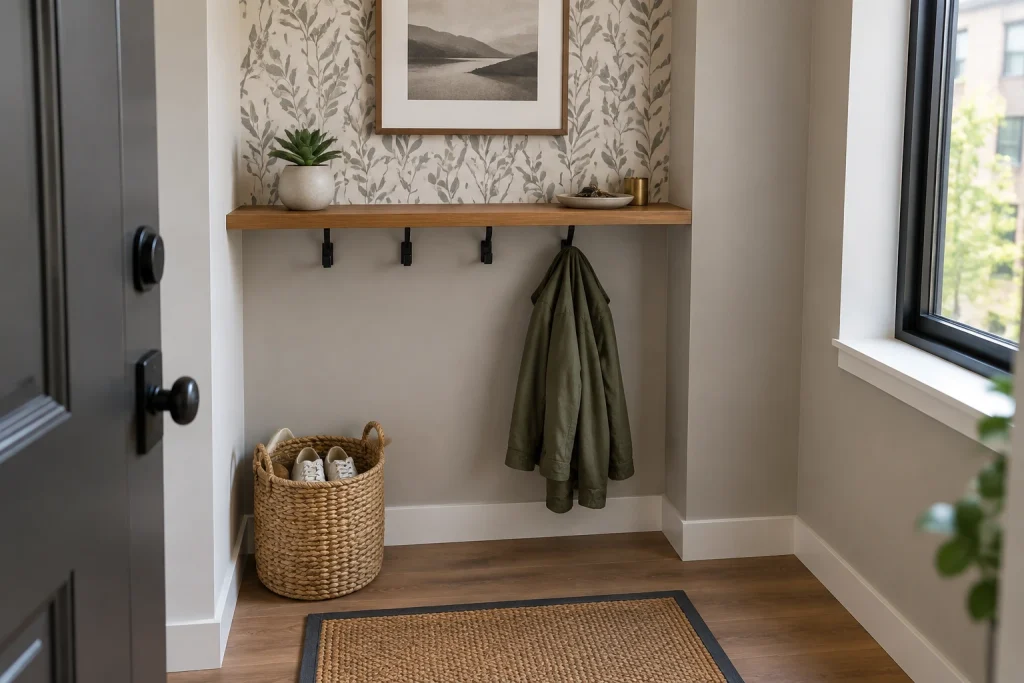
This small entry alcove relies on one hardworking composition: a thick wood shelf set against leafy patterned wallpaper, with a row of black hooks directly below. The shelf holds a compact planted pot, a shallow catchall dish, and a small brass-toned cylinder, proving that a functional landing spot can still feel considered. A framed black-and-white landscape hangs above, neatly contained within the wallpaper panel. Beneath the hooks, a woven floor basket corrals white sneakers, while an olive jacket occupies just one hook. The materials do the visual work—warm wood and woven fiber soften the matte black hardware, and the pale wall surround keeps the niche from feeling closed in. A natural-fiber rug grounds the zone in front of the dark entry door.
Why it works: Storage is stacked vertically: display and small-item storage sit on the shelf, outerwear hangs below, and shoes are contained at floor level.
- Wood floating shelf
- Matte black hook rail
- Leaf-patterned wallpaper panel
- Woven shoe basket
- Natural-fiber rug
Design tip: Use a basket with an open top so everyday shoes can be put away quickly.
3. Build a Mudroom Wall Around Daily Routines
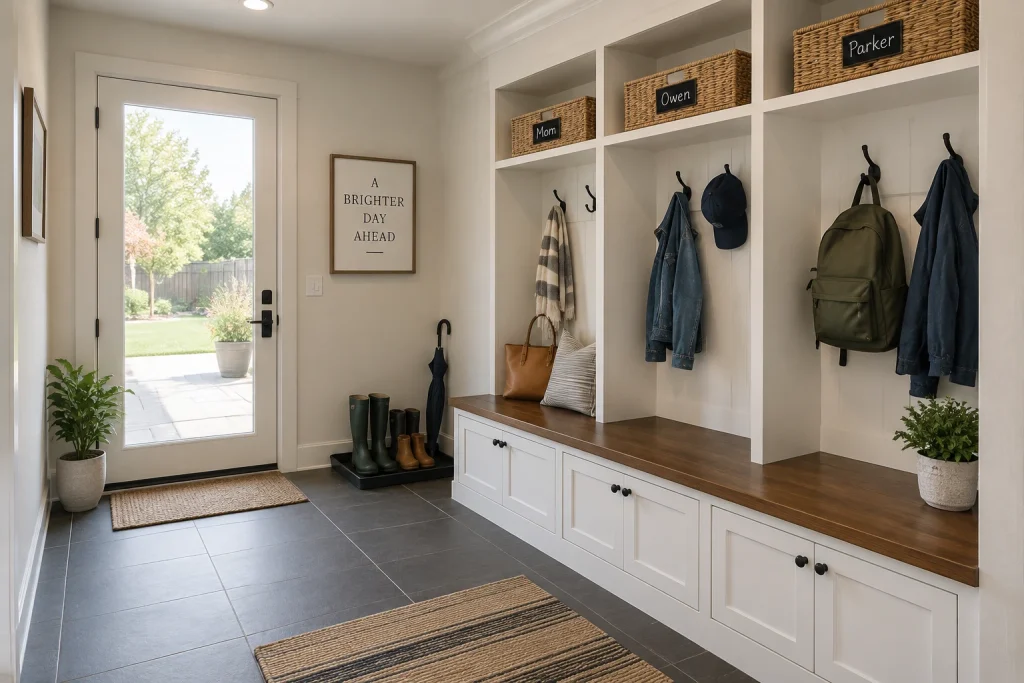
This mudroom turns one long wall into an orderly sequence of storage, seating, and durable surfaces. White cubbies divide the upper section into individual stations, each with black hooks and a woven basket labeled with a name. Below, a continuous walnut-toned bench offers a broad place to sit, while paneled cabinets conceal additional storage behind black knobs. The dark gray tile floor establishes a practical-looking base and sharply defines the pale built-ins. Nearby, boots are grouped in a black tray beside an umbrella, keeping wet-weather items off the bench. A striped runner and small woven mat add texture underfoot, while the glazed door brings daylight into the room. Coats, a backpack, a cap, a scarf, and a handbag remain visible but assigned to specific compartments rather than dispersed across the space.
Why it works: Each cubby combines a basket, hooks, and bench access, creating a repeatable system that makes the long storage wall read as calm and intentional.
- White built-in cubbies
- Walnut-toned bench seat
- Labeled woven baskets
- Black hooks and cabinet knobs
- Dark gray tile floor
Design tip: Assign one basket and one hook zone per person to prevent the bench from becoming the default storage surface.
4. Use Curves and Patina for a Collected Arrival
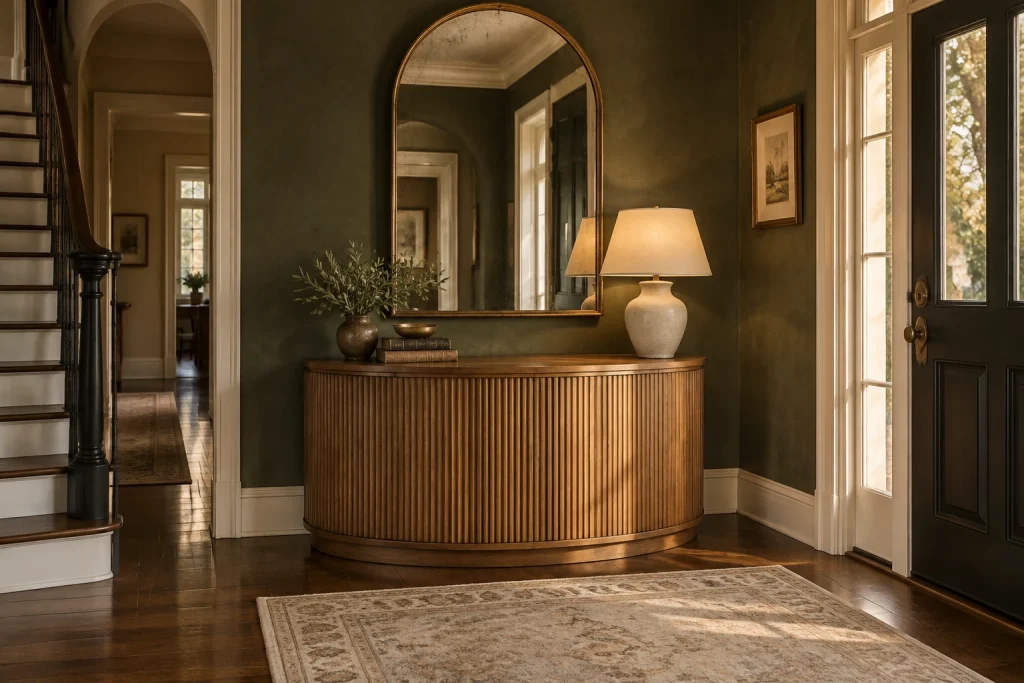
A ribbed, semicircular wood console introduces a graceful silhouette against the deep olive wall, where its curved ends stand out clearly against the surrounding open space. The tall arched mirror above extends that shape upward and adds an aged brass edge that catches the warm light. The tabletop is arranged in three distinct moments: leafy branches in a dark vessel, a stack of old-looking books topped with a small brass bowl, and a large ceramic lamp with a warm shade. Their varied heights keep the long surface from reading flat. Dark wood floors, a softly faded cream-and-taupe rug, white trim, and the nearby staircase give the vignette a layered, historic character. Tall glass sidelights beside the dark door add daylight, while the lamp contributes a welcoming amber glow.
Why it works: Repeating the console’s rounded profile in the arched mirror makes the display feel cohesive, while ribbing, brass, ceramic, and greenery supply contrast in texture and finish.
- Ribbed semicircular wood console
- Arched brass-framed mirror
- Deep olive wall
- Ceramic table lamp
- Vintage-style books, brass bowl, and leafy branches
Design tip: Pair one curved furniture piece with a similarly curved mirror to make an entry vignette feel deliberately composed.
1. Boutique-Entryway Vignettes Start With a Grounded Wood Bench
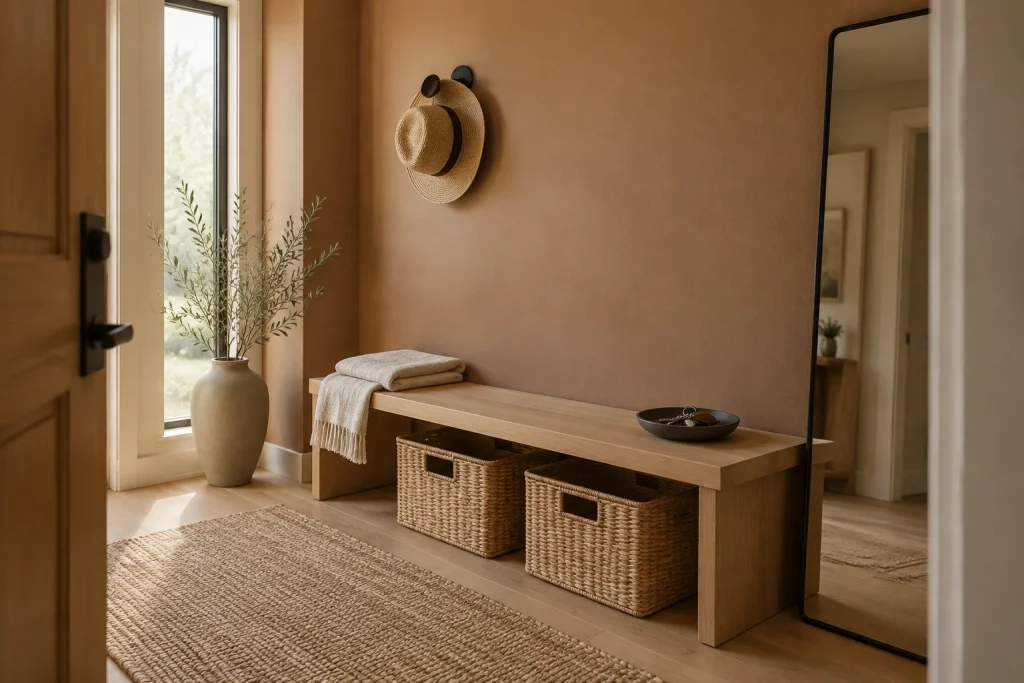
A pale wood bench gives this entry its quiet center, running cleanly along the warm clay-colored wall. Its broad, unadorned top is used with restraint: a folded, fringed neutral throw at one end and a shallow dark bowl holding keys at the other. Two square woven baskets fill the open space beneath, introducing useful texture without breaking the bench’s strong horizontal line. Above, a woven straw hat hangs from two dark wall pegs. A slim, black-framed floor mirror leans at the bench’s right side, while a tall matte ceramic vase with leafy branches softens the window corner. The woven rug, wood floor, and light filtering through the tall window keep the palette cohesive and tactile.
Why it works: The composition relies on a limited mix of pale wood, woven fiber, matte ceramic, and black metal, so every contrasting detail reads clearly rather than competitively.
- Long pale wood bench
- Two woven storage baskets
- Black-framed leaning mirror
- Matte ceramic floor vase with branches
- Woven rug and straw hat
Design tip: Keep the bench top to two purposeful items for a calm, boutique-like read.
2. Use a Saturated Wall as a Gallery Backdrop
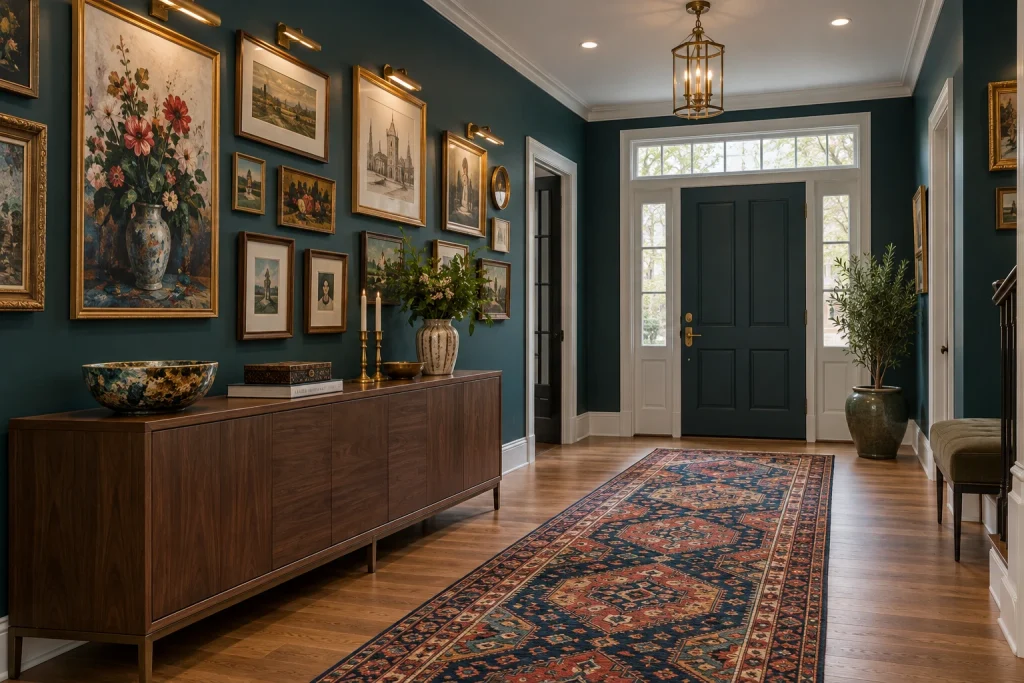
Deep teal walls turn this generous entry into a richly layered gallery vignette. Along the left wall, framed artwork in varied sizes and traditional-looking gold frames is arranged from near the console to high under the crown molding. Slim brass picture lights highlight several pieces, adding another warm metallic note. The long walnut console stays visually low and streamlined beneath the art, though its top is styled with a large patterned bowl, stacked books, a decorative box, brass candlesticks, and a tall flower-filled vessel. A patterned runner stretches through the center of the wood floor toward the dark front door. White trim, sidelights, and the transom sharply outline the entry architecture, while a tall leafy plant and a small upholstered bench add balance on the opposite side.
Why it works: The low console gives the artwork room to dominate vertically, and the repeated warm tones of walnut, brass, and the rug keep the dark wall from feeling cold.
- Deep teal wall color
- Mixed-scale gold-framed artwork
- Brass picture lights
- Low walnut console
- Patterned runner with rust and blue tones
Design tip: Group frames tightly enough to read as one installation, then keep the furniture below visually simple.
3. Turn a Slim Console Into an Organized Work Drop
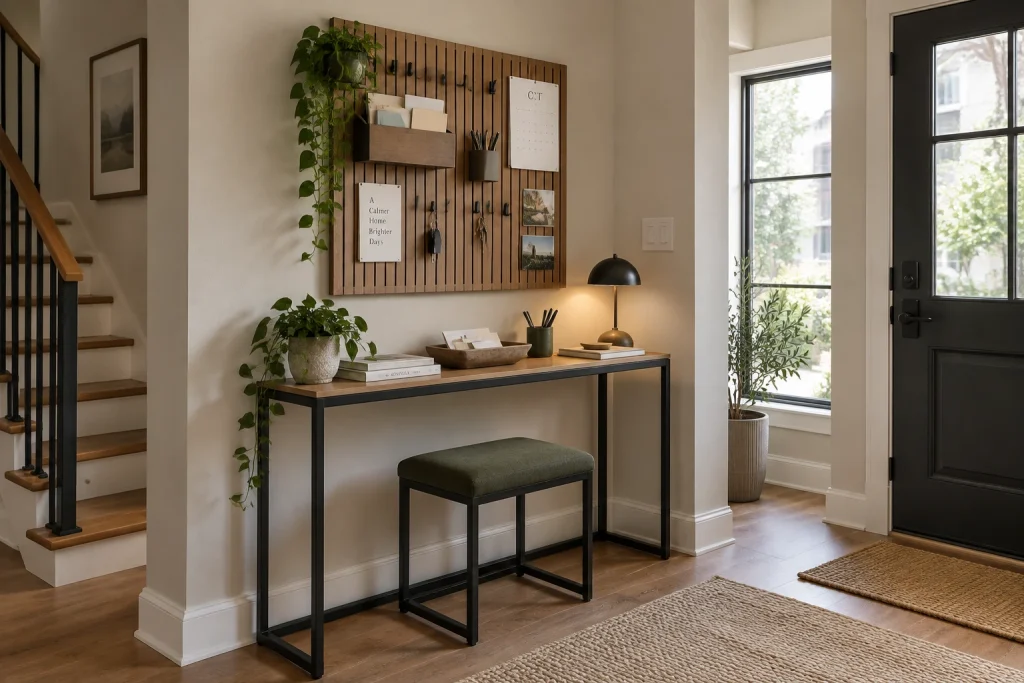
This entry makes a narrow wood-and-black-metal desk work harder by pairing it with a large slatted wood wall organizer. The organizer holds loose papers in a wall pocket, small notes and images, keys on hooks, a hanging pencil cup, and a visible monthly calendar. A trailing plant drapes from its upper left corner, balancing the grid of vertical slats with softer movement. Below, the desktop is arranged for everyday tasks: a planted pot, a few books, a shallow paper tray, a pencil cup, and a compact black dome lamp. An olive upholstered stool tucks underneath, preserving the desk’s open, lightweight profile. Black door framing, stair railing, and desk legs repeat one crisp accent color against the pale walls and warm wood flooring.
Why it works: Vertical organization clears the narrow work surface, while the tucked stool lets the station retain a compact silhouette when it is not in use.
- Slatted wood wall organizer
- Hooks, mail pocket, and pencil cup
- Narrow wood-top metal desk
- Olive upholstered stool
- Compact black dome lamp
Design tip: Assign wall zones for papers, keys, and writing tools before adding decorative pieces.
4. Make an Under-Stair Recess Feel Deliberate
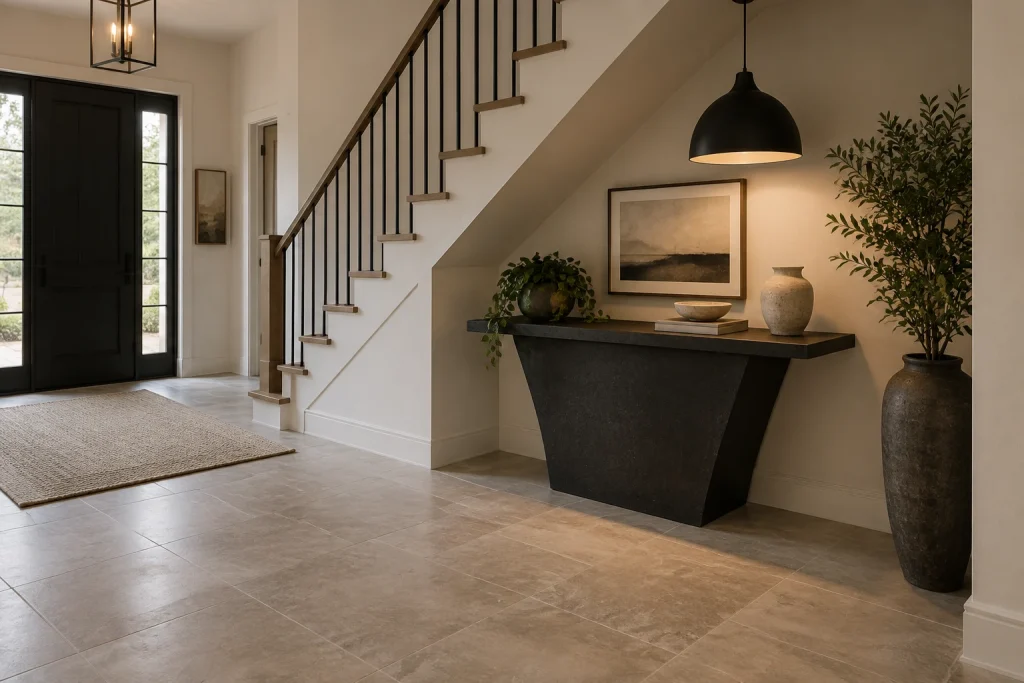
The triangular space beneath this staircase is treated as an architectural vignette rather than leftover square footage. A substantial charcoal console with sharply tapered sides sits inside the recess, echoing the strong diagonal line overhead. Its dark surface is styled in a measured grouping: a trailing plant in a rounded dark vessel, a shallow bowl set on books, and a weathered pale ceramic vase. A muted landscape print above continues the restrained, earthy palette. To the right, a tall floor planter with a leafy tree adds height and an organic counterpoint to the console’s angular form. A large black pendant hangs over the arrangement, casting warm light downward. Pale walls, light stone-look floor tiles, and the black stair spindles frame the scene without crowding the open entry floor.
Why it works: The console’s geometric silhouette answers the stair’s diagonal shape, while the tall planter and pendant build a balanced vertical composition around it.
- Tapered charcoal console
- Large black pendant light
- Tall dark planter with leafy tree
- Framed muted landscape
- Layered ceramic and book styling
Design tip: Choose one sculptural console shape that mirrors the stair geometry, then leave the surrounding floor open.
1. Industrial Contrast With a Grounded Leather Seat
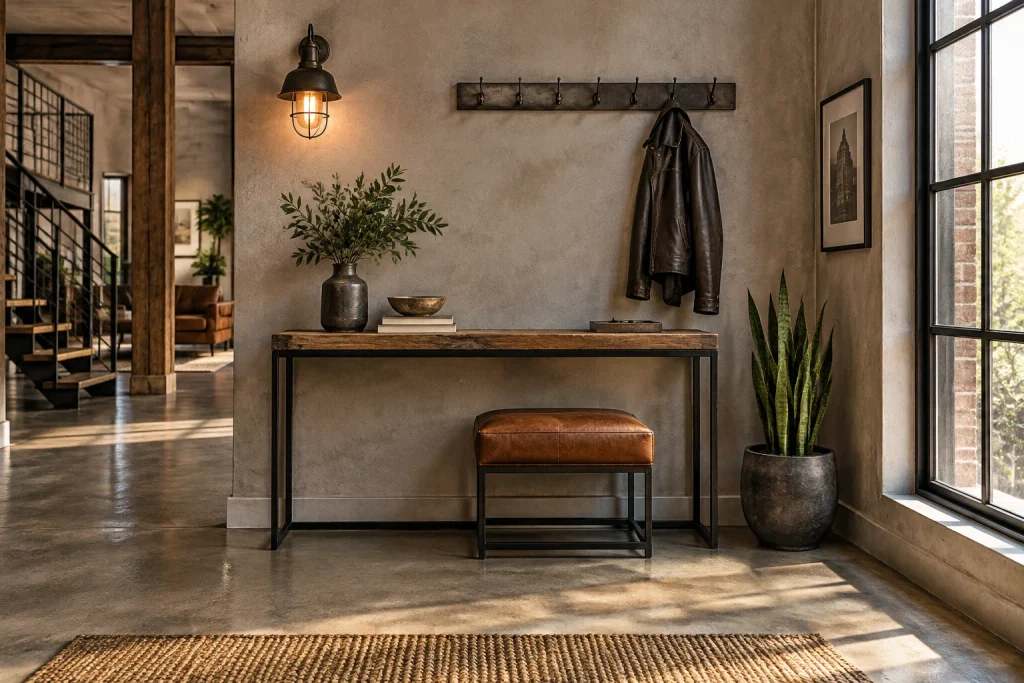
This boutique-entryway-vignettes approach builds its impact through a disciplined mix of weathered wood, black metal, concrete, and leather. A slim console with a thick wood top and open metal frame sits against a mottled plaster wall, leaving its silhouette crisp and unobstructed. Above it, a long dark hook rail turns the wall into useful vertical storage, while a dark leather jacket supplies both function and a deeper note of texture. The cognac leather stool is positioned beneath the console, softening the hard-edged framework without visually crowding the floor. A dark vase of leafy branches, a shallow bowl, stacked books, and a small tray keep the tabletop styled but restrained. Window light and a caged wall sconce amplify the material variation.
Why it works: The composition balances linear, industrial pieces with organic forms and warm brown leather. Keeping the console open underneath allows the polished concrete floor and the stool’s compact profile to remain visible.
- Reclaimed-look wood and black metal console
- Cognac leather stool with black metal base
- Dark multi-hook wall rail
- Caged black wall sconce
- Large snake plant in a charcoal planter
Design tip: Use one warm leather piece to temper a black-metal-and-concrete palette.
2. Make a Bench the Center of a Seasonal Welcome
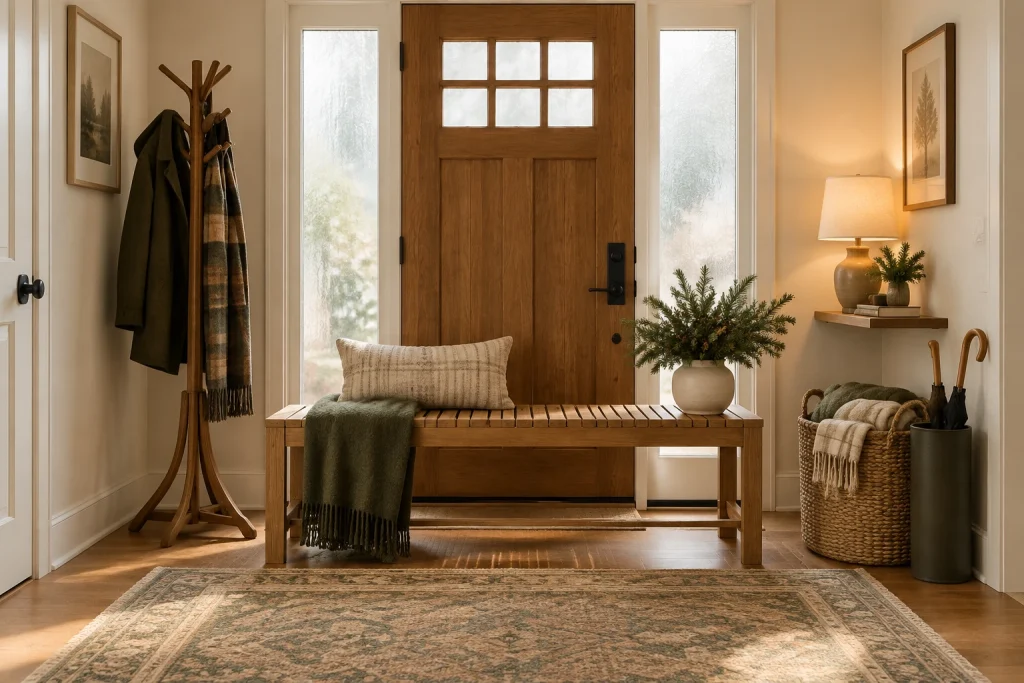
Here, a long slatted wood bench creates a welcoming focal point directly in front of a warm wood front door with divided glass panes. The bench is treated as a flexible display surface: a striped lumbar pillow, moss-green throw, and white ceramic pot filled with evergreen branches introduce softness and seasonal color without hiding the bench’s clean construction. To the left, a sculptural wood coat stand holds a dark coat and plaid scarf. To the right, a woven basket contains folded throws, while a tall cylindrical umbrella stand holds two umbrellas. A floating wood shelf adds a lamp, small evergreen arrangement, and books, creating a second, compact layer of warmth. Framed botanical artwork and a muted patterned rug continue the natural palette.
Why it works: The room is organized around a single substantial bench, then framed with slim vertical elements at either side. Repeating wood, woven fibers, green accents, and botanical imagery makes several practical storage pieces read as one coordinated vignette.
- Slatted wood bench
- Moss-green throw and striped lumbar pillow
- Freestanding wood coat rack
- Woven basket with folded textiles
- Evergreen branches in a white ceramic pot
Design tip: Refresh the look by swapping the bench throw, pillow cover, and clipped greenery together.
Final thoughts
A successful boutique-style entryway vignette begins with the architecture and the daily routine. Center a mirror over a console, turn hooks and a shelf into a compact drop zone, or give an overlooked recess a purposeful composition. Then keep the styling edited: vary heights with art, lamps, branches, or vessels; repeat a finish such as brass or black metal; and reserve baskets, trays, and cabinets for the items that create clutter. The result is an arrival space with a distinct point of view and a practical role in everyday life.